

The Art of Debate
The Art of Debate offers a guide to hashing out differences of opinion and making stronger arguments based on reason; Professor Jarrod Atchison helps one develop command of logic, construct clear arguments and sharpen strategic thinking skills.
Already subscribed?
Sign in
Learning about debates and how immersing oneself in the techniques of a formal debate has a dramatic impact on decisions made; from the business world to the barroom, the process of exchanging ideas makes one a better thinker and citizen.
S1:E1 • Mar 3, 2017 • 33m
Debate gives an honest assessment of an idea and is a powerful decision-making tool; Professor Atchison explains the structure of a formal debate and explores when debate can help; big and future-oriented decisions are ripe for formal discussion.
S1:E2 • Mar 3, 2017 • 31m
After learning when to debate, shifting attention to what to debate; the proposition is an important concept to understand; surveying how to structure the proposition most effectively; understanding who makes the ultimate decision.
S1:E3 • Mar 3, 2017 • 29m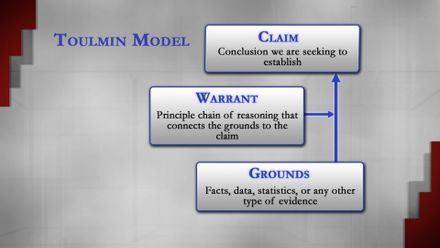
The claim, evidence and the warrant provide the structure of a strong argument; studying what they are, how they work and how they come together to produce an argument; the warrant is often the most vulnerable part of an argument.
S1:E4 • Mar 3, 2017 • 28m
Examining the strengths and weaknesses of narrative evidence, empirical evidence and evidence based on authority; reviewing each type of evidence; Professor Atchison applies them to debates about gun control and physician-assisted suicide.
S1:E5 • Mar 3, 2017 • 29m
To be a great debater, one must learn to recognize argument fallacies and combat them during the debate; helping one identify fallacies that stem from flaws in the opponent's research, including the post hoc ergo propter hoc fallacy and more.
S1:E6 • Mar 3, 2017 • 29m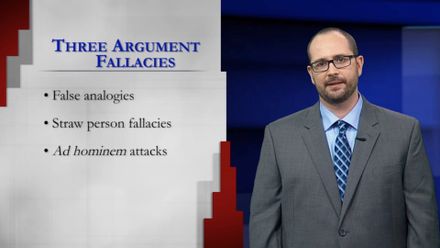
Surveying fallacies that stem from the actual debate itself; to make their case, debaters often resort to false analogies, straw men and ad hominem attacks; learning to recognize and combat them and score points to win the debate.
S1:E7 • Mar 3, 2017 • 28m
No debate is won without consideration of the audience; if one cannot connect with the audience, one cannot win them over; after considering how to make such a connection, sharpening one's skills in creating a well-researched case with enough nuance.
S1:E8 • Mar 3, 2017 • 29m
The affirmative side of a debate must stay relevant to the resolution, indict the status quo and offer a proposal designed to solve the problems identified with the status quo; learning how to meet these obligations and build a winning argument.
S1:E9 • Mar 3, 2017 • 29m
After learning to develop a strong argument, applying skills to a specific debate, taking a resolution about campus carry laws as an example, Professor Atchison walks through the steps to indict the status quo and offer a tenable solution.
S1:E10 • Mar 3, 2017 • 30m
A good critique helps in testing out an idea; developing a good negative case requires creativity to disprove the affirmative argument; learning about the disadvantages of the affirmative case and critiques of the affirmative's assumptions.
S1:E11 • Mar 3, 2017 • 29m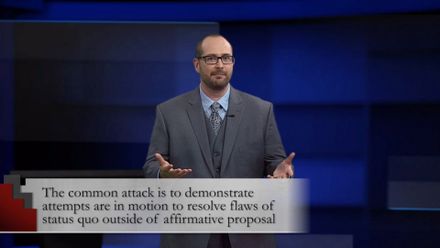
The three-part attack is an effective way to counter the affirmative proposal, learning several approaches to confronting the affirmative case head-on, including inherency, attacking the harms of the affirmative and attacking the proposal's solvency.
S1:E12 • Mar 3, 2017 • 29m
Once each case is built, it is time for a cross-examination, a chance to interrogate opponents to better understand their arguments; identifying holes in their reasoning; keeping the audience engaged; reflecting on the goals of cross-examination.
S1:E13 • Mar 3, 2017 • 30m
Continuing study of cross-examinations with a look at leading questions; useful for identifying holes in an argument, leading questions also represent persuasive arguments; learning how to create a good leading question and how they help win debates.
S1:E14 • Mar 3, 2017 • 28m
Learning about open-ended questions and how they help one understand the opponents' arguments; open-ended questions give a chance to shift one's position, thus maximizing strategic flexibility; learning how to craft and answer open-ended questions.
S1:E15 • Mar 3, 2017 • 30m
No matter how well a case is made, one needs to defend it; there are several straightforward elements of a good rebuttal, such as assessment, organization and emotional appeal; Professor Atchison guides through each element.
S1:E16 • Mar 3, 2017 • 28m
Learning the secrets to navigating the unexpected in a debate has far-reaching applications; understanding what it takes to slow down, diagnose, analyze and respond to unexpected arguments; finding one's way back to terra firma.
S1:E17 • Mar 3, 2017 • 28m
Learning about varsity-level debate skills, starting with even if arguments; by starting with the premise that the opponent is right about everything, one can explain why one should still win the debate, an extremely effective argument.
S1:E18 • Mar 3, 2017 • 30m
There is a moment where one side clearly out-maneuvers the other; flipping the warrant requires the highest level of analytic argument and allows one to destroy the opponent's argument by showing that their proposal will actually make things worse.
S1:E19 • Mar 3, 2017 • 29m
The best debaters understand the need for strategic flexibility, and concessions are one of the most powerful strategic moves in the playbook; conceding points allows one to focus on the best arguments or even set a trap for the opponent.
S1:E20 • Mar 3, 2017 • 29m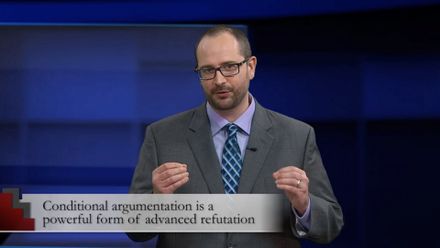
Although they are two separate fields, the art of debate sometimes employs formal logic with success; learning how conditional argumentation, a way of employing if-then statements to argue a point, lets one acknowledge a point without agreeing to it.
S1:E21 • Mar 3, 2017 • 30m
Learning advanced debate techniques with a survey of line-by-line refutation; understanding how to map out the flow of a debate using shorthand; distilling key ideas and preparing to respond to all points; mapping out the flow of a test case.
S1:E22 • Mar 3, 2017 • 30m
Finding oneself in the role of a judge needing to make the big decision; surveying the best way to communicate the reasons for a decision, starting with a short thesis statement followed by an explanation of the reasoning.
S1:E23 • Mar 3, 2017 • 31m
One often debates ideas in informal settings; unpredictable and ambiguous conversations with blurred lines between judges and participants; learning how to win a debate at a cocktail party and when to bow out of the discussion.
S1:E24 • Mar 3, 2017 • 33mMore Like This
 TVG • 1 season
 2024 • TV14 • 1h 23mDetails
 NR • 1 season
 TVG • 3 seasons
 TVG • 2 seasons
- PG13 • 2 seasons
 TVPG • 2 seasons
 TVPG • 1 season
 PG13 • 5 seasons
 TV14 • 2 seasons
 TVPG • 1 season
 2020 • R • 1h 21mDetails
 TVPG • 1 season
 TVPG • 1 season
 TVPG • 1 season
 TV14 • 1 season
 TVPG • 1 season
 TVPG • 1 season
 TVPG • 1 season
 TVPG • 1 season
