

Sacred Texts of the World
S1:E13 The Three Baskets of Buddhism
An introduction to the huge library of Buddhist scriptures; the origin of the Pali, Chinese and Tibetan Buddhist canons; learning about the efforts to preserve these texts and their significance to Buddhists.
Already subscribed?
Sign in
The world's sacred texts hold profound significance for the cultures that produce them, covering five reasons for the importance of studying them, from their accessibility to the wisdom they contain.
S1:E1 • Feb 7, 2014 • 28m
Grasping the nature and roles of sacred writings within Hinduism, as contrasted with the Judeo-Christian tradition; learning about the structure of the Vedas and their function in Hindu rituals; reading excerpts from the Vedas.
S1:E2 • Feb 7, 2014 • 29m
The Upanishads constitute the philosophical or wisdom texts of the Hindu Vedas; studying the composition of the Brihadaranyaka and Chandogya Upanishads; the influence of the Upanishads on westerners.
S1:E3 • Feb 7, 2014 • 31m
A second body of Hindu sacred writings encompasses literature and explores the nature of dharma; including the Ramayana and the Mahabharata, two great Indian epics, about kinship and familial discord as well as bonds.
S1:E4 • Feb 7, 2014 • 33m
Learning about Hindu sutras, shastras, Puranas and Tantra; exploring the Laws of Manu, a text that outlines rules, customs and guidelines for living for the four Indian castes; the Bhagavad Gita speaks to matters of spiritual insight.
S1:E5 • Feb 7, 2014 • 30m
Tracing the evolution of the Sikh religion and the lineage of gurus that produced the Adi Granth, the faith's sacred text; studying the composition of the Adi Granth and its hymns, poems and prayers; how Sikhs revere the book as a living guru.
S1:E6 • Feb 7, 2014 • 30m
Learning about the history of the Aleppo Codex, a historically significant copy of the Tanakh; tracing the origins of the Tanakh, the Torah, the Prophets, and the Writings; how the Tanakh is the focus of Jewish identity.
S1:E7 • Feb 7, 2014 • 29m
Studying the books of Genesis, Exodus, Leviticus, Numbers and Deuteronomy; exploring the Torah from the religious perspective that regards it as a repository of eternal truths and the historical-critical perspective.
S1:E8 • Feb 7, 2014 • 29m
The political and religious history of ancient Israel from the perspective of the Prophets; exploring the spectrum of the Writings, containing stories, proverbs, poetry, psalms, and theological explorations; the core themes of the texts.
S1:E9 • Feb 7, 2014 • 30m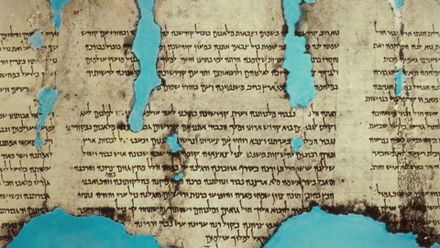
The stories and historical narratives of the Apocrypha; their thematic emphasis on the spiritual and political challenges faced by the Jews; insights from the Dead Sea Scrolls; the evolution of the Hebrew Bible.
S1:E10 • Feb 7, 2014 • 32m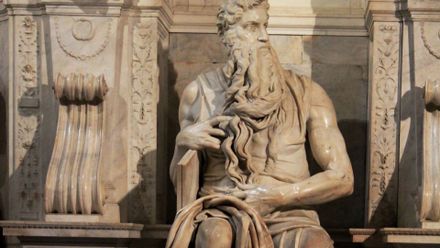
Within Judaism, two central texts form the basis for devotion to God through study; grasping the nature of the Mishnah, a body of legal judgments that teach students how to think critically; examining the Talmud, a commentary on Jewish life.
S1:E11 • Feb 7, 2014 • 31m
Zoroastrianism envisions the universe as ruled by good and evil beings of equal status; the Avesta is a text comprising books of hymns, myths and religious regulations that promote holiness; tracing Zoroastrianism's influence on monotheistic faiths.
S1:E12 • Feb 7, 2014 • 31m
An introduction to the huge library of Buddhist scriptures; the origin of the Pali, Chinese and Tibetan Buddhist canons; learning about the efforts to preserve these texts and their significance to Buddhists.
S1:E13 • Feb 7, 2014 • 31m
Two prominent Buddhist scriptures and their applications; examining the Vinaya that comprises regulations for monks and nuns; excerpts from the Jataka, the large body of stories used for teaching Buddhist morality.
S1:E14 • Feb 7, 2014 • 32m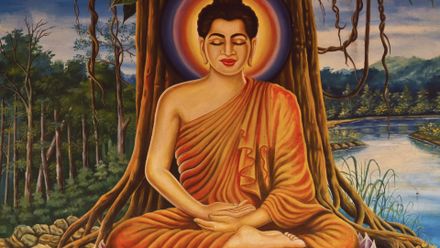
Among the textual riches of the Theravada tradition of Buddhism is the Buddha's teaching on the origins of suffering; the Therigatha contains poems of women's enlightenment; the Dhammapada comprises verses of advice and inspiration.
S1:E15 • Feb 7, 2014 • 28m
Studying the Mahayana conceptions of the perfection of wisdom and the nature of emptiness and non-duality; these notions are expressed through the renowned Lotus Sutra, Diamond Sutra and Heart Sutra; how the texts are venerated as sacred objects.
S1:E16 • Feb 7, 2014 • 30m
The two distinctive forms of Buddhism in Japan; learning about the Pure Land School where seekers can learn the dharma; contemplating the traditions experiential approach to enlightenment through Zen scriptures and koans.
S1:E17 • Feb 7, 2014 • 30m
How Vajrayana Buddhism combines the Mahayana philosophy of the perfection of wisdom with Tantra, secret rituals and practices; examining the Tibetan Book of the Dead, a treatise on rebirth.
S1:E18 • Feb 7, 2014 • 29m
Jainism, a sister religion to Buddhism, maintains an unusual relationship to scripture; exploring the principles and ascetic customs of the faith's two groups, the Shvetambara and Digambara; excerpts from sacred texts.
S1:E19 • Feb 7, 2014 • 32m
Confucianism and the debate about its status as a religion or philosophy; learning about the Confucian canon and how it became the foundation of Chinese state ideology; why the texts are referred to as classics rather than scripture.
S1:E20 • Feb 7, 2014 • 31m
Investigating the Yijing and how its system of divination has actual practical applications; exploring Neo-Confucianism, its principles of self-cultivation and harmony with humanity; the texts of the Analects, the Mencius and the Constant Mean.
S1:E21 • Feb 7, 2014 • 33m
The foundational text of Daoism, the Daodejing, discusses the transcendent order underlying all phenomena; Daodejing's compelling expression of harmonious duality; exploring the Zhuangzi, a masterpiece of literature and philosophy.
S1:E22 • Feb 7, 2014 • 31m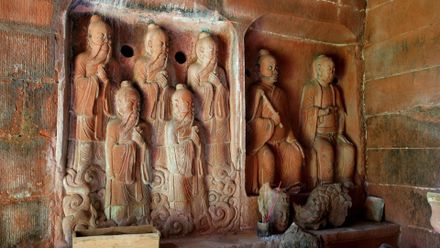
Studying scriptures such as the Neiye, the Huainanzi, the Scripture on Great Peace, and the Declarations of the Perfected; how the Daozang, or complete canon, is organized into three divisions that reflect the major schools of Daoism.
S1:E23 • Feb 7, 2014 • 32m
Exploring the customs and rituals of the Japanese Shinto religion; studying excerpts from its revered texts, comprising histories of Japan and ritual prayers; its integral role in Japanese life; the Tenrikyo faith and its three books of scripture.
S1:E24 • Feb 7, 2014 • 31m
Tracing the complex origins of the New Testament, beginning with the letters of Paul and the Gospels; the proliferation and categorization of later Christian texts; the composition of the Christian Bibles and their translations.
S1:E25 • Feb 7, 2014 • 32m
The New Testament Gospels present four distinct accounts of the life of Jesus of equal authority; comparing the differences between the four Gospels and the key theological motivations underlying them; the Acts of the Apostles.
S1:E26 • Feb 7, 2014 • 29m
Letters are an important means of instruction in the early church; studying seven key letters written by Paul, speaking to theological understanding; the Revelation and its dramatic vision of the coming kingdom of God.
S1:E27 • Feb 7, 2014 • 29m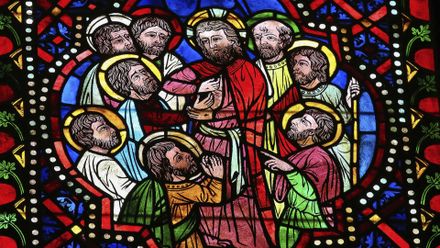
Exploring the apocryphal accounts of the life of Jesus; discovering the Gospel of Peter, which directly portrays the Resurrection; the Infancy Gospel of Thomas, which recounts events of Jesus's childhood; Gnostic Christianity.
S1:E28 • Feb 7, 2014 • 29m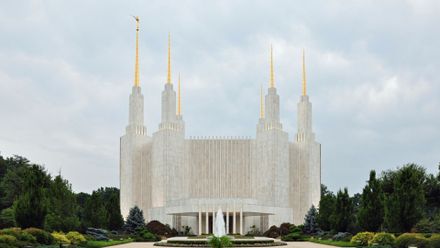
The unique scriptures of the Mormon religion; learning about the Book of Mormon, an epic religious-historical narrative; Mormonism's oral temple ceremony; how they are used as expressions of the faith.
S1:E29 • Feb 7, 2014 • 31m
The remarkable oral tradition in Islam mandates that the Quran be recited and regards memorization as an act of devotion; delving into the origins of the Quran; the conception of its text as direct revelation; its recitation as an esteemed art form.
S1:E30 • Feb 7, 2014 • 31m
The Quran's structure and contents; how the message of faith is spread through suras; exploring the Quran's major themes; comparing its stories to those in the Old Testament of the Bible.
S1:E31 • Feb 7, 2014 • 31m
The actions and sayings of Muhammad; the sources and composition of the Islamic Hadith; how they provide guidance on essential matters of Muslim life; the superlative poetry of Sufism, Islam's mystical tradition.
S1:E32 • Feb 7, 2014 • 31m
The emergence of Bahá'í, a distinctive faith with origins in Iran; the tenets of the religion and its huge canon of scriptures; how the religion believes in oneness of humanity and the unity of religions.
S1:E33 • Feb 7, 2014 • 30m
Exploring the sacred texts of traditions that have not survived; striking excerpts from the Egyptian Book of the Dead, a compendium of spells guiding the deceased in the afterlife; the Popol Vuh, a text containing mythological stories of the Maya.
S1:E34 • Feb 7, 2014 • 33m
The thought-provoking parallels between religious texts and certain secular ones; applications of scriptures within religious faiths; how the founding documents of the United States have come to function as sacred texts.
S1:E35 • Feb 7, 2014 • 30m
Professor Hardy's recommendations from each of the major religious traditions; how the comparative study of sacred texts makes a difference in one's life after reading them with empathy and understanding.
S1:E36 • Feb 7, 2014 • 31m