

Thinking About Religion and Violence
S1:E10 Sexuality, Morality and Punishment
Religious traditions respond to sexuality with demonization, social constraint and physical assault; outlandish forms of religious self-discipline; religious and political persecution work to target issues related to sexuality and morality.
Already subscribed?
Sign in
Learning the essence of religious violence; the historical trends that explain the relationship between religious beliefs and violence; some problematic ways one often frames the issue of religious violence; perplexing questions about this subject.
S1:E1 • Apr 27, 2018 • 31m
Different ways of recognizing and studying religion as a way to examine religious violence; the idea that religion and violence exist in a fluid relationship; making the boundary between religious and non-religious identities fuzzy.
S1:E2 • Apr 27, 2018 • 29m
Exploring the special power that sacred texts have for religious practitioners; some people invoke these stories and images to legitimize violence; prevalent themes found in sacred texts; vengeful deities, holy wars and holy suffering.
S1:E3 • Apr 27, 2018 • 31m
Sacrifice is one of the most fundamental building blocks of religion; examining how and why people commit self-harm and sacrifice for religious purposes; animal sacrifice during India's Vedic period; self-denial and asceticism; religious suicides.
S1:E4 • Apr 27, 2018 • 31m
Discovering how religious violence is always justified by portraying its targets as malevolent, Professor Bivins explains how the social process of othering leads religions to process and create fear through scapegoats, demons and Antichrist figures.
S1:E5 • Apr 27, 2018 • 31m
An effective way of demonstrating religious power is through trial and punishment; the use of law and the meanings of public displays of violence as seen in historical cases of witch-hunting and witch trials; witches are more reviled than demons.
S1:E6 • Apr 27, 2018 • 31m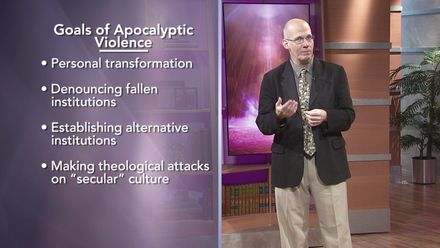
Using examples like the People's Temple, the Branch Davidians, Aum Shinrikyo and 19th-century America; exploring the meanings of apocalypticism as a form of human meaning-making; its role in the phenomenon of religious violence.
S1:E7 • Apr 27, 2018 • 30m
Exploring the idea of different races as the objects of religious violence; examining how religions generate racial ideas; looking at two different expressions of racial religion; white supremacist Christianity and the Nation of Islam.
S1:E8 • Apr 27, 2018 • 31m
The gendering of religious language; the treatment of women's bodies in practices like menstrual seclusion and self-sacrifice; the anxiety around women that occurs during the Salem witch trials; competing interpretations of women's freedom in Islam.
S1:E9 • Apr 27, 2018 • 31m
Religious traditions respond to sexuality with demonization, social constraint and physical assault; outlandish forms of religious self-discipline; religious and political persecution work to target issues related to sexuality and morality.
S1:E10 • Apr 27, 2018 • 33m
Heresies exist in every religious tradition; Professor Bivins explains religious violence consists of physical harm against people or groups; it also includes legal constraints and denials of basic liberties; Pope Gregory IX's heresy courts.
S1:E11 • Apr 27, 2018 • 32m
Hindus, Buddhists, Jews, Christians and Muslims wrestle morally, conceptually and strategically; examining how to balance religious ideals with real-world conflicts; religions define violence in the context of war as a necessary, limited evil.
S1:E12 • Apr 27, 2018 • 30m
Sacred texts contain passages on warfare and violence; they also contain maxims, stories and images exhorting believers to peace; three historical cases; Mahatma Gandhi, 20th-century American Catholic pacifism and Sheikh al-Hajj Salim Suwari.
S1:E13 • Apr 27, 2018 • 32m
The role of war gods in human cultures and sacred texts; looking at the medieval Crusades and the Cold War religious imagery; it turns out the roots of war gods are not as removed from the present day as one would like to think.
S1:E14 • Apr 27, 2018 • 31m
Interreligious conflict and the role of national identity; in modern-day Israel, conflicts between Judaism, Christianity and Islam demonstrate the fractious experience of overlapping histories; limits of secular power in a complex religious world.
S1:E15 • Apr 27, 2018 • 31m
The historical relationship of religious ethics to public life in India; the legacy of colonialism in contributing to the rise of interreligious violence; the Hindu hyper-nationalism known as Hindutva and the phenomenon called saffron terror.
S1:E16 • Apr 27, 2018 • 32m
Learning how religions wrestle with and also condone the brutal institution of slavery; some of slavery's most powerful critics have been full-throated religious practitioners; the same can be said of slavery's defenders.
S1:E17 • Apr 27, 2018 • 30m
The role of violence in and around Native American traditions; land displacement or theft; the relationship between competing gods and vengeful ghosts; knowing whether the story of indigenous peoples is inseparable from colonialism and imperialism.
S1:E18 • Apr 27, 2018 • 30m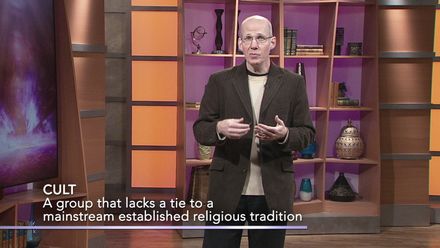
The characteristics that make a group a cult; a desire for authenticity and a new pattern of life that breaks with mainstream culture; using Mormonism, China's Falun Gong and the Solar Temple as ways to explore why some religions provoke violence.
S1:E19 • Apr 27, 2018 • 29m
The power of stereotypes and misrepresentation to justify religious violence; church reformers in Europe and the United States of America produce negative images and stereotypes of Catholics; describing them as degenerate, drunken and power-mad.
S1:E20 • Apr 27, 2018 • 31m
Anti-Semitism, a glaring and persistent tradition of anti-religious violence; learning why this form of historical suffering becomes an intimate component of Jewish identity; its portrayal in scriptural stories; modern-day moments of persecution.
S1:E21 • Apr 27, 2018 • 31m
Viewing Islam and violence from different perspectives; the negative stereotypes common to discrimination against Muslims; Islamophobia depends on generalization; Muslim theological sources of violence in the modern world; Islamic revolution.
S1:E22 • Apr 27, 2018 • 32m
Defining terrorism and understanding how and why terrorists see the world as they do; a task worth undertaking if one is serious about understanding contemporary problems with religious violence; Gush Emunim, Hezbollah and al-Qaeda.
S1:E23 • Apr 27, 2018 • 31m
Changing a world that produces religious violence; Professor Bivins's tools for individuals; proceeding through communities, nations and international institutions; thinking concretely about religious violence rather than be numbed into fear.
S1:E24 • Apr 27, 2018 • 33m