

Understanding Calculus: Problems, Solutions, and Tips
S1:E24 Natural Logarithmic Function - Differentiation
Reviewing the properties of logarithms in base 10; how the so-called natural base for logarithms, e, has important uses in calculus; it is a significant number in mathematics; how such natural logarithms help to simplify derivative calculations.
Already subscribed?
Sign in
Calculus is the mathematics of change, a field with important applications in science, engineering, medicine and business; surveying the goals of the series; investigating the classic tangent line problem, which illustrates the concept of limits.
S1:E1 • Mar 5, 2010 • 33m
In the first of two review episodes on precalculus, examining graphs of equations and properties such as symmetry and intercepts; the use of equations to model real life; study of functions, which Edwards calls an important concept in mathematics.
S1:E2 • Mar 5, 2010 • 30m
Different types of functions and how they can be identified by their distinctive shapes when graphed; reviewing trigonometric functions, using both the right triangle definition and the unit circle definition, which measures angles in radians.
S1:E3 • Mar 5, 2010 • 30m
Jumping into real calculus by going deeper into the concept of limits introduced in the first episode; the working definition of limits and how to determine a limit in three distinct ways; how to recognize when a given function does not have a limit.
S1:E4 • Mar 5, 2010 • 31m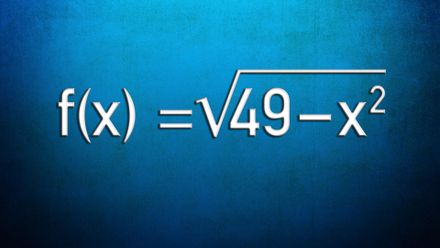
A function is continuous if there is no interruption in the curve when its graph is drawn; the three conditions that must be met for continuity; applications of associated ideas; the greatest integer function and the intermediate value theorem.
S1:E5 • Mar 5, 2010 • 31m
Infinite limits describe the behavior of functions that increase or decrease without bound, in which the asymptote is the specific value that the function approaches without ever reaching it; some examples from relativity theory and biology.
S1:E6 • Mar 5, 2010 • 31m
Building on what one has learned about limits and continuity; derivatives are the foundation of differential calculus; developing the formula for defining a derivative; surveying the history of the concept and its different forms of notation.
S1:E7 • Mar 5, 2010 • 31m
Finding derivatives; the power rule, the constant multiple rule, sum and difference rules; a shortcut when sine and cosine functions are involved; derivatives are the key to determining the rate of change in problems involving objects in motion.
S1:E8 • Mar 5, 2010 • 30m
The formulas for finding derivatives of products and quotients of functions; the quotient rule to derive formulas for the trigonometric functions not covered earlier; higher-order derivatives, differential equations and horizontal tangents.
S1:E9 • Mar 5, 2010 • 31m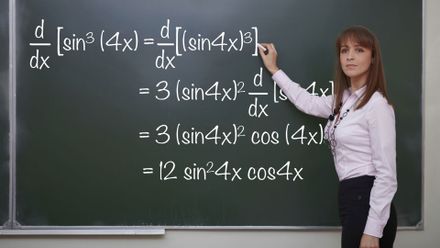
One of the most useful of the differentiation rules is the chain rule; it allows one to find the derivative of a composite of two functions; different examples of this technique; a problem from physics that involves the motion of a pendulum.
S1:E10 • Mar 5, 2010 • 31m
The final strategy; implicit differentiation is used when it is difficult to solve a function for y; applying this rule to problems in related rates; the rate at which a camera must move to track the space shuttle at a specified time after launch.
S1:E11 • Mar 5, 2010 • 31m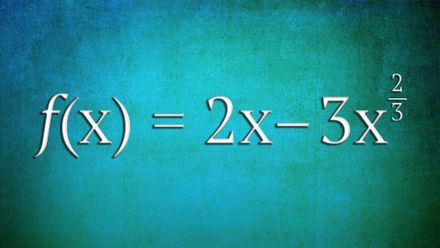
Having covered the rules for finding derivatives, the first of five episodes dealing with applications of these techniques, derivatives can be used to find the absolute maximum and minimum values of functions, analyzing real-life situations.
S1:E12 • Mar 5, 2010 • 30m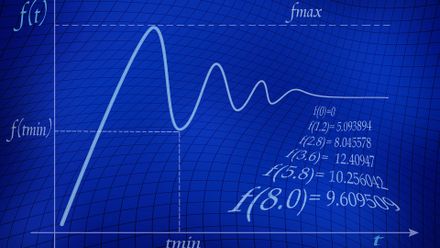
Using the first derivative to determine where graphs are increasing or decreasing; Rolle's theorem and the mean value theorem; during a car trip, one's actual speed must correspond to their average speed during at least one point of their journey.
S1:E13 • Mar 5, 2010 • 31m
Knowing what the second derivative reveals about a graph; it describes how the curve bends, whether it is concave upward or downward; determining concavity much as one finds the intervals where a graph is increasing or decreasing.
S1:E14 • Mar 5, 2010 • 31m
By using calculus, one has discovered all the properties of the graph of a function, focusing on the tangent line to a graph, which is a convenient approximation for values of the function that lie close to the point of tangency.
S1:E15 • Mar 5, 2010 • 32m
Real-life problems in optimization; finding the relative extrema of different functions by differentiation; calculating the optimum size for a box; the largest area that can be enclosed by a circle and a square made from a given length of wire.
S1:E16 • Mar 5, 2010 • 31m
Additional problems in optimization; for success with such word problems, Professor Edwards stresses the importance of first framing the problem with precalculus; reducing the equation to one independent variable; using calculus to find the answer.
S1:E17 • Mar 5, 2010 • 31m
Up until now, one has calculated a derivative based on a given function; reversing the procedure and determining the function based on the derivative; this approach is known as obtaining the antiderivative; learning the notation for integration.
S1:E18 • Mar 5, 2010 • 31m
A classic problem of integral calculus is finding areas bounded by curves; this was solved for simple curves by the ancient Greeks; a powerful method was later developed that produces a number called the definite integral; the relevant notation.
S1:E19 • Mar 5, 2010 • 31m
The two essential ideas of this course: derivatives and integrals are connected by the fundamental theorem of calculus, an important theorem in mathematics. Gain a grasp of this deep relationship by working several problems and surveying a proof.
S1:E20 • Mar 5, 2010 • 30m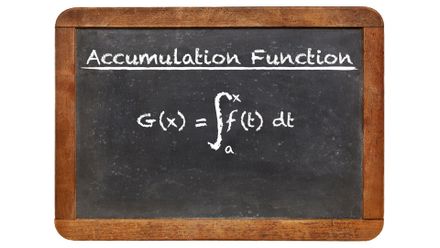
Trying examples using the second fundamental theorem of calculus; it allows one to let the upper limit of integration be a variable; exploring more relationships between differentiation and integration; how they are almost inverses of each other.
S1:E21 • Mar 5, 2010 • 31m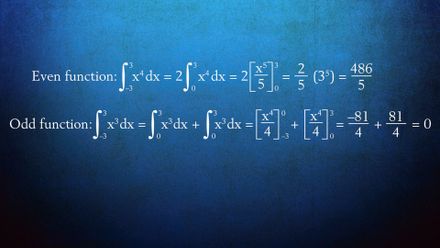
An easy technique for finding antiderivatives is called integration by substitution; based on the chain rule, it allows to convert a difficult problem into one that is easier to solve; using the variable u to represent a more complicated expression.
S1:E22 • Mar 5, 2010 • 31m
When calculating a definite integral, the first step of finding the antiderivative can be difficult; the trapezoid rule is a technique that yields a close approximation to the definite integral; a problem involving a plot of land bounded by a river.
S1:E23 • Mar 5, 2010 • 31m
Reviewing the properties of logarithms in base 10; how the so-called natural base for logarithms, e, has important uses in calculus; it is a significant number in mathematics; how such natural logarithms help to simplify derivative calculations.
S1:E24 • Mar 5, 2010 • 31m
Studying logarithms by looking at some of the consequences of the integral formula developed in the previous episode; reviewing inverse functions at the precalculus level; preparing the way for a deeper exploration of the subject in coming episodes.
S1:E25 • Mar 5, 2010 • 31m
The inverse of the natural logarithmic function is the exponential function; discovering that this function has an amazing property; it is its own derivative; the connection between the exponential function and the bell-shaped curve in probability.
S1:E26 • Mar 5, 2010 • 31m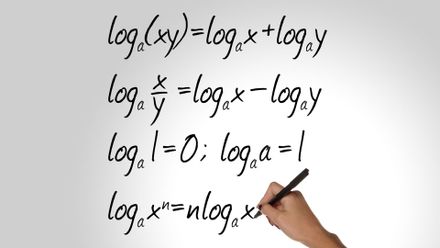
The use of the logarithmic and exponential functions to bases other than e; a problem in radioactive decay; finding the derivatives of such functions; how e emerges in other mathematical contexts; the formula for continuous compound interest.
S1:E27 • Mar 5, 2010 • 31m
The last set of functions in studying calculus is the inverse trigonometric functions; using some of the formulas for differentiating these functions, how fast the rotating light on a police car sweeps across a wall and whether one can evade it.
S1:E28 • Mar 5, 2010 • 31m
The area problem and discovering how to find the area of a region bounded by two curves; imagining that the region is divided into representative rectangles; adding up an infinite number of these rectangles, which corresponds to a definite integral.
S1:E29 • Mar 5, 2010 • 30m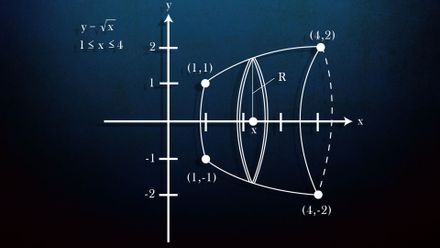
Learning to calculate the volume of a solid of revolution, an object that is symmetrical around its axis of rotation; imagining adding up an infinite number of slices; in this case, of disks rather than rectangles, which yields a definite integral.
S1:E30 • Mar 5, 2010 • 30m
Applying the shell method for measuring volumes; comparing it with the disk method on the same shape; finding the volume of a doughnut-shaped object called a torus; the volume for a figure called Gabriel's Horn, which has finite volume.
S1:E31 • Mar 5, 2010 • 31m
Two applications of calculus that are at the heart of engineering: measuring arc length and surface area; one problem is to determine the length of a cable hung between two towers, a shape known as a catenary; a peculiar paradox of Gabriel's Horn.
S1:E32 • Mar 5, 2010 • 32m
Seeing how to apply integration formulas in various examples; exploring cases in which a calculator gives different answers from the ones obtained by hand calculation; Professor Edwards gives advice on how to succeed in introductory calculus.
S1:E33 • Mar 5, 2010 • 30m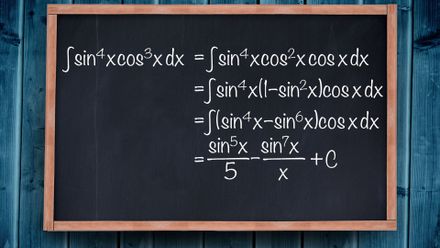
Exploring a powerful method for finding antiderivatives; integration by parts is based on the product rule for derivatives; using this technique to calculate area and volume; focusing on integrals involving products of trigonometric functions.
S1:E34 • Mar 5, 2010 • 31m
Exploring slope fields as a method for getting a picture of possible solutions to a differential equation without having to solve it; several problems of the type; a solution technique for differential equations called separation of variables.
S1:E35 • Mar 5, 2010 • 30m
Using calculus skills in three applications of differential equations; calculating the radioactive decay of a quantity of plutonium; determining the initial population of a colony of fruit flies; solving one of Professor Edwards's favorite problems.
S1:E36 • Mar 5, 2010 • 31m