

Athenian Democracy: An Experiment for the Ages
Exploring the Athenians' view of democracy, their political experiment; Professor Robert Garland portrays leaders like Solon, Cleisthenes and Pericles; the judgments of historians such as Herodotus and Thucydides; a bold political initiative.
Already subscribed?
Sign in
Considering the nature of Athenian democracy; how it functions in practice; surveying some of its key tenets; Professor Garland compares the Athenian governmental system to western democracy today; he shows the similarities and crucial differences.
S1:E1 • May 25, 2018 • 36m
Among Greek city-states, Athens is not alone in having a form of democratic rule; Greek governments run on a sliding scale from oligarchy and democracy to kingship and tyranny; Homer's epics; examining several early examples of a democratic assembly.
S1:E2 • May 25, 2018 • 30m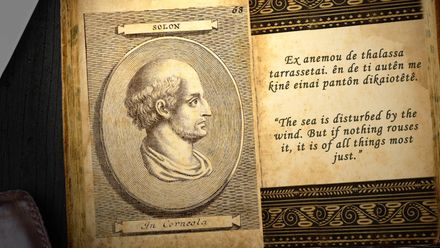
One must first examine Athens as a polis or city-state, within the broader context of Ancient Greece; reviewing the territory of Attica; the lay of the land for Athenian government in the 6th and 7th centuries B.C.; Solon's reforms.
S1:E3 • May 25, 2018 • 33m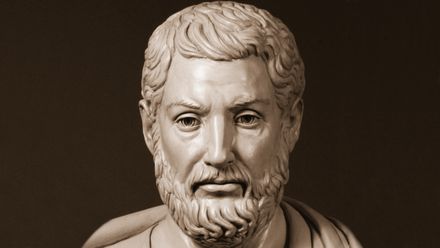
Fifty years after Solon's reforms, a tyrant named Peisistratus seizes power; the overthrow of his tyranny; the ensuing skirmish among different aristocratic groups; the rise of Cleisthenes; he carries the democratic experiment forward.
S1:E4 • May 25, 2018 • 34m
According to Professor Garland, the end of the Greco-Persian Wars in the early 5th century B.C. is Athens' finest hour; the reforms of 462 B.C., when Ephialtes and Pericles attack Areopagus and bring radical democracy — an unprecedented experiment.
S1:E5 • May 25, 2018 • 34m
The ancient Greeks consider military service a privilege; hoplite warfare and the construction of their navy go hand in hand with the rise of democracy in Athens; particularly since the Athenian military has no permanent commander-in-chief.
S1:E6 • May 25, 2018 • 33m
A hallmark institution of Athenian democracy; open to freeborn citizens older than 20, the assembly meets 10 times a year; for many citizens who live away from Athens, it is a three-day affair; some of the debates of a typical assembly meeting.
S1:E7 • May 25, 2018 • 32m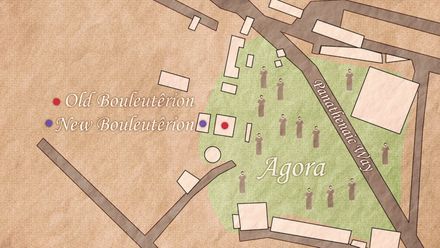
The roles of the council of 500 officials chosen by lot, required to serve for a whole year; the respected, if not particularly powerful, magistrates known as archons; the relatively limited systems of taxation and welfare in ancient Athens.
S1:E8 • May 25, 2018 • 33m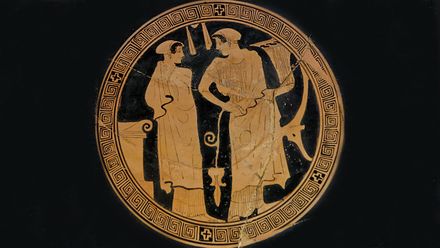
Knowing who are the citizens of Athens; perhaps, as low as one-fifth of Athenian residents are citizens; women, slaves and resident aliens are excluded; the responsibilities of citizens; the lives of those who cannot participate.
S1:E9 • May 25, 2018 • 35m
The Delian Confederacy is an association of free city-states that Athens turns into an instrument of imperial ambitions; it plays a major role in 5th-century Greece; the confederacy from the Persian Wars to the Peloponnesian War; how Athens benefits.
S1:E10 • May 25, 2018 • 33m
Pericles is one of the most intriguing political leaders of all time; surveying his life and key moments in his rule; Professor Garland takes one beyond the dates and battles to show what Pericles is like in real life; scandals in his domestic life.
S1:E11 • May 25, 2018 • 30m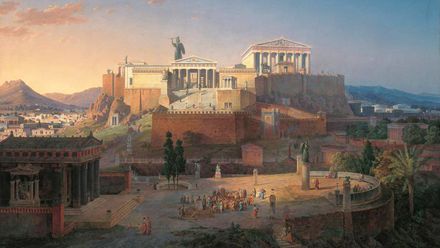
A successful public life depends on public speaking; the Athenians pride themselves on rhetoric; learning about the art of public speaking; the great political debates of the era; one politician's contention that his opponents deliver fake news.
S1:E12 • May 25, 2018 • 31m
The funeral procession is one of the most important ceremonies performed in ancient Athens; Pericles's funeral speech is captured by Thucydides; one of the most striking pieces of prose; the structure of the funeral ceremony and Pericles's speech.
S1:E13 • May 25, 2018 • 30m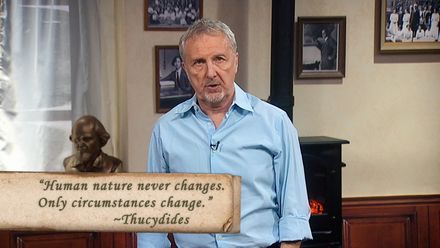
A less admirable period; beginning with the outbreak of a terrible plague around 431 B.C.; the civil war on Corcyra; the doom and gloom of this period are caused less by the nature of democracy than by plain human nature, as Thucydides observes.
S1:E14 • May 25, 2018 • 30m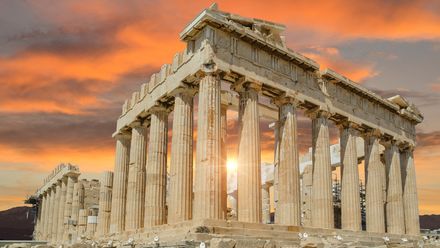
Beyond democracy, the cultural achievements of ancient Athens are some of the most impressive in all of world history, surveying some of the city's great buildings and sculptures, knowing what makes Athenian culture so distinctive and what it lacks.
S1:E15 • May 25, 2018 • 31m
Public speakers dominate the assemblies; the politicians whose voices rise above the fray; every citizen theoretically has a voice in the democracy; a few politicians and demagogues tend to dominate; learning about Cleon, Alcibiades and others.
S1:E16 • May 25, 2018 • 30m
Athenian democracy does not always respond well under pressure; three case studies; the massacre of neutral people; the illegal trial and execution of Athenian generals en bloc; the trial and execution of Socrates; the capacity for genuine brutality.
S1:E17 • May 25, 2018 • 34m
The expedition to Sicily is a military blunder; like the American war in Vietnam, the Sicilian expedition is an avoidable disaster; the combination of poor decisions from politicians and a divided military leadership leads to a humiliating failure.
S1:E18 • May 25, 2018 • 33m
Post the disastrous Sicilian campaign, Athenian democracy is on the ropes; in 413 B.C., the demos appoint a board of 10 elderly advisors to deal with the immediate crisis; these leaders steady the ship; the democratic experiment carries on.
S1:E19 • May 25, 2018 • 34m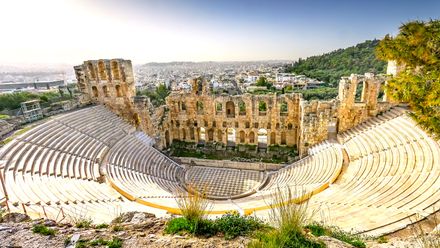
Exploring the world of the theater, one of Athens's greatest cultural achievements; delving into a study of Aeschylus, Sophocles, Aristophanes and others; there is a strong connection between politics and the theater.
S1:E20 • May 25, 2018 • 33m
Athenian democracy has both a political and a legal aspect; the city-state's legal system; the role of the courts and the procedures of a trial; the process of arraignment, jury selection and sentencing; the strengths and flaws of the legal system.
S1:E21 • May 25, 2018 • 31m
Learning what the Athenians themselves think about their system of government, Professor Garland shows that not everyone in the city-state is thrilled by the democracy; despite moments of friction, Athenian democracy is largely a success.
S1:E22 • May 25, 2018 • 30m
Greece is often described as the cradle of democracy; democracy is not a continuing entity from its start in the 7th century B.C. through today; Professor Garland traces the story of democracy from the end of 4th-century Athens through modern times.
S1:E23 • May 25, 2018 • 30m
There are some correlations and differences between Athenian democracy and democracy today; considering what the Athenians may make of democracy today; what democracy really means in the modern world; whether it is as secure as sometimes assumed.
S1:E24 • May 25, 2018 • 35mMore Like This
 2025 • 53mDetails
 2018 • PG • 1h 51mDetails
 2016 • UR • 1h 40mDetails
 2019 • UR • 1h 5mDetails
 2011 • TV14 • 48m 38sDetails
 2025 • TV14 • 21m 43sDetails
 2025 • 53mDetails
 2025 • 46mDetails
 2011 • TV14 • 52m 37sDetails
 2024 • TVPG • 1h 5mDetails
 2021 • TV14 • 49m 22sDetails
 1990 • TVG • 30mDetails
 2019 • UR • 1h 43mDetails
 2021 • NR • 18mDetails
 2025 • 42mDetails
 2021 • UR • 1h 5mDetails
 2007 • TVPG • 1hDetails
 2025 • TVPG • 27mDetails
 2012 • UR • 1h 26mDetails
 1948 • TVPG • 1h 39mDetails