


The history of drawing has produced knowledge, methodology and techniques that are readily learnable; misconceptions about talent and genius; seeing analytically and abstractly helps one draw; first drawing exercise, retracing what ancestors drew.
S1:E1 • Nov 13, 2015 • 33m
Drawing materials to use throughout the lessons; exploring artists' graphite pencils, charcoal, brush, ink and drafting and measuring tools; setting up work area; place both oneself and the subject vis-à-vis one's drawing board or easel.
S1:E2 • Nov 13, 2015 • 33m
First drawing exercises; applying the skills to complex subjects; the pieces making up the grammar of drawing; composition, proportion, perspective, value, texture and color; the knowledge and ability to explore one's creative vision.
S1:E3 • Nov 13, 2015 • 30m
The contour line describes the outer edges of objects; the construction line helps one build the objects to draw; drawing individual objects by constructing them from geometric shapes; aggregate shape unites a drawing's disparate individual elements.
S1:E4 • Nov 13, 2015 • 32m
Studying cross-contour line, oblique or foreshortened shapes and their relation to geometric solids; learning to make objects appear three-dimensional; the relation of figure to ground within a drawing; drawing three-dimensional still lifes.
S1:E5 • Nov 13, 2015 • 33m
The concept of negative shape, the shapes existing between the positive shapes representing the objects; artists use negative shape in their drawings; in still life exercises, practicing drawing both positive object shapes and the negative shapes.
S1:E6 • Nov 13, 2015 • 28m
The structure of rectangles, the basic shape of most drawings; the character of any rectangle is defined by the relationship of its verticality to its horizontality; simple diagonals within a rectangle offer possibilities for visual interpretation.
S1:E7 • Nov 13, 2015 • 30m
Artists think structurally in building a drawing; tying the drawing's content to the geometric underpinnings of a given rectangular shape; focal areas, focal points and compositional balance; the structural understanding of creating a unified whole.
S1:E8 • Nov 13, 2015 • 29m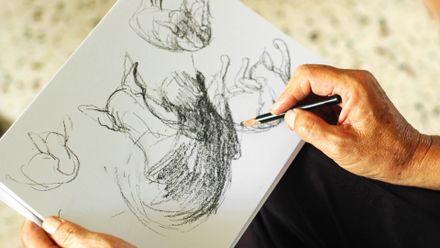
The types and qualities of line; how these attributes affect line's expressive potential; practicing nine key attributes of line, from value and width to continuity, shape and texture; the gestural line swiftly captures the character of a subject.
S1:E9 • Nov 13, 2015 • 30m
Visual strategies artists use in composing drawings; the factors of contrast and repetition affect how a viewer reads a drawing; shapes and directions that get repeated rhythmically; spatial organization; the narrative possibilities of composition.
S1:E10 • Nov 13, 2015 • 30m
Proportion and measurement; a key discovery of 15th-century European art is the velo; a gridded device that allows creating a convincing depiction of a figure or landscape; using a velo; drawing a proportioned, foreshortened view of an interior.
S1:E11 • Nov 13, 2015 • 30m
Tools artists use to arrive at correct proportions; using an analog clock face as a way to quantify angles; using a standard unit of measure to measure across the picture plane; using level and plumb lines; putting these elements in practice.
S1:E12 • Nov 13, 2015 • 28m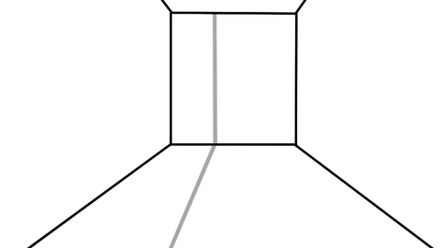
How artists create flatness, volume and space on two-dimensional surfaces; 12 factors that affect how one perceives depth of space; principles such as overlap, the relative scale of objects, atmospheric perspective and how distance affects color.
S1:E13 • Nov 13, 2015 • 30m
Applying knowledge and skills to several intriguing and complex drawing conundrums; creating a still life of boxes; translating a complex figure painting into a line drawing; drawing a self-portrait; common pitfalls and their solutions.
S1:E14 • Nov 13, 2015 • 30m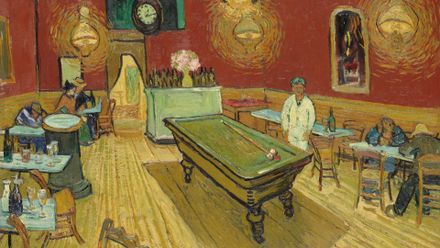
Linear perspective radically changes art; a core tool for controlling proportion and creating a life-like drawing; one-point perspective; how diagonal lines recede to a vanishing point; using this principle to create a convincing form in space.
S1:E15 • Nov 13, 2015 • 33m
Knowledge of illusionistic space and linear perspective in drawing an architectural landscape of two buildings on a ground plane; constructing the buildings and the space between them using the one-point perspective; drawing through the buildings.
S1:E16 • Nov 13, 2015 • 27m
Drawing a perspectival grid; ways artists use grids to measure the depth of space in a drawing; drawing a complete gridded room, beginning with the floor plane; adding gridded walls and a ceiling; adding interior objects of a specific measure.
S1:E17 • Nov 13, 2015 • 28m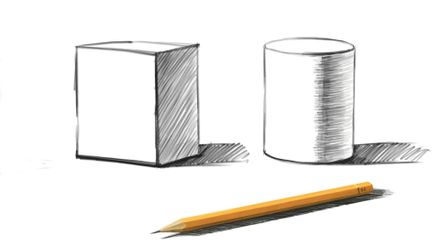
Applying the principles learned to draw curvilinear volumetric forms; the drawing of geometric patterns in perspective; a complex drawing from one's imagination; using one-point perspective to construct a believable and measurable interior space.
S1:E18 • Nov 13, 2015 • 31m
Drawing a believable environment; a two-point perspective is used to accurately draw planes that are angled to the picture plane; drawing sloping or inclined planes; three-point perspective depicts what is seen when one tilts heads, looks up or down.
S1:E19 • Nov 13, 2015 • 29m
Approaching value; how the tonal palette of a drawing governs mood and the viewer's emotional response; one's conceiving of the range of values from white to black as a scale; artists use value as a tool; the passage of light and shadow over form.
S1:E20 • Nov 13, 2015 • 29m
Drawing with value; taking a look at the types and qualities of the materials to use; the uses of graphite, charcoal, ink and the use of fixative; the many types of drawing papers; how different materials interact with different papers.
S1:E21 • Nov 13, 2015 • 29m
Discovering how artists use value; with brush and ink, learning to make both white and black shapes; creating a still life using only these two values; drawing a nine-step value scale, comprising nine distinct tones ranging from white to black.
S1:E22 • Nov 13, 2015 • 30m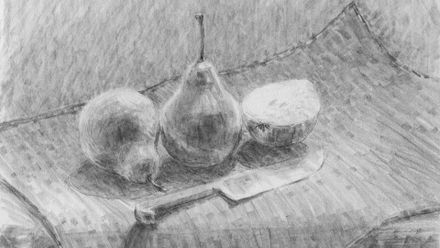
Putting the knowledge of value into practice; still lifes of white objects on white backgrounds drawn in a broad palette of light to dark; seeing a color's value as distinct from its hue and saturation; realizing a range of value-based projects.
S1:E23 • Nov 13, 2015 • 29m
How artists draw cast shadows from their imaginations; shadows thrown by blocks and curvilinear solids in one- and two-point perspective; the expressive value of shadows; compound surfaces receiving shadows; drawing cast shadows of inclined planes.
S1:E24 • Nov 13, 2015 • 29m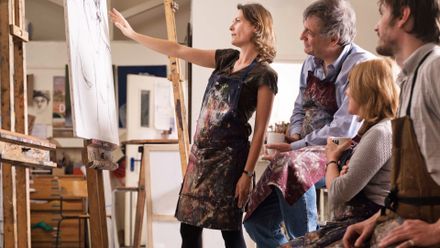
Learning to draw shadows produced by oblique light coming from both the front and rear of objects; investigating artificial light as it affects shadows projected by objects within interiors; drawing a complex interior and an invented still life.
S1:E25 • Nov 13, 2015 • 30m
Investigating the use of mark making as a means of creating visual texture and tonal value; experimenting with hatching; how to use it compositionally; practicing the invention of marks; exploring a range of possibilities; applying them in drawings.
S1:E26 • Nov 13, 2015 • 31m
Taking a look at texture; five master drawings that exhibit contrasting textural personalities and moods; the primary factors that affect texture, from the drawing surface to the material's application; learning to draw simulated textures.
S1:E27 • Nov 13, 2015 • 29m
Delving into color theory; the organization of primary and secondary colors; analogous and complementary colors; the attributes of hue, value and saturation; color in nature; how light and the environment influence the perception of color.
S1:E28 • Nov 13, 2015 • 30m
How an artist's color palette affects light, mood and emotion; studying palettes used by major artists; flat color; open color; color gradation; principles regarding how artists use color compositionally to direct the viewer's attention.
S1:E29 • Nov 13, 2015 • 31m
Choosing palettes of pastels for drawings; using a specific color palette to create mood, a visual hierarchy, and the illusion of space, volume and light; how a seemingly white wall is not white, but actually a range of colors.
S1:E30 • Nov 13, 2015 • 31m
Drawing the human figure using a set of measures and simple geometric shapes; a study of human proportions in three views; using the height of the head; how artists view human proportions, body posture and differences between male and female figures.
S1:E31 • Nov 13, 2015 • 30m
Drawing anterior, lateral and posterior views of the human figure; turning the flat shapes used to construct the figure into volume; methods for proportionately drawing the head; conquering the complexity of the hands and the feet.
S1:E32 • Nov 13, 2015 • 31m
Studying human anatomy; learning its value for drawing the figure; analyzing the human skeleton, with focus on skeletal landmarks; investigating the principal muscle groups and their functions; drawing skeleton and muscles into figure drawings.
S1:E33 • Nov 13, 2015 • 30m
Covering the muscles of the lower body and limbs; a spectrum of drawing projects, beginning with a full-length self-portrait in three views; drawing variations such as figures in one- and two-point perspective and a figure within an invented room.
S1:E34 • Nov 13, 2015 • 34m
How artists throughout history approach depicting three dimensions on a two-dimensional surface; how artists take liberties with Renaissance principles of illusionistic space; how they set them to contradict one another; new possibilities for art.
S1:E35 • Nov 13, 2015 • 29m
Challenging projects that weave various concepts together; how to develop subject matter and source material for drawings; locating areas of personal interest, themes and ideas to identify the kind of art to make and cultivate an artistic vision.
S1:E36 • Nov 13, 2015 • 32mMore Like This
 TVPG • 1 season
 2021 • TV14 • 1hDetails
 2025 • 56mDetails
 TVPG • 1 season
 2025 • TVPG • 31mDetails
 2025 • 46mDetails
 2025 • 53mDetails
 2020 • 1h 30mDetails
 TVPG • 1 season
 TVPG • 1 season
 TVPG • 1 season
 TVPG • 1 season
 2021 • G • 1hDetails
 TVPG • 1 season
 TVPG • 1 season
 TVPG • 1 season
 2025 • 54mDetails
 TV14 • 2 seasons
 TVPG • 1 season
 2025 • 1h 42mDetails