

Mind-Bending Math: Riddles and Paradoxes
Season 1
Discovering riddles and paradoxes that confound the greatest philosophical, mathematical and scientific minds in history; stretching the mind to try to solve a puzzle, even when the answer is elusive, can help sharpen the mind and focus.
Already subscribed?
Sign in
Plunging into the world of paradoxes and puzzles with a "strange loop"; it is a self-contradictory problem from which there is no escape; the liar's paradox and the barber's paradox; "proving" that 1+1=1; the Island of Knights and Knaves.
S1:E1 • Jul 24, 2015 • 33m
Why all numbers are interesting; why 0.99999... is nothing less than the number 1; learning that one's intuition about breaking spaghetti noodles is probably wrong; how averages, from mileage to the Dow Jones Industrial Average, can be deceptive.
S1:E2 • Jul 24, 2015 • 28m
Investigating the Monty Hall problem, a puzzle named after the host of "Let's Make a Deal"; Hall lets contestants change their guess about the location of a hidden prize after revealing new information about where it is not.
S1:E3 • Jul 24, 2015 • 31m
Some statistics are the product of confused thinking due to Simpson's paradox and similar errors of statistical reasoning; how this problem arises in sports, social science and especially medicine, where it can lead to inappropriate treatments.
S1:E4 • Jul 24, 2015 • 31m
Touring Zeno's paradoxes of motion, space and time; exploring solutions using calculus and other techniques; looking at the deeper philosophical implications, which gain new relevance through the discoveries of modern physics.
S1:E5 • Jul 24, 2015 • 30m
Explore several paradoxes involving infinity, then study supertasks: exercises with an infinite number of steps that are completed in finite time.
S1:E6 • Jul 24, 2015 • 29m
Stretch your mind and attempt to solve the timeless riddles and paradoxes that have confounded the greatest philosophical, mathematical, and scientific minds in history.
S1:E7 • Jul 24, 2015 • 31m
Randomly picking a real number between 0 and 1; considering the probability that the number is a fraction or zero; probing this and other facts about infinite sets; the discovery that makes Cantor exclaim, "I see it, but I don't believe it!".
S1:E8 • Jul 24, 2015 • 33m
Delving into Bertrand Russell's paradox that undermines Cantor's theory of sets; following the scramble to fix set theory and all of mathematics with a new set of axioms designed to avoid all paradoxes and keep mathematics consistent.
S1:E9 • Jul 24, 2015 • 29m
Studying Kurt Gödel's demonstration that mathematical consistency is a mirage; Gödel shows that the price for avoiding paradoxes is incompleteness; outlining Gödel's proof; seeing how it relates to the liar's paradox.
S1:E10 • Jul 24, 2015 • 30m
Learning that determining the will of the voters can require a mathematician; the paradoxical outcomes of elections at various levels; Kenneth Arrow's Nobel prize-winning impossibility theorem; assessing the U.S. Electoral College system.
S1:E11 • Jul 24, 2015 • 30m
How the founders of the U.S. struggle with a mathematical problem; apportioning representatives to Congress based on population; the results possible with different methods; the origin of the current approach; learning that no perfect system exists.
S1:E12 • Jul 24, 2015 • 29m
Leaping into puzzles that teach the rudiments of game theory; dividing loot with pirates; pondering the two-envelope problem; learning about Newcomb's paradox; visiting the island where everyone has blue eyes; tackling the prisoner's dilemma.
S1:E13 • Jul 24, 2015 • 32m
Spotting the hidden strange loop in the unexpected exam paradox; contemplating Parrondo's paradox that two losing strategies can combine to make a winning strategy; trying challenging hat games; using the axiom of choice from set theory.
S1:E14 • Jul 24, 2015 • 29m
Classical mechanics is full of paradoxical phenomena; Professor Kung shows this using springs, a slinky, a spool and oobleck; the physical principles that make everyday objects do strange things; how to float a cruise ship in a gallon of water.
S1:E15 • Jul 24, 2015 • 30m
Investigating the paradoxes of near-light-speed travel; separated twins age at different rates; dimensions contract; venturing into the quantum realm; exploring the nature of light; the true meaning of the Heisenberg uncertainty principle.
S1:E16 • Jul 24, 2015 • 33m
Searching for the solutions to classic geometric puzzles such as the vanishing leprechaun; scratching one's head over a missing square; connecting an array of dots with the fewest lines; map challenges; how to ride a bicycle with square wheels.
S1:E17 • Jul 24, 2015 • 30m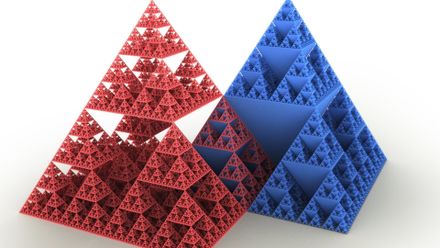
Entering a fractional dimension; honing one's understanding of dimensionality by solving the riddle of Gabriel's horn; venturing into the fractal world of Sierpinski's triangle and the Menger sponge, both of which have different dimensions.
S1:E18 • Jul 24, 2015 • 32m
Visiting the land of topology, where one shape morphs into another; starting with figures such as the Möbius strip; the Alexander horned sphere and the Klein bottle; studying the minimum number of colors needed to distinguish their different regions.
S1:E19 • Jul 24, 2015 • 31m
Here, consider the complexities of topological surfaces, including the iconic and non-orientable Möbius strip.
S1:E20 • Jul 24, 2015 • 31m
Many puzzles are optimization problems in disguise; nature often reveals shortcuts to the solutions; how light, bubbles, balloons and other phenomena provide hints to these conundrums; closing with the surprising answer to the Kakeya needle problem.
S1:E21 • Jul 24, 2015 • 29m
Proving that some sets cannot be measured; this is crucial to understanding the Banach-Tarski paradox, the strangest theorem in mathematics; asking why mathematicians want to measure sets; learning how to construct a non-measurable set.
S1:E22 • Jul 24, 2015 • 34m
The Banach-Tarski paradox shows that one can take a solid ball, split it into five pieces and reassemble them into two complete balls the same size as the original; Professor Kung explains the mathematics behind this result.
S1:E23 • Jul 24, 2015 • 33m
Asking the big questions about puzzles and paradoxes; why people are obsessed with them; the mental dismay that comes from contemplating a paradox; why one expends so much effort trying to solve conundrums; there is a method to this madness.
S1:E24 • Jul 24, 2015 • 32mMore Like This
 2025 • 48mDetails
 TVPG • 1 season
 TVPG • 1 season
 2025 • 54mDetails
 TVPG • 1 season
 TVPG • 1 season
 TVPG • 1 season
 TVPG • 1 season
 TVPG • 1 season
 TVPG • 1 season
 TVPG • 1 season
 TVPG • 1 season
 TVPG • 1 season
 TVPG • 1 season
 TVPG • 1 season
 TVPG • 1 season
 TVPG • 1 season
 TVPG • 1 season
 TVPG • 1 season
 TVPG • 1 season