

How You Decide: The Science of Human Decision Making
S1:E4 How Habits Make Decisions Easier
Habits are immediate automatic responses, good and bad, to situations; decision science gives the psychological framework within which to understand how habits form, how they are activated and how best to change them when needed.
Already subscribed?
Sign in
Learning what science reveals about human decision-making using the metaphor of manufacturing; informational raw materials go in; the cognitive machinery processes; control mechanisms guide the machinery; a decision is made.
S1:E1 • Sep 23, 2016 • 31m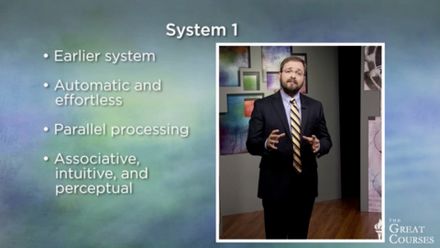
Delving into the two-system model of decision-making; System 1 is the automatic and intuitive processor; it is an earlier system from an evolutionary perspective; System 2 is the flexible and powerful serial processor that one thinks of as "them".
S1:E2 • Sep 23, 2016 • 30m
Heuristics are the decision shortcuts that people use every day; they are powerful tools that allow one to make appropriate decisions fairly easily; not understanding the limitations of heuristics can easily lead one astray from the truth.
S1:E3 • Sep 23, 2016 • 30m
Habits are immediate automatic responses, good and bad, to situations; decision science gives the psychological framework within which to understand how habits form, how they are activated and how best to change them when needed.
S1:E4 • Sep 23, 2016 • 28m
The feeling that the mind is too overworked to make one more decision; the cognitive "fuel" needed for System 2 to rein in the automatic responses of System 1; how to recognize when one is too resource-depleted to make the best decisions.
S1:E5 • Sep 23, 2016 • 30m
Prospect Theory reveals the ways in which decision-making machinery values an item; how to make better decisions; understanding appropriate reference points; sensitivity to changes in value; super-sensitivity when it comes to potential loss.
S1:E6 • Sep 23, 2016 • 29m
Recognizing that emotions affect decisions; scientists discover that emotions play an even larger role than previously thought; in fact, they are an integral and necessary part of the cognitive machinery.
S1:E7 • Sep 23, 2016 • 30m
Pondering whether one can influence the cognitive machinery that manufactures decisions; why and how one's goals motivates them; which goals inspire the greatest effort; how best to motivate others to help them meet their own goals.
S1:E8 • Sep 23, 2016 • 31m
One's control panel can steer them in the wrong direction; why the cognitive machinery often over-weights attributes; why it considers information that has no bearing on the decision at hand; why it sometimes makes short-term evaluations.
S1:E9 • Sep 23, 2016 • 29m
Mental accounting is a powerful decision-making tool; the process of partitioning objects and experiences in purposeful ways; how it can increase happiness, decrease pain and lead to better physical and emotional health.
S1:E10 • Sep 23, 2016 • 31m
Decisions are not made in a vacuum; people are mentally prepared to receive a stimulus before it comes; the mindset significantly affects how one perceives and processes information and the decisions that result from it.
S1:E11 • Sep 23, 2016 • 31m
How the desire for consistency drives decision-making and the judgment of others' actions; what happens when one's actions are not consistent with their stated beliefs; decision science reveals that they tend to make a surprising accommodation.
S1:E12 • Sep 23, 2016 • 29m
Relationships with others and broader societal pressures influence decision-making; how people look to others for guidance in the most subtle of ways; the many decisions they make to try to mimic or please those whom they perceive to be powerful.
S1:E13 • Sep 23, 2016 • 29m
Considering the question of whether subliminal messages cause people to make decisions almost against their will; the scientifically proven ways in which one is subtly influenced by subliminal messages and environmental cues.
S1:E14 • Sep 23, 2016 • 31m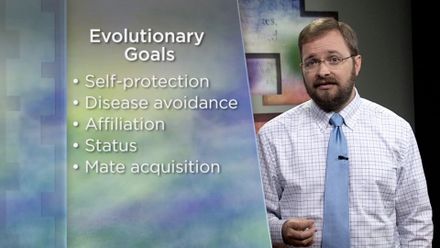
There might be a reason to blame a bad decision on an ancestors' development millennia ago; the often surprising and unexpected ways in which evolutionary drives guide decision processes even in the current day, for better or for worse.
S1:E15 • Sep 23, 2016 • 30m
Recent scientific research reveals a complex framework behind decision-making motivation; regulatory focus theory shows that people operate from four motivational states; it reveals a richer and more accurate framework for understanding decisions.
S1:E16 • Sep 23, 2016 • 30m
How much information one collects before making a decision; how much is optimal; whether to focus on pertinent data or extraneous information; the decision rules used every day; real-world ways in which people evaluate and compare choices.
S1:E17 • Sep 23, 2016 • 29m
The unexpected ways in which information context affects decisions; what happens when the mind acts like a big shovel scooping up all the data in its path; scientific studies reveal how the choice context can lead to some surprising decisions.
S1:E18 • Sep 23, 2016 • 28m
The way in which one presents a choice is often as important as the specific question asked; decision science reveals just how the tool of decision framing can be used to one's benefit; how it is used to manipulate the choices of consumers.
S1:E19 • Sep 23, 2016 • 28m
Using memory in the decision-making process; the quality of any decision often depends on accessing the appropriate memories at the appropriate time; learning how some surprising tools can help one recall those memories more effectively.
S1:E20 • Sep 23, 2016 • 28m
Research shows that when faced with too many choices, consumers are sometimes unable to make any decision at all; decision science reveals the best tools to use to narrow one's choices when deciding on everything from a movie to a soul mate.
S1:E21 • Sep 23, 2016 • 30m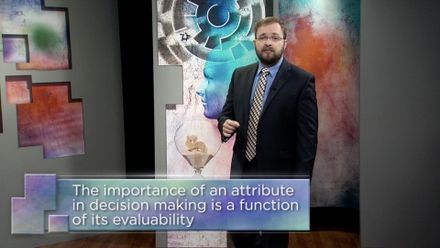
Research shows that when evaluating options, people tend to place more importance on attributes they understand; learning how to better evaluate the choices available; how to avoid as many poor-decision pitfalls as possible.
S1:E22 • Sep 23, 2016 • 28m
Medical imaging reveals that when faced with a marketing campaign for food, the brain reacts as if the ad influences the food's taste; learning about the ways in which this halo effect can hinder or help the accuracy of decision-making.
S1:E23 • Sep 23, 2016 • 29m
Scientists do not anticipate developing one unified theory to model decision-making; one can improve their own decision-making with four empirical generalizations; these are reference points, reasons, resources and replacement.
S1:E24 • Sep 23, 2016 • 34m