

The Rise of Communism: From Marx to Lenin
S1:E7 The Making of Lenin
Lenin's ideas and actions propel him to become the first man to bring communist theory into power in 1917; Lenin's hardness in the face of the 1891-1892 famine, his manifesto "What Is to Be Done?"; the Bolshevik and Menshevik factions.
Already subscribed?
Sign in
Lenin's arrival at Petrograd's Finland Station in April 1917 is one of the most important turning points in modern history: the establishment of a communist regime after decades of theory; definitions of terms such as communism and socialism.
S1:E1 • Nov 8, 2019 • 24m
The ideas of Karl Marx and Friedrich Engels rock society and affect millions of lives; their body of theory is known as dialectical materialism; Marxism offers a tableau of history with key roles played by the toiling masses and economic forces.
S1:E2 • Nov 8, 2019 • 30m
The revolutionary messages in "The Communist Manifesto" and "Das Kapital"; a vocabulary of Marxist concepts to better understand Marx's model of history and economics; how the revolutionary lives of Marx and Engels seek to unify theory with practice.
S1:E3 • Nov 8, 2019 • 27m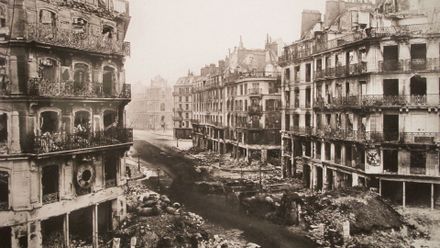
The violent upheaval of the Paris Commune in 1871; a political experiment that lasts 10 weeks; the Paris Commune makes Marx one of the most feared and hated men in the world; Marx considers it a living example of the dictatorship of the proletariat.
S1:E4 • Nov 8, 2019 • 25m
Following the death of Marx in 1883, the socialist movement grows; arguments about theory and organizational tactics; the rise of political parties in Germany and America; the establishment of the Second International; the struggle over revisionism.
S1:E5 • Nov 8, 2019 • 30m
A Marxist regime comes to power in Russia of all places; Marx considers it an unpromising place for a proletarian crusade; Professor Liulevicius tackles this question and also probes Russia's revolutionary tradition and the ideas of Georgi Plekhanov.
S1:E6 • Nov 8, 2019 • 27m
Lenin's ideas and actions propel him to become the first man to bring communist theory into power in 1917; Lenin's hardness in the face of the 1891-1892 famine, his manifesto "What Is to Be Done?"; the Bolshevik and Menshevik factions.
S1:E7 • Nov 8, 2019 • 25m
With the First World War, Lenin has a world crisis he could turn to his advantage; Marxist debates over the philosophies of defensism and defeatism; Leon Trotsky's theory of permanent revolution; the rift between socialists and communists.
S1:E8 • Nov 8, 2019 • 26m
The Bolsheviks seize power in October 1917, a moment that is celebrated afterward as Red October; the formula for success behind the Bolshevik takeover; the mythologizing of Red October in film and music; the dawn of the Cheka, a secret police force.
S1:E9 • Nov 8, 2019 • 29m
Rosa Luxemburg is a famous woman radical in history; her revolutionary activities throughout Switzerland, Poland and Germany; her support of spontaneous revolt; her struggles with the ambiguities of revolutionary devotion; her martyrdom.
S1:E10 • Nov 8, 2019 • 29m
How a revolutionary regime builds a bridge to world revolution; Comintern is created in 1919 to spread the message of global revolution; attempts at sovietizing Hungary and Bavaria; the Soviet-Polish War of 1920; hopes for linking up with Germany.
S1:E11 • Nov 8, 2019 • 30m
Bolshevik social experiments inaugurate a new civilization up through the death of Lenin in 1924; Lenin's propaganda plan changes the appearance of Russia; a nationalist program; party recruitment drives and purges; the mummification of Lenin's body.
S1:E12 • Nov 8, 2019 • 33m