

Algebra II
S1:E1 An Introduction to Algebra II
Professor Sellers explains the topics covered in the series; the importance of algebra and how one can get the most out of these episodes; the fundamentals of algebra; reviewing the order of operations and trying a hand at several problems.
Already subscribed?
Sign in
Professor Sellers explains the topics covered in the series; the importance of algebra and how one can get the most out of these episodes; the fundamentals of algebra; reviewing the order of operations and trying a hand at several problems.
S1:E1 • Mar 4, 2011 • 32m
Exploring linear equations; studying one-step equations and then advancing to those requiring two or more steps to solve; applying the distributive property to simplify certain problems; learning about the three categories of linear equations.
S1:E2 • Mar 4, 2011 • 31m
Taking knowledge of linear equations a step ahead; examples involving absolute values, which can be thought of as a distance on a number line, always expressed as a positive value; recognizing absolute value problems that have limited or no answers.
S1:E3 • Mar 4, 2011 • 31m
Moving into the visual realm; how linear equations are represented as straight lines on graphs using either the slope-intercept or point-slope forms of the function; parallel and perpendicular lines; identifying them by the value of their slopes.
S1:E4 • Mar 4, 2011 • 29m
Reversing the procedure from the previous episode; starting with an equation and drawing the line that corresponds to it; matching four linear equations to their graphs; how to rewrite an equation to move its graph in different directions.
S1:E5 • Mar 4, 2011 • 29m
Functions are important not only for algebra, but for precalculus, calculus and higher mathematics; a function's definition; concepts such as domain and range; the vertical line test for determining whether a given curve is a graph of a function.
S1:E6 • Mar 4, 2011 • 31m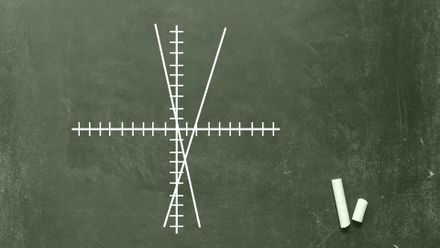
Solving systems of two linear equations by graphing the corresponding lines; looking for the intersection point; discovering that there are three possible outcomes; no solution, infinitely many solutions and exactly one solution.
S1:E7 • Mar 4, 2011 • 29m
Two other techniques for solving systems of two linear equations: the method of substitution solves one of the equations and substitutes the result into the other; elimination adds or subtracts the equations to see if a variable can be eliminated.
S1:E8 • Mar 4, 2011 • 30m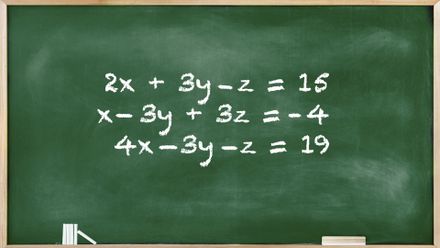
As the number of variables increases, it becomes unwieldy to solve systems of linear equations by graphing; these problems are not as hard as they look; systems of three linear equations often yield to the strategy of eliminating variables.
S1:E9 • Mar 4, 2011 • 31m
Making the leap into systems of linear inequalities, where the solution is a set of values on one side or another of a graphed line; an inequality is an assertion such as less than or greater than, which encompasses a range of values.
S1:E10 • Mar 4, 2011 • 29m
Begin the investigation of quadratic functions by visualizing what they look like when graphed; they form a U-shaped curve called a parabola, whose location on the coordinate plane can be predicted based on the individual terms of the equation.
S1:E11 • Mar 4, 2011 • 32m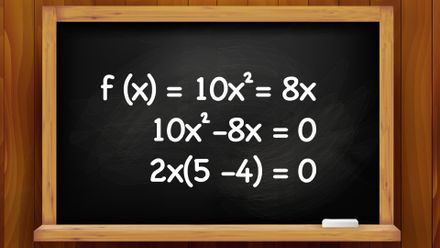
One of the most important skills related to quadratics is factoring; reviewing the basics of factoring; learning to recognize a special case known as the difference of two squares; working on a word problem that translates into a quadratic equation.
S1:E12 • Mar 4, 2011 • 32m
The square root approach to solving quadratic equations works not just for perfect squares, but also for values that do not seem to involve squares at all; probing the idea behind this technique; venturing into the world of complex numbers.
S1:E13 • Mar 4, 2011 • 31m
Completing the square involves turning a quadratic equation into a solvable form that includes a perfect square; a benefit of this approach is that the rewritten form gives the coordinates for the vertex of the parabola represented by the equation.
S1:E14 • Mar 4, 2011 • 30m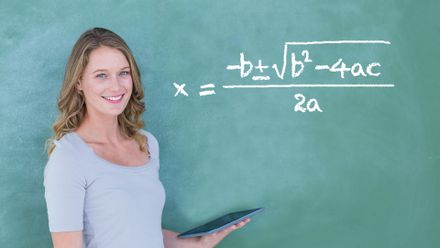
When other approaches fail, the quadratic formula can solve every quadratic equation; practicing this formula on a wide range of problems; how a special expression called the discriminant tells how many real-number solutions the equation has.
S1:E15 • Mar 4, 2011 • 30m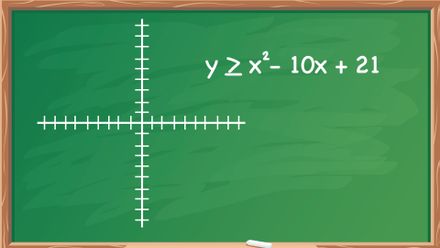
Stepping into the realm of quadratic inequalities, where the boundary graph is not a straight line but a parabola; using the skills for analyzing quadratic expressions to sketch graphs quickly and solve systems of quadratic inequalities.
S1:E16 • Mar 4, 2011 • 30m
Delving into the algebra of conic sections, which are cross-sectional shapes produced by slicing a cone; studying parabolas and hyperbolas, which differ in how many variable terms are squared in each; how to sketch a hyperbola from its equation.
S1:E17 • Mar 4, 2011 • 32m
The algebraic properties of ellipses and circles; ellipses resemble stretched circles; they are defined by their major and minor axes, whose ratio determines the ellipses' eccentricity; circles are ellipses whose eccentricity equals one.
S1:E18 • Mar 4, 2011 • 32m
Pausing to examine the nature of polynomials, a class of algebraic expressions, Professor Sellers introduces several useful concepts, such as the standard form of polynomials and their degree, domain, range and leading coefficients.
S1:E19 • Mar 4, 2011 • 32m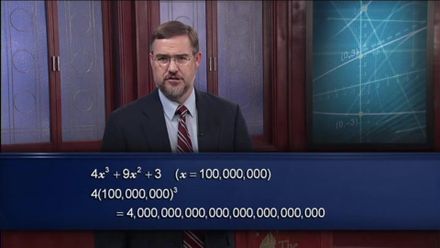
Graphing polynomial functions to see how they differ from non-polynomials; how the general shape of the graph can be predicted from the highest exponent of the polynomial, known as its degree; how other terms in the function also affect the graph.
S1:E20 • Mar 4, 2011 • 31m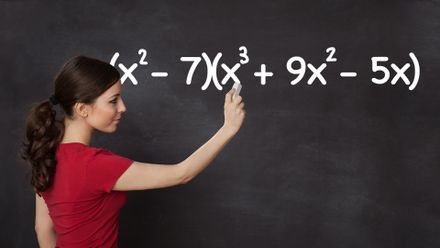
The algebraic side of polynomial functions; learning how to combine them in many different ways, including addition, subtraction, multiplication and even long division; discovering which of these operations do and do not produce new polynomials.
S1:E21 • Mar 4, 2011 • 34m
How to solve polynomial equations where the degree is greater than two by turning them into expressions one already knows how to handle; the "toolbox" includes techniques such as the difference of two squares and the difference of two cubes.
S1:E22 • Mar 4, 2011 • 32m
Going beyond the approaches learned so far; how to solve polynomial equations by applying two tools for finding rational roots, which are the rational roots theorem and the factor theorem; both will prove useful in succeeding lessons.
S1:E23 • Mar 4, 2011 • 32m
Exploring two additional tools for identifying the roots of polynomial equations; Descartes' rule of signs, which narrows down the number of possible real roots; the fundamental theorem of algebra, which gives the total of all roots for a polynomial.
S1:E24 • Mar 4, 2011 • 32m
Shifting gears away from polynomials to focus on expressions involving roots, including square roots, cube roots and roots of higher degrees; practicing multiplying, dividing, adding and subtracting a wide variety of radical expressions.
S1:E25 • Mar 4, 2011 • 32m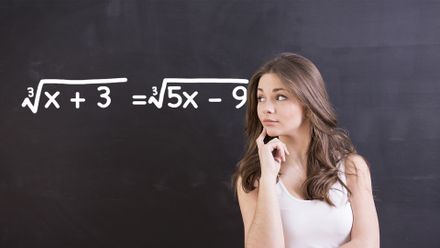
Trying one's hand at solving equations with roots and radicals; beginning by learning how to manipulate rational, or fractional, exponents; practicing with simple equations while being on the lookout for extraneous, or "imposter", solutions.
S1:E26 • Mar 4, 2011 • 31m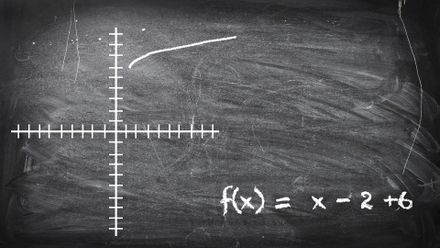
Experimenting with curves formed by simple radical functions; determining the domain of the function, which tells the general location of the graph on the coordinate plane; how different terms in the function alter the graph in predictable ways.
S1:E27 • Mar 4, 2011 • 32m
Studying graphs of rational functions, which are the ratio of two polynomials; these graphs are more complicated; their characteristics can be determined by calculating the domain, the x- and y-intercepts, and the vertical and horizontal asymptotes.
S1:E28 • Mar 4, 2011 • 31m
Combining rational functions using addition, subtraction, multiplication, division and composition; the trick is to start each problem by putting the expressions in factored form; leaving the answer in factored form also allows for other operations.
S1:E29 • Mar 4, 2011 • 31m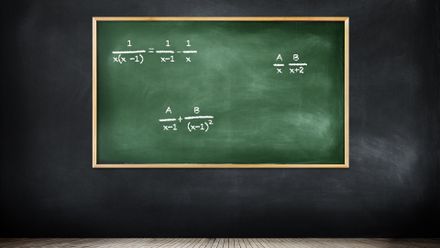
Trying the procedure of splitting a more complicated rational expression into its component parts, called partial fraction decomposition, this approach is a topic in introductory calculus; it is used for solving more advanced math problems.
S1:E30 • Mar 4, 2011 • 30m
Exponential functions are important in real-world applications; experimenting with exponential functions; exploring such concepts as the base, growth factor and decay factor; how different values for these terms affect the graph of the function.
S1:E31 • Mar 4, 2011 • 30m
Plotting a logarithmic function on the coordinate plane to see how it is the mirror image of a corresponding exponential function; logarithms can be disorienting; studying their properties to discover how they make certain calculations simpler.
S1:E32 • Mar 4, 2011 • 32m
Delving deeper into exponential and logarithmic functions with the goal of solving a typical financial investment problem using the "Pert" formula; studying the change of base formula for logarithms; the special function of the base called e.
S1:E33 • Mar 4, 2011 • 30m
Pascal's triangle is an array of numbers that corresponds to the coefficients of binomials of different powers; connecting combinatorics with algebra; the formula for each value in Pascal's triangle, the factorial function and the binomial theorem.
S1:E34 • Mar 4, 2011 • 31m
Using the factorial function to solve problems in permutations and combinations; figuring out what all the permutations of the letters a, b and c are; how many combinations of four books are possible when one has six to choose from.
S1:E35 • Mar 4, 2011 • 32m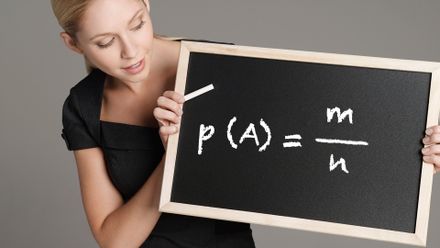
A short introduction to probability; celebrating the completion of the series with a deck of cards; finding out if one can use the principles of probability, permutations and combinations to calculate the probability of being dealt different hands.
S1:E36 • Mar 4, 2011 • 34m