

Understanding Multivariable Calculus: Problems, Solutions, and Tips
The next step for students and professionals to expand their knowledge for work or study in quantitative fields; an intellectual exercise for teachers, retired professionals and anyone else who wants to understand the applications of 3-D calculus.
Already subscribed?
Sign in
Reviewing key concepts from basic calculus; a brief overview of what is to be learned; applying distance and midpoint formulas to three-dimensional objects; observing some of the new curiosities unique to functions of more than one variable.
S1:E1 • May 9, 2014 • 34m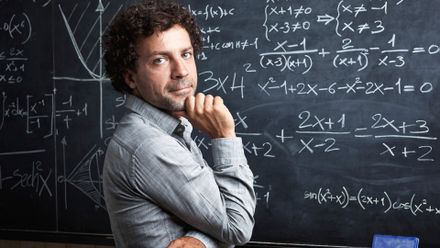
What makes a function "multivariable"; beginning with definitions; how these new functions behave as one applies familiar concepts of minimum and maximum values; using graphics and other tools to observe their interactions with the xy-plane.
S1:E2 • May 9, 2014 • 30m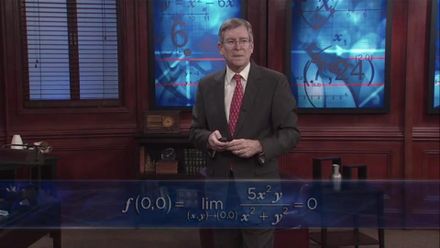
Applying fundamental definitions of calculus to multivariable functions, starting with their limits; how these limits become complicated as one approaches them; using this to derive the definition of a versatile new tool, the partial derivative.
S1:E3 • May 9, 2014 • 30m
Discovering the new dimensions of second partial derivatives; differentiating either twice with respect to x or y, or once each with respect to x and y; considering Laplace's equation to see what makes a function "harmonic".
S1:E4 • May 9, 2014 • 30m
Combining the differential and chain rule from elementary calculus; how to generalize them to functions of more than one variable; how the total differential can be used to approximate ?z over small intervals without calculating the exact values.
S1:E5 • May 9, 2014 • 31m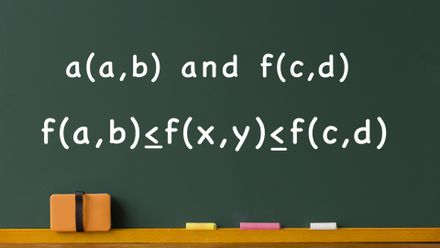
The ability to find extreme values for optimization is one of the most powerful consequences of differentiation; defining the Extreme Value Theorem for multivariable functions; using it to identify relative extrema using a "second partials test".
S1:E6 • May 9, 2014 • 31m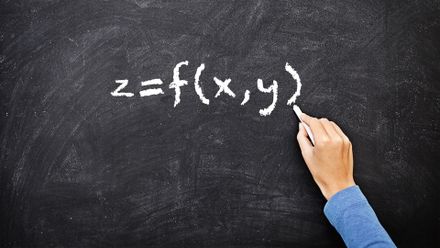
Exploring multivariable optimization by using the Extreme Value Theorem on closed and bounded regions; finding absolute minimum and maximum values across bounded regions of a function; applying these concepts to a real-world problem.
S1:E7 • May 9, 2014 • 31m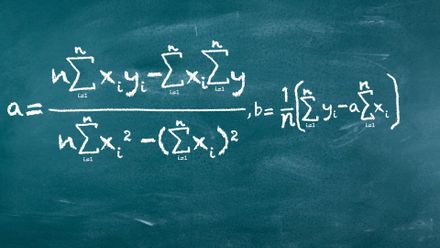
Applying techniques of optimization to curve-fitting; exploring a statistical tool yielded by multivariable calculus; beginning with the Least Squares Regression Line that yields the best fit to a set of points; applying it to a real-life problem.
S1:E8 • May 9, 2014 • 31m
Beginning the study of vectors in three-dimensional space; extrapolating vector notation and formulas for magnitude from the familiar equations for two dimensions; learning to derive the parametric equations of a line parallel to a direction vector.
S1:E9 • May 9, 2014 • 30m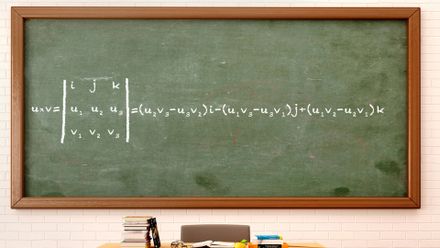
Taking the cross product of two vectors, yielding a third vector perpendicular to both; the properties of this new vector; how to define the triple scalar product; using it to evaluate the volume of a parallelepiped.
S1:E10 • May 9, 2014 • 29m
Defining a plane using the tools acquired so far; learning about projections of one vector onto another; finding the angle between two planes; using vector projections to find the distance between a point and a plane.
S1:E11 • May 9, 2014 • 32m
Applying what one has learned to curved surfaces; beginning with the equation of a sphere; finding the recognizable parabolas and other 2-D shapes that lie hidden in new vector equations; observing surfaces of revolution in three-dimensional space.
S1:E12 • May 9, 2014 • 31m
Defining vector-valued functions and their derivatives; various formulas relating to arc length; applying these definitions to position, velocity and acceleration vectors; differentiating them using a surprisingly simple method.
S1:E13 • May 9, 2014 • 31m
Examining Johannes Kepler's laws of planetary motion; applying vector-valued functions to Newton's second law of motion and his law of gravitation; how Newton is able to take laws Kepler derives from observation and prove them using calculus.
S1:E14 • May 9, 2014 • 30m
Building on the knowledge of multivariable differentiation with gradient vectors; using them to determine directional derivatives; discovering a unique property of the gradient vector and its relationships with level curves and surfaces.
S1:E15 • May 9, 2014 • 30m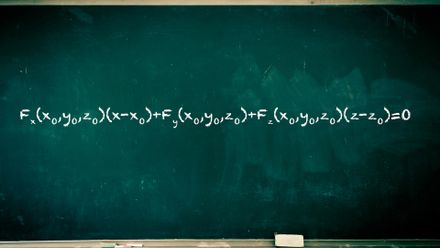
Utilizing the gradient to find normal vectors to a surface; how these vectors interplay with standard functions to determine the tangent plane to a surface at a given point; starting with tangent planes to level surfaces; analyzing the result.
S1:E16 • May 9, 2014 • 29m
The method of Lagrange multipliers; using this theorem and some simple algebra to optimize functions subject not just to boundaries, but to constraints given by multivariable functions; applying this tool to a real-world cost-optimization example.
S1:E17 • May 9, 2014 • 31m
Observing the simplicity of Lagrange multipliers firsthand by re-examining an optimization problem from an earlier episode; exploring one of the many uses of constrained optimization in the world of physics by deriving Snell's Law of Refraction.
S1:E18 • May 9, 2014 • 30m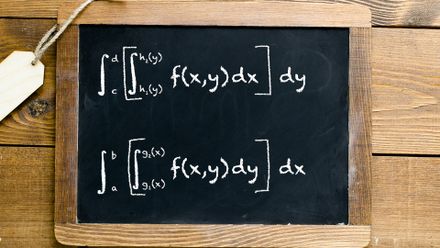
Exploring integration, the other side of calculus in three dimensions; starting off with iterated integrals, an intuitive and simple approach that merely adds an extra step and a slight twist to one-dimensional integration.
S1:E19 • May 9, 2014 • 30m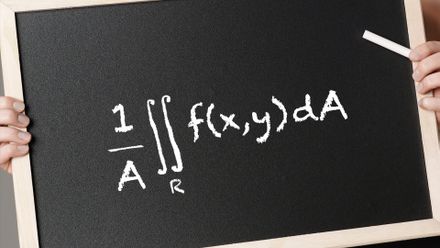
Learning to integrate multivariable functions; the double integral has many of the same properties as its one-dimensional counterpart; evaluating these over a region R bounded by variable constraints; extrapolating a single-variable formula.
S1:E20 • May 9, 2014 • 30m
Transforming Cartesian functions f(x, y) into polar coordinates defined by r and θ; getting familiar with surfaces defined by this new coordinate system; how these coordinates can be used to derive simple and elegant solutions from certain integrals.
S1:E21 • May 9, 2014 • 31m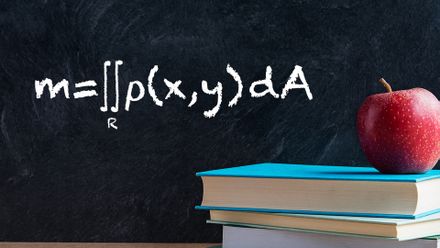
Applying new methods of evaluating integrals over a region to the realm of physics; learning the formulas for mass and moments of mass for a planar lamina of variable density; finding the center of mass for these regions.
S1:E22 • May 9, 2014 • 30m
Bringing another fundamental idea of calculus into three dimensions by expanding arc lengths into surface areas; reviewing arc length and surfaces of revolution; the formulas for surface area and the differential of surface area over a region.
S1:E23 • May 9, 2014 • 31m
Taking the next step to triple integrals, which can be used to find the volume of a solid in space; extrapolating the density of planar lamina to volumes defined by triple integrals; evaluating density in the form of mass per unit of volume.
S1:E24 • May 9, 2014 • 29m
Exploring the immediate extension of double integrals into volumes with cylindrical coordinates, moving from a surface defined by (r,?) to a cylindrical volume with an extra parameter defined by (r,?,z); using these conversions to simplify problems.
S1:E25 • May 9, 2014 • 31m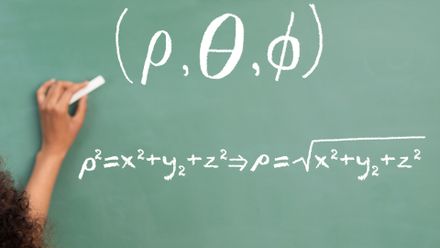
Observing how spherical coordinates often yield more useful information in a more concise format than other coordinate systems; how they are essential in evaluating triple integrals over a spherical surface.
S1:E26 • May 9, 2014 • 30m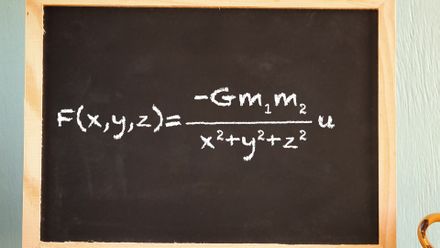
An introduction to vector fields; their role in describing gravitational and electric fields; learning the definition of a conservative vector field using the gradient vector; calculating the potential of a conservative vector field on a plane.
S1:E27 • May 9, 2014 • 30m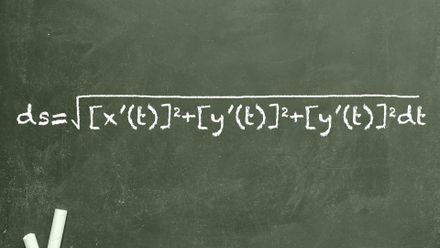
Using the gradient vector to find the curl and divergence of a field, both of which describe the rotation and movement of a particle in these fields; exploring the line integral, which is used to evaluate a density function over a curved path.
S1:E28 • May 9, 2014 • 31m
One of the most important applications of the line integral is its ability to calculate work done on an object as it moves along a path in a force field, learning how vector fields make the orientation of a path significant.
S1:E29 • May 9, 2014 • 31m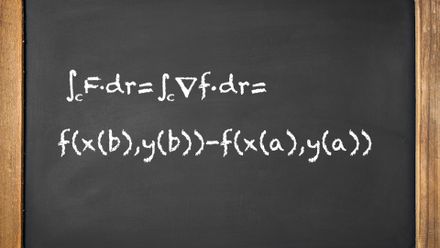
Generalizing the fundamental theorem of calculus; the key properties of curves in space; learning what makes a curve smooth, piecewise-smooth, simple and closed; manipulating curves to reveal new, simpler methods of evaluating some line integrals.
S1:E30 • May 9, 2014 • 31m
Using one of the most important theorems in multivariable calculus to observe how a line integral can be equivalent to an often more-workable area integral; why the line integral around a closed curve is equal to zero in a conservative vector field.
S1:E31 • May 9, 2014 • 31m
Transforming difficult line integrals quickly and efficiently into more approachable double integrals; learning an alternative form of Green's theorem that generalizes to some important upcoming theorems.
S1:E32 • May 9, 2014 • 30m
Extending one's understanding of surfaces by defining them in terms of parametric equations; learning to graph parametric surfaces; learning to calculate surface area.
S1:E33 • May 9, 2014 • 32m
Discovering the surface integral and a special case known as the flux integral; evaluating the surface integral as a double integral; continuing the study of fluid mechanics by utilizing this integral to evaluate flux in a vector field.
S1:E34 • May 9, 2014 • 31m
The Divergence theorem, a hallmark of multivariable calculus, combines flux and triple integrals; discovering the divergence of a fluid; calling upon the gradient vector to define how a surface integral over a boundary can give the volume of a solid.
S1:E35 • May 9, 2014 • 29m
Developing Stokes's theorem, the third capstone relationship between the new integrals of multivariable calculus; seeing how a line integral equates to a surface integral; connections to Maxwell's equations for electric and magnetic fields.
S1:E36 • May 9, 2014 • 34mMore Like This
 TVPG • 1 season
 TV14 • 1 season
 TVPG • 1 season
 TVPG • 4 seasons
 TVPG • 1 season
 TVPG • 1 season
 TVPG • 1 season
 TVPG • 1 season
 TVPG • 1 season
 TVPG • 1 season
 UR • 1 season
 TVPG • 1 season
 TVPG • 1 season
 TVPG • 1 season
 TVPG • 1 season
 TVPG • 1 season
 TVPG • 1 season
 TVPG • 1 season
 TVPG • 1 season
 TVPG • 1 season