

The Roman Empire: From Augustus to the Fall of Rome
S1:E18 Chariot Racing, Spectacles, and Theater
Chariot racing is the most popular sport in the Roman Empire; going inside the Circus Maximus; learning about the factions and teams of chariot racers; paying attention to the world of the theater, where plays, mimes and music entertain the masses.
Already subscribed?
Sign in
Setting the stage for Rome's transition from a republic to an empire; Octavian wins a civil war against Mark Antony; he soon achieves what Julius Caesar could not, a one-man rule over Rome.
S1:E1 • Jan 4, 2019 • 35m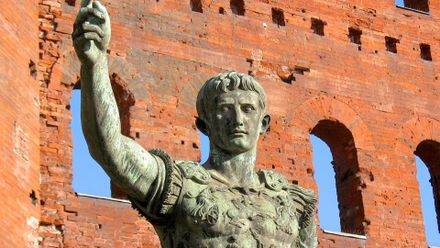
Meeting Octavian, who becomes Rome's first emperor; he takes the title of Augustus; gaining control of the military; ruling Rome without inspiring his own assassination; how these are some of history's most astonishing feats.
S1:E2 • Jan 4, 2019 • 32m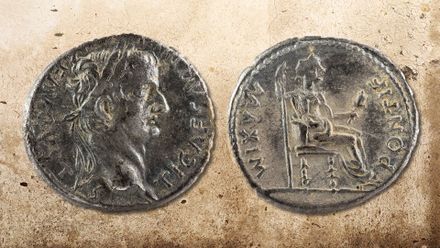
Despite his achievements, Augustus fails in the key area of choosing a successor; after an almost comical series of events, he secures a male heir to take the throne; witnessing the debacle of Roman leadership under Tiberius and Caligula.
S1:E3 • Jan 4, 2019 • 32m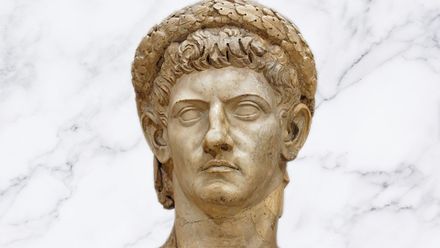
The succession after Caligula continues to be a problem for the Roman Empire; Claudius, though physically challenged, is a good administrator; Nero is depraved and self-aggrandizing, nearly bankrupting the empire; tracing the story of their rule.
S1:E4 • Jan 4, 2019 • 31m
After Nero's reign, Vespasian is the first in the line of Flavian family emperors; reviewing their stories, accomplishments and shortcomings; Professor Aldrete offers insight into Roman bath culture; what it means for the city.
S1:E5 • Jan 4, 2019 • 31m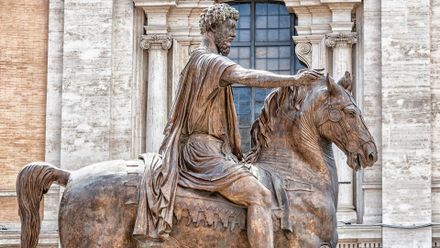
A look at the rulers of the 2nd century, including Trajan, Hadrian and Marcus Aurelius; their stories; their approach to ruling; their achievements, which include Trajan's military conquests and Marcus Aurelius's philosophical meditations.
S1:E6 • Jan 4, 2019 • 33m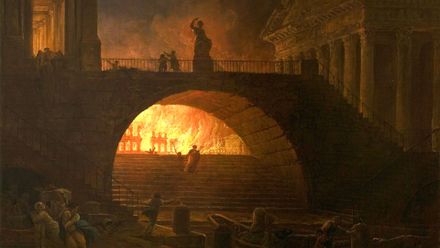
One might think of Rome as a city filled with shining marble and toga-clad citizens; in reality, the city is a disease-ridden mess with filth in the streets and a fire occurring nearly every night; what life is like for Rome's ordinary citizens.
S1:E7 • Jan 4, 2019 • 31m
Reflecting on the Etruscan and Greek influences on Roman portraits and sculptures; how Augustus uses art as propaganda; learning about some of the many architectural and engineering innovations, including the Pantheon and the aqueducts.
S1:E8 • Jan 4, 2019 • 32m
By the time of the Empire, Roman writers come into their own; studying the rhetoric of Cicero; the poetry of Horace and Ovid; Virgil's epic about Rome's founding, the "Aeneid"; reviewing histories, technical works and writings on Christianity.
S1:E9 • Jan 4, 2019 • 32m
The traditional understanding of Rome is based on accounts by upper-class males; more recent historians look at new sources to gain a fuller sense of the city's history; examining graffiti preserved at Pompeii to hear directly from everyday Romans.
S1:E10 • Jan 4, 2019 • 31m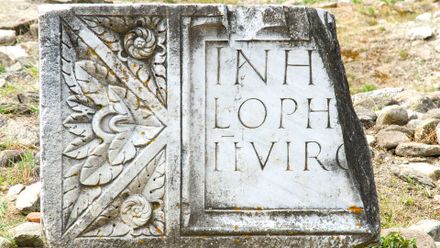
A look at the epitaphs on Roman tombstones; while elaborate tombs are reserved for the very rich, people of all social classes have their thoughts and stories inscribed on tombstones; exploring how the Romans bury their dead.
S1:E11 • Jan 4, 2019 • 30m
Marcus Aurelius appoints his son Commodus as heir, who turns out to be a throwback to the megalomania of Caligula and Nero; Emperor Septimius Severus provides a short period of stability; his son, Caracalla, is yet another unbalanced ruler.
S1:E12 • Jan 4, 2019 • 32m
The empire hits a low point with Elagabalus, who is arguably the worst Roman emperor of all; Rome teeters on the brink of total collapse due to a deadly combination of civil war, barbarian invasions, economic collapse and natural disasters.
S1:E13 • Jan 4, 2019 • 31m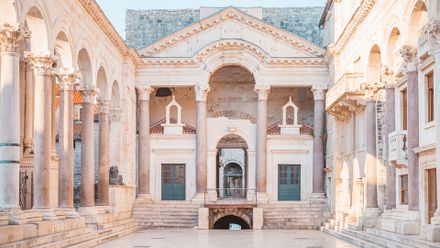
Just when the Roman Empire seems on the verge of collapse, a series of hard-headed, practical emperors manage to rescue it; the story of how these men, led by the reformer Diocletian, drive back the barbarians and stabilize the faltering Empire.
S1:E14 • Jan 4, 2019 • 32m
At the dawn of the fourth century, Christianity emerges as a major world force; Constantine's dramatic and unexpected conversion; how and why Christianity develops and spreads; the role it plays in subsequent political events.
S1:E15 • Jan 4, 2019 • 32m
A closer look at Constantine; his motivations for converting to Christianity; learning about the Arian Controversy and the Council of Nicaea; why Constantine founds a new capital city at Byzantium; the state of the empire at the end of his life.
S1:E16 • Jan 4, 2019 • 32m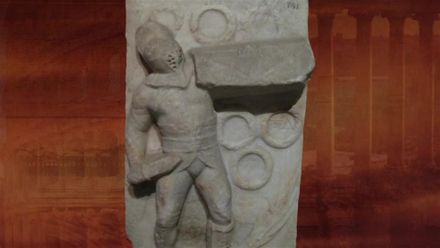
Gladiators dominate popular imagination when it comes to ancient Rome; gladiator combat is only one of many popular entertainments in the empire; who the gladiators are; what their lives are like; turning to the popular contest of the beast hunt.
S1:E17 • Jan 4, 2019 • 32m
Chariot racing is the most popular sport in the Roman Empire; going inside the Circus Maximus; learning about the factions and teams of chariot racers; paying attention to the world of the theater, where plays, mimes and music entertain the masses.
S1:E18 • Jan 4, 2019 • 32m
A detailed look at the Roman military; the organization of Rome's fighting forces; seeing what kind of equipment soldiers are outfitted with; how they train; what joining the military means for farm boys in the provinces.
S1:E19 • Jan 4, 2019 • 32m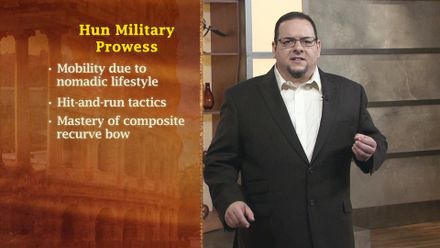
From the third to the fifth centuries, Rome experiences an increasing wave of invasions by outsiders; Professor Aldrete introduces the Huns, the Visigoths, the Vandals and other invaders who penetrate Rome's borders and plunder the empire.
S1:E20 • Jan 4, 2019 • 31m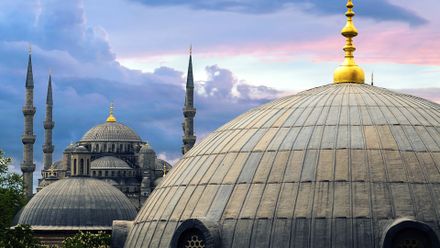
While the Roman Empire's western half collapses, the eastern Romans in the Byzantine Empire flourish; visiting the world of Constantinople; meeting fascinating figures such as Justinian and Theodora; what makes the Byzantine Empire so successful.
S1:E21 • Jan 4, 2019 • 32m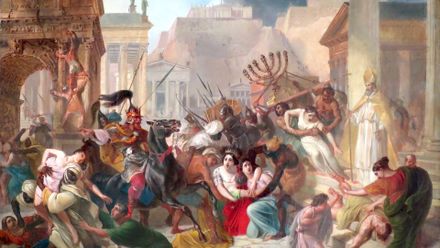
Generations of historians struggle over and disagree about the fundamental questions of when and why the Roman Empire falls; critically evaluating a wide range of possible answers to these complex and enduring questions.
S1:E22 • Jan 4, 2019 • 32m
Traditionally, historians view the years 200 to 600 as a time of collapse and stagnation, the end of Rome and the arrival of the "Dark Ages"; recent historians see a time of invigorating change, a mingling of cultures and an exciting transition.
S1:E23 • Jan 4, 2019 • 34m
Considering the legacy of the Roman Empire, which influences people in innumerable ways; Professor Aldrete closes with a few final voices to keep everyday Romans alive; a reflection on what they might say today.
S1:E24 • Jan 4, 2019 • 38m