

A History of India
The lands east of the Indus River are a historical hub for trade and culture; the subcontinent contains 20 percent of the world's population; it is an economic powerhouse; a survey of South Asia from its earliest societies through the 21st century.
Already subscribed?
Sign in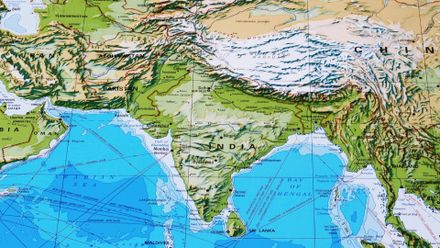
Beginning one's study millions of years ago; plate tectonics shape the subcontinent's mountains, plateaus and river systems; these affect the region's aspects; reviewing South Asia's four macro-regions; how geography guides the course of life.
S1:E1 • Apr 29, 2016 • 33m
Three main cultures inhabit the ancient Indian subcontinent; studying the Adivasi, who once comprise the entirety of South Asia's population; how genetic and linguistic analysis shows the Adivasi of 30,000 years ago; their status in India today.
S1:E2 • Apr 29, 2016 • 34m
Turning to the urban people of the Indus Valley; many mysteries abound regarding this long-lost Bronze Age civilization; exploring excavated cities; examining art and artifacts; what people know about this society; what may have happened to them.
S1:E3 • Apr 29, 2016 • 31m
Exploring the ancient foundations of Hinduism, which emerge from people who identify themselves with the Vedas; studying these poems and hymns; the civilization's culture and cosmology; the origins and development of the Indo-European language.
S1:E4 • Apr 29, 2016 • 31m
The Vedic caste system is one of the most well-known and misunderstood aspects of Hindu society; the ancient Vedic social order; how it structures society; how numerous inherited social groups relate to occupation; a diverse and complex society.
S1:E5 • Apr 29, 2016 • 30m
Delving into the Ramayana, the first Indian epic, the story of Prince Rama, his faithful wife Sita and the gods that control their lives; it is also an important source for many of the historical details about the era.
S1:E6 • Apr 29, 2016 • 31m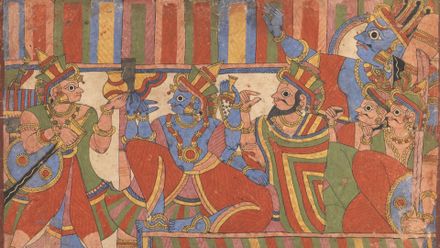
Turning to the Mahabharata, the longest major text in human history, Professor Fisher surveys its sources and style, its plot and what it means from the "emic" perspective of Indians and the "etic" perspective of outsiders.
S1:E7 • Apr 29, 2016 • 30m
Exploring the origins and context for the Bhagavad Gita; the complexities of philosophy and religion that the narrative contains; why it resonates throughout Indian history and around the world; how its wisdom is still the basis for Hinduism.
S1:E8 • Apr 29, 2016 • 28m
In 500 B.C.E., the old Vedic social order changes as the merchant classes begin to achieve upward mobility; alternative religious models emerge to compete with the Vedic cosmology; surveying Jainism's origins and philosophy.
S1:E9 • Apr 29, 2016 • 30m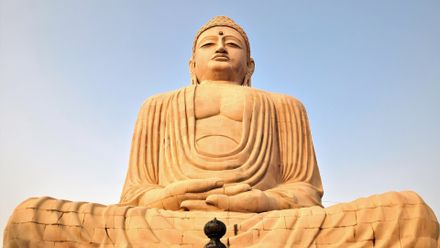
The year 500 B.C.E. sees the adoption of Buddhism as an alternative to the Vedic tradition; the life of Siddhartha Gautama; the tenets of his philosophy, including the Four Noble Truths; how these ideas develop and spread across Asia.
S1:E10 • Apr 29, 2016 • 29m
Around the time Jainism and Buddhism begin challenging the old social order, Chandragupta is able to consolidate and form the subcontinent's first major empire; the trajectory of his life; the conditions that allow him to build the Mauryan Empire.
S1:E11 • Apr 29, 2016 • 31m
Continuing the study of the Mauryan Empire with Chandragupta's grandson, Emperor Ashoka, a famous individual from ancient India; Ashoka becomes a Buddhist and a benevolent ruler after consolidating his territory in a vicious war.
S1:E12 • Apr 29, 2016 • 30m
Brahmin culture is not as strong in southern India as it is in the north; a diverse range of societies flourish on the Deccan plateau; explaining some of the region's historical trends; the features and interactions of a few southern kingdoms.
S1:E13 • Apr 29, 2016 • 31m
Many regional dynasties emerge across the north and northwest; unpacking the history of these two macro-regions; learning about several of the major ethnic groups; the Silk Road trade routes; ending with a study of the Gupta dynasty.
S1:E14 • Apr 29, 2016 • 31m
At the turn of the Common Era, the Brahmins work to rebuild their cultural prominence; they formally develop what is Hinduism today; a series of written manuals lay out the principles of an ideal life, including notions of dharma, kama and artha.
S1:E15 • Apr 29, 2016 • 30m
South Asia incorporates numerous communities of outsiders who come to the subcontinent via the coasts or across the mountains; exploring the worlds of Parsis, Jews and Christians in India; seeing how they interact with Hindu society.
S1:E16 • Apr 29, 2016 • 30m
Islam has a profound impact on South Asia; surveying the history and pillars of Islam; its origins in the Middle East; Professor Fisher examines how many people of South Asia become Muslim via trade, invasion, devotion or personal motivation.
S1:E17 • Apr 29, 2016 • 30m
The binary opposition between Hindus and Muslims oversimplifies a complex relationship; studying this relationship by meeting prominent Muslim rulers from the ninth to the 16th centuries; exploring their kingdoms throughout India; their legacies.
S1:E18 • Apr 29, 2016 • 31m
Examining the Mughal Empire; meeting a Central Asian adventurer named Babur, who rides into South Asia from Kabul and conquers the Delhi sultanate; the checkered career of his son, who almost loses the empire before it gets started.
S1:E19 • Apr 29, 2016 • 33m
Tracing the rule of Emperor Akbar; he establishes the empire thanks to several key initiatives; drawing regional rulers into his army; encouraging interreligious marriage; transforming the administrative system; creating an imperial ideology.
S1:E20 • Apr 29, 2016 • 35m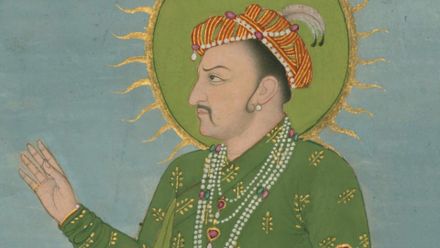
Following the rise of Akbar's son, Jahangir, he introduces many innovations to the subcontinent during his rule; Jahangir's son, Shah Jahan, then constructs the Peacock Throne, the Taj Mahal and other architectural triumphs.
S1:E21 • Apr 29, 2016 • 33m
The slow decline of the Mughal Empire during the reign of Emperor Alamgir; as he ages, he draws the empire into war with the Deccan-based Marathas, watching as the Marathas humiliate the Mughals and establish their own regional identity.
S1:E22 • Apr 29, 2016 • 32m
European traders begin arriving on the Indian coast to establish global companies; surveying Portugal's 200-year dominance of trade; Professor Fisher shows how the English eventually establish their own foothold in the market.
S1:E23 • Apr 29, 2016 • 29m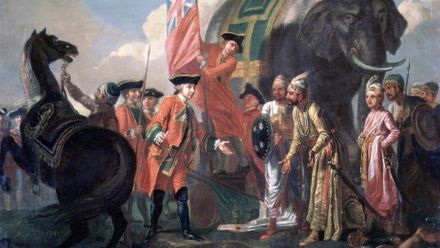
Witnessing the rise of the British East India Company; how it coincides with the rise of British imperialism; the greater British influence and control of South Asia; an inside look at these radical developments in the 18th and 19th centuries.
S1:E24 • Apr 29, 2016 • 32m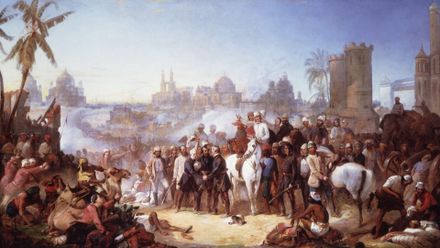
Tensions between the British and the South Asians comes to a boil in 1857 when a group of Indian soldiers rise up against the British army; the context and historical impact of this year, which forever changes the nature of British rule in India.
S1:E25 • Apr 29, 2016 • 29m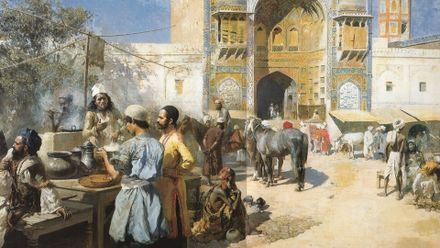
A detailed look at the British Raj, a period of colonialism that stretches from the 1857 uprising to the region's independence in 1947; insight into Britain's racist policies; the beginnings of the subcontinent's struggle for political autonomy.
S1:E26 • Apr 29, 2016 • 31m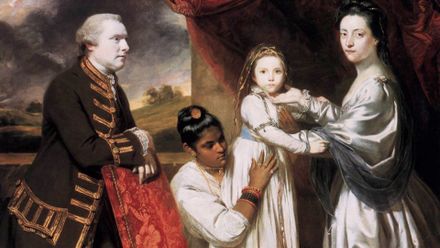
South Asians who leave the subcontinent contribute significantly to the cultural exchange among China, continental Europe and Great Britain; Indian immigrants in Britain find greater freedom; the impact of South Asians throughout the world.
S1:E27 • Apr 29, 2016 • 31m
Learning about the life of political activist Mohandas "Mahatma" Gandhi; tracing his life from his young manhood in India to his education in Britain and his activism in South Africa and India; an admirable but complex figure emerges.
S1:E28 • Apr 29, 2016 • 29m
Many of Gandhi's contemporaries offer other ways to promote the rights of lower classes and Muslims; Meeting Bhimrao Ramji Ambedkar, Subhas Chandra Bose and Muhammad Ali Jinnah; their approaches toward national independence and people's rights.
S1:E29 • Apr 29, 2016 • 30m
After World War II, a tense series of events leads to the subcontinent's partition into India and Pakistan; how the British cede their empire and hastily create two nation-states whose borders and contested identities leave a troubled legacy.
S1:E30 • Apr 29, 2016 • 30m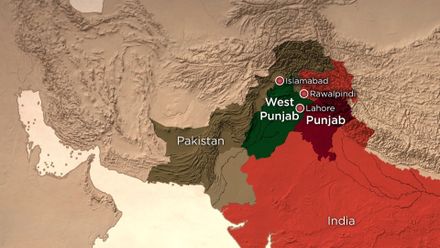
Between 1947 and 1971, Pakistan is a divided state separated into East and West; the early years of the nation see numerous coups and uprisings, as well as border wars with India; the role geography and ethnicity play in the distribution of power.
S1:E31 • Apr 29, 2016 • 28m
Reviewing the story of Pakistan from 1971 to the present; surveying one shift of power after another; meeting leaders such as General Zia, Benazir Bhutto, General Musharraf and Nawaz Sharif; a complete sense of Pakistani history through today.
S1:E32 • Apr 29, 2016 • 30m
Bangladesh is partitioned three times in the 20th century, first by the British in 1905, then during independence in 1947 and finally from Pakistan in 1971; this relatively young nation's turbulent history; some of its contemporary challenges.
S1:E33 • Apr 29, 2016 • 29m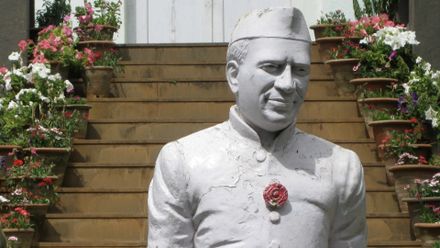
Unlike Pakistan and Bangladesh, India becomes a secular state after its 1947 independence; an examination of the nation's early years; Prime Minister Jawaharlal Nehru's vision to transform the nation; some of his successful economic programs.
S1:E34 • Apr 29, 2016 • 31m
Following the careers of Indira Gandhi and her children, who led India through many changes in the late 20th century; the State of Emergency; the rise of ethnic political organizations; the nuclear arms race with Pakistan; transitions of leadership.
S1:E35 • Apr 29, 2016 • 29m
India, Pakistan and Bangladesh make up 20 percent of the world's population; the subcontinent is a rising global economic powerhouse; recapping major themes; looking at the condition of the region in the 21st century; developments on the horizon.
S1:E36 • Apr 29, 2016 • 34mMore Like This
 TVPG • 1 season
 TVPG • 1 season
 TVPG • 1 season
 TVPG • 1 season
 TVPG • 1 season
 TVPG • 1 season
 TVPG • 1 season
 TVPG • 1 season
 TVPG • 1 season
 TVPG • 1 season
 TV14 • 1 season
 TVPG • 1 season
 TVPG • 1 season
 TVPG • 1 season
 TVPG • 1 season
 TVPG • 1 season
 TVPG • 1 season
 TVPG • 1 season
 TVPG • 1 season
 TVPG • 1 season