

Games People Play: Game Theory in Life, Business, and Beyond
In an exhaustive 24-part course, an award-winning professor explains how the precepts of game theory can help individuals make better decisions in life.
Already subscribed?
Sign in
The professor presents a challenging dilemma to introduce game theory to learners.
S1:E1 • Oct 30, 2008 • 32m
Players, strategies and payoffs are the building blocks of game theory.
S1:E2 • Oct 30, 2008 • 30m
While teaching the construction of a game tree, the professor acquaints learners with one of game theory's key concepts.
S1:E3 • Oct 30, 2008 • 31m
There are four classic two-player games.
S1:E4 • Oct 30, 2008 • 31m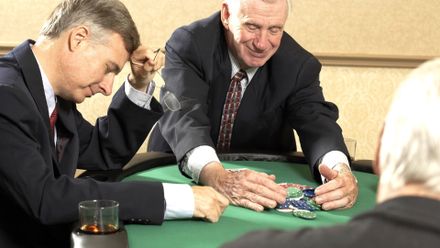
Individuals must learn to represent simultaneous move games and acquire the tools to solve them.
S1:E5 • Oct 30, 2008 • 30m
A lower stock bid can outperform a higher one, just as being blackmailed can sometimes prove beneficial.
S1:E6 • Oct 30, 2008 • 31m
Individuals can use probability to determine the expected or average payoff value.
S1:E7 • Oct 30, 2008 • 31m
It is challenging, although not impossible, to steer clear of second-guessing in a two-person game.
S1:E8 • Oct 30, 2008 • 31m
Individuals must apply recently learned techniques in nonzero-sum games.
S1:E9 • Oct 30, 2008 • 30m
Individuals must fulfil certain requirements for the success of their three strategic moves.
S1:E10 • Oct 30, 2008 • 30m
Depending on the context of the game, players can resort to threats, promises, or commitments to enhance credibility, deterrence, and compellence.
S1:E11 • Oct 30, 2008 • 31m
There are times when certain events or decisions are known to only one player.
S1:E12 • Oct 30, 2008 • 30m
Players can use various means to convey, elicit or guard information in an asymmetric game.
S1:E13 • Oct 30, 2008 • 31m
Whether in business or daily life, one can achieve desired outcomes by influencing others.
S1:E14 • Oct 30, 2008 • 31m
Repeated interactions have a considerable impact on the development of an optimal strategy.
S1:E15 • Oct 30, 2008 • 30m
The professor tries to establish whether game theory can model real-life behavior.
S1:E16 • Oct 30, 2008 • 31m
The professor discusses a multiplayer version of the Prisoner's Dilemma.
S1:E17 • Oct 30, 2008 • 30m
According to one perspective, successful strategies are chosen and shared over time.
S1:E18 • Oct 30, 2008 • 31m
A monopolist dictates the best production levels until other competitors come into play.
S1:E19 • Oct 30, 2008 • 30m
Individuals can use game theory to evaluate voting systems.
S1:E20 • Oct 30, 2008 • 31m
It is crucial to identify the most suitable type of auction based on the participants' goals.
S1:E21 • Oct 30, 2008 • 31m
Players must find a fair way to divide payoffs.
S1:E22 • Oct 30, 2008 • 30m
The professor discusses the practical applications of game theory in business decision-making.
S1:E23 • Oct 30, 2008 • 31m
The professor provides insight into rules, tactics, and scope with respect to co-opetition.
S1:E24 • Oct 30, 2008 • 31mMore Like This
 TV14 • 2 seasons
 TVPG • 1 season
 TVPG • 1 season
 TV14 • 1 season
 TVPG • 1 season
 TV14 • 1 season
 2010 • PG13 • 1h 26mDetails
 TVPG • 1 season
 TVPG • 1 season
 TVPG • 1 season
 TVPG • 1 season
 TVPG • 1 season
 TVPG • 1 season
 TVPG • 1 season
 TVPG • 1 season
 TVPG • 1 season
 G • 1 season
 TVPG • 1 season
 TVPG • 1 season
 TVPG • 1 season