

Algebra I
A new course designed to meet the concerns of both students and their parents; making the concepts of first-year algebra easy to grasp; an ideal tutor for anyone wanting to learn algebra from the beginning, or for anyone needing a thorough review.
Already subscribed?
Sign in
Professor Sellers introduces the general topics and themes; describing his approach; a strategy for making the best use of the lessons and supplementary workbook; warming up with simple problems that demonstrate signed numbers and operations.
S1:E1 • Nov 9, 2009 • 33m
The order in which one does simple operations of arithmetic can make a big difference; how to solve problems that combine adding, subtracting, multiplying and dividing; raising numbers to various powers; simplifying algebraic expressions.
S1:E2 • Nov 9, 2009 • 30m
Exploring various procedures for converting between percents, decimals and fractions; Professor Sellers notes that it helps to see these procedures as ways of presenting the same information in different forms.
S1:E3 • Nov 9, 2009 • 30m
Using variables as building blocks to create algebraic expressions, which are combinations of mathematical symbols that might include numbers, variables and operation symbols; tricks for translating the language of problems into the language of math.
S1:E4 • Nov 9, 2009 • 30m
By following basic rules on how to treat coefficients and exponents, one can simplify complicated algebraic expressions; using the commutative property of multiplication to rearrange the terms of an expression, making combining them relatively easy.
S1:E5 • Nov 9, 2009 • 31m
Exploring the coordinate plane, also known as the Cartesian plane, using graph paper and a pencil; how to plot points in the four quadrants of the plane; how to choose a scale for labeling the x and y axes; how to graph a linear equation.
S1:E6 • Nov 9, 2009 • 28m
Working through simple one- and two-step linear equations; learning how to isolate the variable by different operations; Professor Sellers also presents a word problem involving a two-step equation and gives tips on how to solve it.
S1:E7 • Nov 9, 2009 • 30m
Investigating more complicated examples of linear equations; learning that linear equations fall into three categories; first, the equation might have exactly one solution; second, it might have no solutions at all; third, it might be an identity.
S1:E8 • Nov 9, 2009 • 29m
Exploring the concept of a slope, which for a given straight line is its rate of change, defined as the rise over run; the formula for calculating a slope with coordinates only; what it means to have a positive, negative and undefined slope.
S1:E9 • Nov 9, 2009 • 28m
Graphing linear equations in the slope-intercept form, y = mx + b, where m is the slope and b is the y intercept; experimenting with examples in which one calculates the equation from a graph and from a table of pairs of points.
S1:E10 • Nov 9, 2009 • 31m
A more versatile approach to writing the equation of a line is the point-slope form, in which only two points are required and neither needs to intercept the y axis; several examples; determining the equation using the line, and vice versa.
S1:E11 • Nov 9, 2009 • 30m
Applying equations of lines to parallel and perpendicular lines; how to tell if lines are parallel or perpendicular from their equations alone, without having to see the lines themselves; word problems that feature both types of lines.
S1:E12 • Nov 9, 2009 • 31m
Linear equations reflect the behavior of real-life phenomena; practicing evaluating tables of numbers to determine if they can be represented as linear equations; concluding with an example about the yearly growth of a tree.
S1:E13 • Nov 9, 2009 • 31m
Investigating more real-world applications of linear equations; deriving the formula for converting degrees Celsius to Fahrenheit; determining the boiling point of water in Denver, Colorado; calculating the speed and time of various objects.
S1:E14 • Nov 9, 2009 • 30m
When two lines intersect, they form a system of linear equations; discovering two methods for finding a solution to such a system, which are by graphing and by substitution; a real-world example involving a farmer who wants to plant different crops.
S1:E15 • Nov 9, 2009 • 30m
Expanding the tools for solving systems of linear equations by exploring the method of solving by elimination; this technique allows people to eliminate one variable by performing addition, subtraction or multiplication on both sides of an equation.
S1:E16 • Nov 9, 2009 • 32m
Considering linear inequalities, which are mathematical expressions featuring a less-than sign or a greater-than sign instead of an equal sign; these kinds of problems have interesting twists and come up frequently in business applications.
S1:E17 • Nov 9, 2009 • 31m
Transitioning to a more complex type of algebraic expression, which incorporates squared terms and is therefore known as quadratic; how to use the FOIL method to multiply linear terms to get a quadratic expression.
S1:E18 • Nov 9, 2009 • 31m
Finding solutions for quadratic equations; starting with the FOIL technique in reverse to find the binomial factors of a quadratic trinomial; Professor Sellers explains the tricks of factoring such expressions, which is almost like solving a mystery.
S1:E19 • Nov 9, 2009 • 31m
In some circumstances, quadratic expressions are given in a special form that allows them to be factored quickly; focusing on two such forms, which are perfect square trinomials and the differences of two squares; learning to recognize these cases.
S1:E20 • Nov 9, 2009 • 32m
For cases that defy simple factoring, the quadratic formula provides a technique for solving quadratic equations; discovering that this expression is not as difficult as it appears to be; how to determine if a quadratic equation has no solutions.
S1:E21 • Nov 9, 2009 • 30m
Investigating an additional approach to solving quadratic equations, which is completing the square; this technique is very useful when rewriting the equation of a quadratic function in such a way that the graph of the function is easily sketched.
S1:E22 • Nov 9, 2009 • 31m
Analyzing the parabolic shapes produced by quadratic functions when represented on a graph; using algebraic skills to determine the parabola's vertex, its x and y intercepts, and whether it opens in an upward "cup" or downward in a "cap".
S1:E23 • Nov 9, 2009 • 29m
Quadratic functions often arise in real-world settings; exploring a number of problems, which include calculating the maximum height of a rocket; learning that graphing can often help in finding a solution.
S1:E24 • Nov 9, 2009 • 32m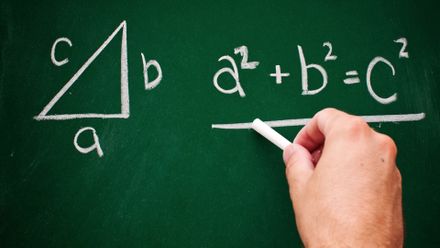
Because it involves terms raised to the second power, the famous Pythagorean theorem is actually a quadratic equation; how techniques for analyzing quadratic functions can be used to solve problems involving right triangles.
S1:E25 • Nov 9, 2009 • 31m
What characterizes a polynomial; how to recognize polynomials in both algebraic functions and in graphical form; Professor Sellers defines several terms, including the degree of an equation, the leading coefficient and the domain.
S1:E26 • Nov 9, 2009 • 31m
The role of linear and quadratic expressions in adding, subtracting, multiplying and dividing polynomials; how the FOIL operation can be used to multiply large polynomials; a version of long division works for dividing one polynomial by another.
S1:E27 • Nov 9, 2009 • 30m
When one polynomial is divided by another, the result is called a rational function because it is the ratio of two polynomials; rational functions play an important role in algebra; how to add and subtract rational functions.
S1:E28 • Nov 9, 2009 • 30m
Multiplying and dividing rational expressions; the key to solving these complicated-looking equations is to proceed one step at a time; closing the lesson with a problem that brings together all one has learned about rational functions.
S1:E29 • Nov 9, 2009 • 32m
Examining the distinctive graphs formed by rational functions, which may form vertical or horizontal curves that are not even connected on a graph; learning to identify the intercepts and the vertical and horizontal asymptotes of these curves.
S1:E30 • Nov 9, 2009 • 31m
Sketching the graphs of several rational functions by calculating the vertical and horizontal asymptotes, the x and y intercepts, and then plotting several points in the function; simplifying the expression to extract the needed information.
S1:E31 • Nov 9, 2009 • 32m
What mathematicians call a radical; how to simplify radical expressions; how to perform operations on them, such as multiplication, division, addition and subtraction, as well as combinations of these operations.
S1:E32 • Nov 9, 2009 • 32m
How to solve equations that contain radical expressions; isolating the radical term and squaring both sides; it is important to check the solution by plugging it into the equation to see if it makes sense; how this is true for radical equations.
S1:E33 • Nov 9, 2009 • 32m
Moving from radical functions to the graphs that display them; it is important to pay attention to the domain of the functions to ensure that negative values are not introduced beneath the root symbol.
S1:E34 • Nov 9, 2009 • 32m
Pattern recognition is an important mathematical skill; investigating two types of number patterns, which are geometric sequences and arithmetic sequences; how to analyze such patterns and work out a formula that predicts any term in the sequence.
S1:E35 • Nov 9, 2009 • 32m
Concluding by examining more types of number sequences; discovering how rich and enjoyable the mathematics of pattern recognition can be; employing reasoning skills and algebra to find order and beauty in a sea of confusing numbers.
S1:E36 • Nov 9, 2009 • 33mMore Like This
 TVPG • 1 season
 TVPG • 1 season
 TVPG • 1 season
 TVPG • 1 season
 TVPG • 1 season
 TVPG • 1 season
 TVPG • 1 season
 TVPG • 1 season
 TVPG • 1 season
 TVPG • 1 season
 TVPG • 1 season
 TVPG • 1 season
 TVPG • 1 season
 TVPG • 1 season
 TVPG • 1 season
 TVPG • 1 season
 TVPG • 1 season
 TVPG • 1 season
 TVPG • 1 season
 TVPG • 1 season