

Understanding the Universe: An Introduction to Astronomy, 2nd Edition
S1:E53 Exploding Stars-Celestial Fireworks!
In boundless space, there exist infinite stars with a long, albeit, limited lifespan. While dying, some of them explode so intensely that they appear as bright as an entire galaxy.
Already subscribed?
Sign in
Embarking on a journey through the universe, starting with a whirlwind tour of its wonders.
S1:E1 • Jan 22, 2007 • 34m
The science behind the creation of rainbows and their appearance under various circumstances.
S1:E2 • Jan 22, 2007 • 30m
Examining various sunrise and sunset-related phenomena, including the elusive green flash.
S1:E3 • Jan 22, 2007 • 32m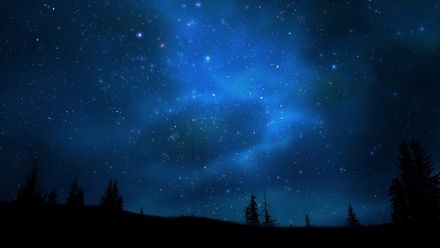
Even in urban areas, certain celestial objects in the night sky are visible to the naked eye.
S1:E4 • Jan 22, 2007 • 31m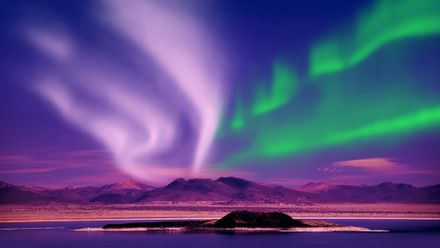
Far from city lights, the night sky offers occasional sightings of the Milky Way and comets.
S1:E5 • Jan 22, 2007 • 31m
Using binoculars and telescopes to study a diverse range of celestial objects.
S1:E6 • Jan 22, 2007 • 30m
The science behind the varying appearances of the sky in different geographical regions.
S1:E7 • Jan 22, 2007 • 33m
Debunking a popular myth and unraveling the true cause of changing seasons on the Earth.
S1:E8 • Jan 22, 2007 • 31m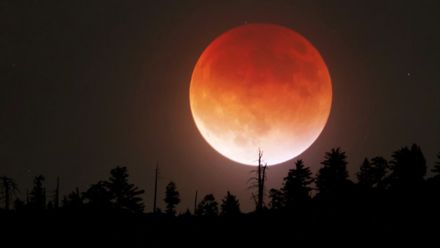
Eerie lunar eclipses happen when the Earth, the Sun, and the Moon are in near-perfect alignment.
S1:E9 • Jan 22, 2007 • 30m
Delving into the various rare phenomena associated with total solar eclipses.
S1:E10 • Jan 22, 2007 • 31m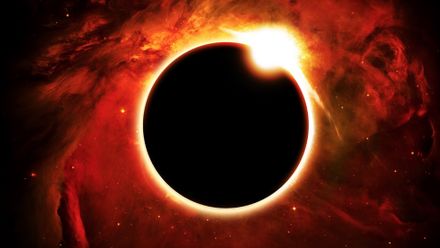
Depending on the changing distance between the Moon and Earth, solar eclipses can be either annular or hybrid.
S1:E11 • Jan 22, 2007 • 31m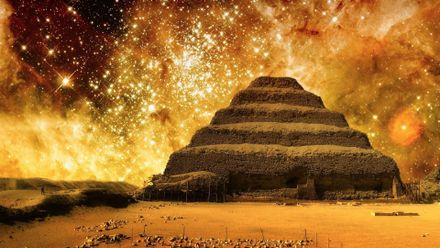
Tracing the origins of astronomy in several ancient civilizations across the Middle East and Asia.
S1:E12 • Jan 22, 2007 • 29m
Studying the Ptolemaic and Aristotelian geocentric models of the universe.
S1:E13 • Jan 22, 2007 • 30m
Exploring the rise of the heliocentric system, in which all the planets orbit the Sun.
S1:E14 • Jan 22, 2007 • 31m
Studying Tycho's and Kepler's refinements in the Copernican model.
S1:E15 • Jan 22, 2007 • 31m
Newton's laws of motion and universal gravitation are his revolutionary contributions to astronomy.
S1:E16 • Jan 22, 2007 • 32m
Across the boundless expanse of the Universe, the speed of light plays a major role in the human understanding of time and space.
S1:E17 • Jan 22, 2007 • 31m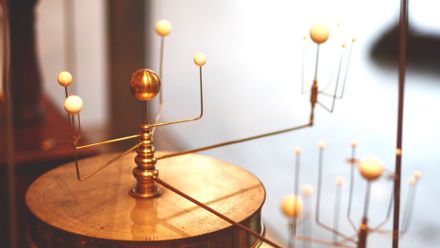
A step-by-step investigative approach can help comprehend the size of the Universe.
S1:E18 • Jan 22, 2007 • 31m
Astronomers rely heavily on the analysis of light to unravel the secrets of the Universe.
S1:E19 • Jan 22, 2007 • 31m
Exploring the duality between electromagnetic waves and particles.
S1:E20 • Jan 22, 2007 • 30m
The surface temperature plays a critical role in giving a star a particular color.
S1:E21 • Jan 22, 2007 • 31m
While transitioning energy levels in atoms, electrons emit and absorb photons uniquely in different elements. This enables astronomers to deduce the compositions of distant objects by analyzing their emitted light.
S1:E22 • Jan 22, 2007 • 31m
Modern telescopes provide huge light-gathering mirrors at a relatively low cost.
S1:E23 • Jan 22, 2007 • 31m
Studying how human visibility across the Universe has improved with the use of radio frequency, adaptive optics and other advancements in various modern telescopes.
S1:E24 • Jan 22, 2007 • 31m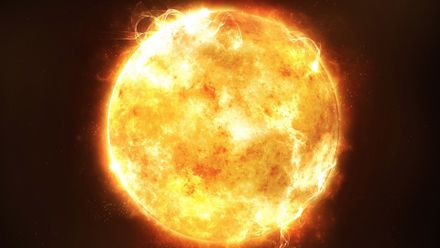
Exploring the Sun from the interior to the surface.
S1:E25 • Jan 22, 2007 • 30m
Examining Earth's structure, properties, and the forces that affect it.
S1:E26 • Jan 22, 2007 • 32m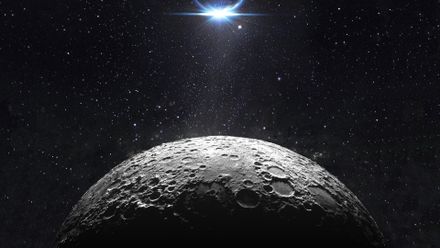
Examining the Moon, a heavily cratered celestial object that is not perpetually dark.
S1:E27 • Jan 22, 2007 • 31m
Studying how Mercury and Venus differ from Earth despite the broad similarities.
S1:E28 • Jan 22, 2007 • 33m
Various recent Mars explorations reveal signs of a water-rich past when life may have existed on its now-barren surface.
S1:E29 • Jan 22, 2007 • 31m
Jupiter is the solar system's largest planet. Among its moons, Io is notable for its volcanic activity.
S1:E30 • Jan 22, 2007 • 31m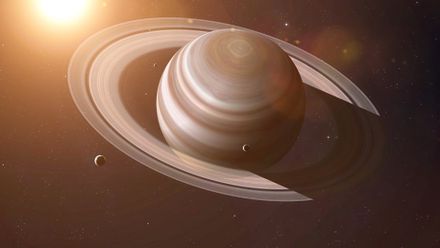
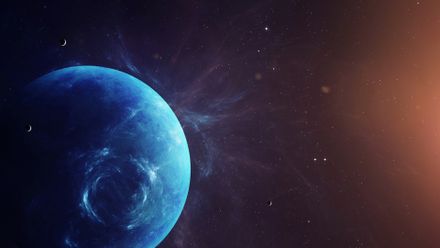
The presence of hydrogen and helium is one of the many shared characteristics of Uranus and Neptune.
S1:E32 • Jan 22, 2007 • 30m
Pluto can be considered a member of a distant group of comet-like bodies.
S1:E33 • Jan 22, 2007 • 30m
Over the years, the definition of planets has narrowed, leading to the emergence of a new category that includes celestial bodies such as Pluto, Eris, and Ceres.
S1:E34 • Jan 22, 2007 • 33m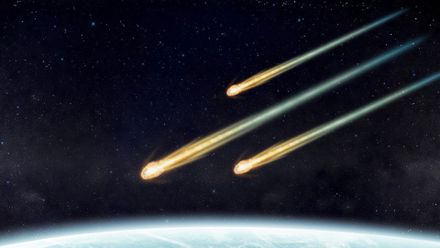
Comets in the night sky are quite a sight. However, compositionally, they are nothing more than "dirty snowballs" made of ice, dust, and various gases.
S1:E35 • Jan 22, 2007 • 31m
Comets and asteroids add to the beauty of outer space. However, if they collide with Earth, it can trigger catastrophes like the dinosaur extinction that happened millions of years ago.
S1:E36 • Jan 22, 2007 • 31m
The temperature is extremely high at the center of the dust and gas cloud inside which the planets and stars are born.
S1:E37 • Jan 22, 2007 • 32m
Almost 200 extrasolar planets have been discovered following the first one in 1995. Many of them are known to orbit a Sun-like star.
S1:E38 • Jan 22, 2007 • 31m
Discovering extrasolar planets is no piece of cake for astronomers. It requires a great deal of diligence and ingenuity incorporated into a myriad of techniques.
S1:E39 • Jan 22, 2007 • 31m
Examining the potential for life on distant planets and moons.
S1:E40 • Jan 22, 2007 • 31m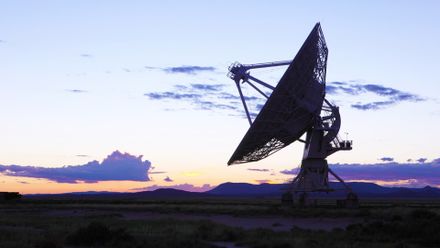
Astronomers look for signs of the presence of intelligent extraterrestrials across the Galaxy.
S1:E41 • Jan 22, 2007 • 31m
Assessing whether human beings can overcome the current technological constraints that make it impossible for them to go on interstellar voyages.
S1:E42 • Jan 22, 2007 • 31m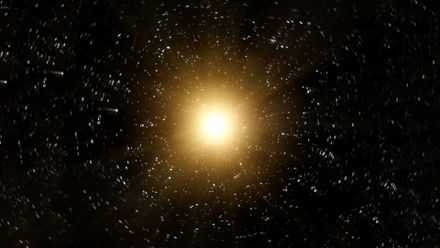
Exploring how astronomers measure the distance between Earth and nearby stars.
S1:E43 • Jan 22, 2007 • 32m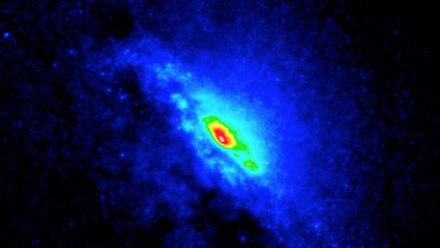
While comparing stars, astronomers use a standard reference called intrinsic brightness, aka luminosity, to eliminate the variable of distance.
S1:E44 • Jan 22, 2007 • 30m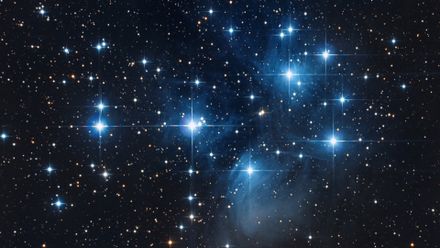
While unraveling the mysteries of stars, astronomers often refer to a special diagram that depicts the correlation between surface temperature and luminosity.
S1:E45 • Jan 22, 2007 • 31m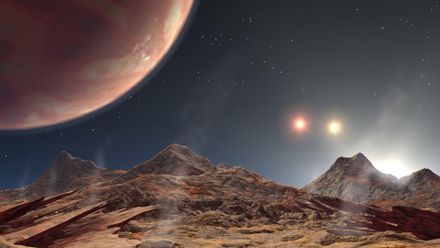
The binary system, where two stars interact gravitationally, is a valuable resource for astronomers when it comes to deriving reliable stellar mass estimates.
S1:E46 • Jan 22, 2007 • 31m
Astronomers use various methods to determine the approximate age of a star cluster.
S1:E47 • Jan 22, 2007 • 31m
A star is born when the temperature at the center of a contracting gas cloud rises significantly, triggering a natural nuclear reaction.
S1:E48 • Jan 22, 2007 • 30m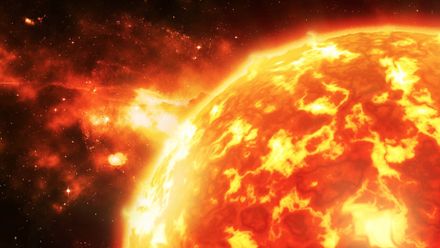
Ghostly subatomic particles called neutrinos reveal what happens in the Sun's nuclear furnace.
S1:E49 • Jan 22, 2007 • 31m
Free-floating planets are not linked to any star and have lower mass than brown dwarfs, which emit a faint glow due to gradual gravitational contraction and deuterium fusion.
S1:E50 • Jan 22, 2007 • 31m
Studying the process that occurs after the depletion of hydrogen in the Sun's core.
S1:E51 • Jan 22, 2007 • 31m
Once the Sun ends up as a white dwarf, it can trigger a nova by siphoning matter from a companion star in a binary system.
S1:E52 • Jan 22, 2007 • 31m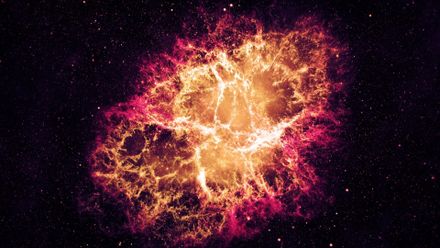
In boundless space, there exist infinite stars with a long, albeit, limited lifespan. While dying, some of them explode so intensely that they appear as bright as an entire galaxy.
S1:E53 • Jan 22, 2007 • 31m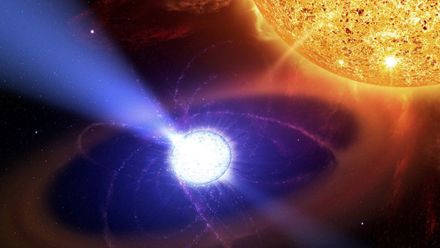
Studying the explosive consequences of a white dwarf's unstable matter accretion in a binary system.
S1:E54 • Jan 22, 2007 • 31m
When a supergiant star's core collapses precipitously, it triggers a massive explosion, giving rise to a Type II supernova.
S1:E55 • Jan 22, 2007 • 31m
Scientists are believed to have detected ghostly neutrinos from a Type II supernova that became visible at a distance of tens of thousands of light-years in 1987.
S1:E56 • Jan 22, 2007 • 31m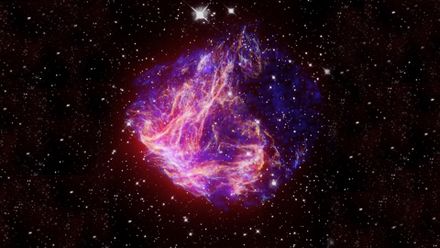
Born in the imploding core of a dying supergiant during a Type II supernova, a neutron star is a compact celestial object composed of densely packed neutrons.
S1:E57 • Jan 22, 2007 • 31m
Einstein's general theory of relativity is essential for understanding the gravitational fields of neutron stars.
S1:E58 • Jan 22, 2007 • 32m
Exploring observational tests of general relativity.
S1:E59 • Jan 22, 2007 • 31m
In a black hole, space-time curvature is so extreme that even light cannot get out.
S1:E60 • Jan 22, 2007 • 32m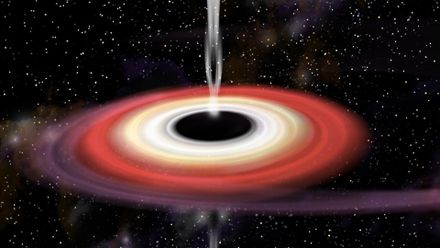
Black holes are not readily visible, but can be detected through their gravitational influence.
S1:E61 • Jan 22, 2007 • 31m
Astronomers imagine what it is like to venture into a black hole.
S1:E62 • Jan 22, 2007 • 31m
Theoretically, black holes can open doors to other universes and facilitate time travel. However, in practice, these scenarios seem next to impossible.
S1:E63 • Jan 22, 2007 • 32m
According to Stephen Hawking, black holes evaporate through a quantum mechanical process.
S1:E64 • Jan 22, 2007 • 31m
Roughly once per day, there is a short and intense burst of gamma rays in distant galaxies.
S1:E65 • Jan 22, 2007 • 31m
According to astronomers' recent findings, gamma-ray bursts occur either due to the collapse of a massive star or the merging of two neutron stars. In both scenarios, black holes are born.
S1:E66 • Jan 22, 2007 • 31m
In a series of lectures on galaxies, the first one focuses on the Milky Way and its nebulae.
S1:E67 • Jan 22, 2007 • 30m
Astronomers study various clues in detail to deduce the structure of the Milky Way.
S1:E68 • Jan 22, 2007 • 30m
The discovery of other galaxies is a remarkable chapter in the annals of astronomy.
S1:E69 • Jan 22, 2007 • 31m
According to recent findings, dark matter may be the dominant component in the majority of galaxies across the Universe.
S1:E70 • Jan 22, 2007 • 31m
Presenting an overview of the Universe as a whole.
S1:E71 • Jan 22, 2007 • 32m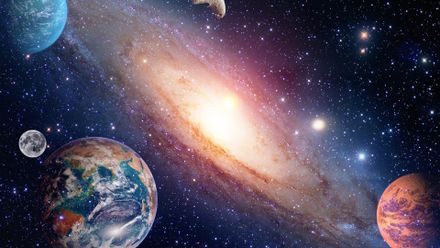
The Universe is believed to be expanding into a dimension inaccessible to humans.
S1:E72 • Jan 22, 2007 • 32m
Exploring how astronomers search for distant galaxies.
S1:E73 • Jan 22, 2007 • 31m
Exploring the formation and evolution of galaxies over time.
S1:E74 • Jan 22, 2007 • 31m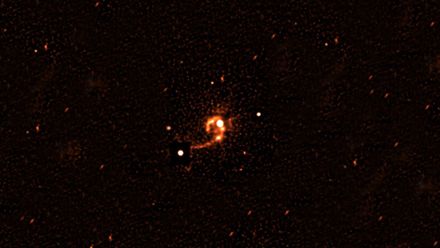
A quasar, also known as a quasi-stellar object, shines like a beacon across billions of light-years. It is considered one of the most powerful celestial objects in space.
S1:E75 • Jan 22, 2007 • 32m
The science behind the brightness of distant quasars.
S1:E76 • Jan 22, 2007 • 31m
Astronomers presently possess evidence to prove that supermassive black holes power quasars and other active galactic nuclei.
S1:E77 • Jan 22, 2007 • 32m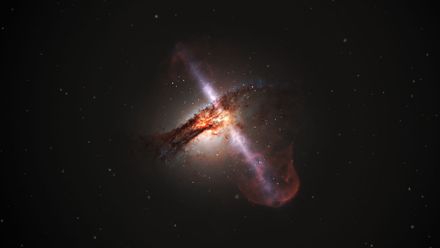

Investigating the reason behind the night sky's darkness.
S1:E79 • Jan 22, 2007 • 32m
The Hubble Space Telescope plays a crucial role in determining the age of the Universe.
S1:E80 • Jan 22, 2007 • 31m
According to general relativity, the Universe can either collapse or expand depending on its curvature. In other words, its fate is tied to geometry.
S1:E81 • Jan 22, 2007 • 31m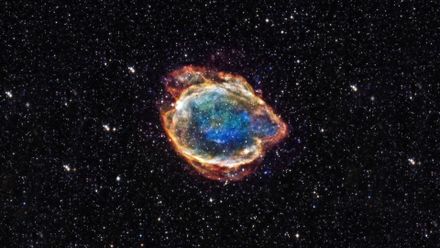
Studying the various methods employed by astronomers to ascertain the Universe's mass density and expansion history.
S1:E82 • Jan 22, 2007 • 32m
Einstein's once-discredited concept of a cosmological constant, which he himself dismissed as a blunder, regains validity after the discovery of the Universe's rapid rate of expansion.
S1:E83 • Jan 22, 2007 • 31m
In 1965, an accidental discovery overturns the steady-state theory of the universe.
S1:E84 • Jan 22, 2007 • 31m
The cosmic microwave background radiation is a fingerprint of the primordial Universe. It has plenty of insights to offer even hundreds of thousands of years after the Big Bang.
S1:E85 • Jan 22, 2007 • 31m
Studying the significance of dark energy, dark matter, and ordinary matter to understand their impact on the rate of expansion of the Universe.
S1:E86 • Jan 22, 2007 • 32m
It is possible that the incomplete cancellations of quantum fluctuations in space contribute to the dark energy's negative pressure throughout the Universe.
S1:E87 • Jan 22, 2007 • 31m
Examining the problems with the theory linking quantum fluctuations to dark energy.
S1:E88 • Jan 22, 2007 • 32m
The scientific community is working to reconcile general relativity and quantum mechanics in the pursuit of a unified theory of everything.
S1:E89 • Jan 22, 2007 • 32m
String theories explain the behavior of fundamental particles as tiny, vibrating strings of energy.
S1:E90 • Jan 22, 2007 • 32m
Studying the Universe in higher dimensions to understand its enigmatic nature, unfathomable expanse, and the uncertainties lying ahead.
S1:E91 • Jan 22, 2007 • 32m
A chronology of post-Big Bang events leading to the formation of stars and galaxies.
S1:E92 • Jan 22, 2007 • 32m
The Universe's large-scale uniformity and flatness challenge the standard Big Bang theory.
S1:E93 • Jan 22, 2007 • 32m
Inflationary cosmology theories often mention quantum fluctuations and a zero-energy universe.
S1:E94 • Jan 22, 2007 • 32m
The concept of a multiverse is intricate. While studying its origins and potential variations, it becomes evident that there are many dilemmas associated with it.
S1:E95 • Jan 22, 2007 • 32m
Reflecting on the significance, or lack thereof, of human life in the boundless cosmos.
S1:E96 • Jan 22, 2007 • 38m