

The Joy of Mathematics
Humans have had fun and games with mathematics for thousands of years; along the way, they discover the utility of this field, celebrating the sheer joy of mathematics, taught by a mathematician who is literally a magician with numbers.
Already subscribed?
Sign in
Professor Benjamin introduces the ABCs of math appreciation; the field's applications, its beauty and structure and its certainty; mathematics is a source of endless delight through creative play with numbers.
S1:E1 • Apr 11, 2007 • 31m
How to add all the numbers from 1 to 100 instantly; what makes a square number square and a triangular number triangular; why the rules of arithmetic really work; how one calculates in bases other than 10.
S1:E2 • Apr 11, 2007 • 29m
A number is prime if it is evenly divisible by only itself and the number one; Professor Benjamin proves that there are an infinite number of primes and how primes are the building blocks of the number system.
S1:E3 • Apr 11, 2007 • 30m
Combinatorics is the study of counting questions, such as how many outfits are possible if one owns eight shirts, five pairs of pants and 10 ties; combinatorics can also be used to analyze numbering systems and games of chance.
S1:E4 • Apr 11, 2007 • 28m
The Fibonacci numbers follow a simple pattern in which each number is the sum of the two preceding numbers; Fibonacci numbers have many beautiful and unexpected properties; Fibonacci numbers in nature, art and poetry.
S1:E5 • Apr 11, 2007 • 30m
Arguably the most important area of mathematics, algebra introduces the idea of using an abstract variable to represent an unknown quantity; discovering algebra's golden rule, which is to do unto one side of an equation as one does unto the other.
S1:E6 • Apr 11, 2007 • 31m
How to solve quadratic equations using the technique of completing the square and the quadratic formula; the quadratic formula reveals the connection between Fibonacci numbers and the golden ratio.
S1:E7 • Apr 11, 2007 • 31m
Algebra can be used to solve geometrical problems, such as finding where two lines cross; the technique is useful in real-life situations; graphs help people better understand everything from lines to equations with negative or fractional exponents.
S1:E8 • Apr 11, 2007 • 32m
Adding the digits of a multiple of nine always gives a multiple of nine; in modular arithmetic, this property allows checking answers by casting out nines; a related trick is mentally computing the day of the week for any date in history.
S1:E9 • Apr 11, 2007 • 32m
Professor Benjamin begins his discussion of mathematical proofs with intuitive cases like "even plus even is even" and "odd times odd is odd"; he builds to more complex proofs by existence and induction; he ends with a checkerboard challenge.
S1:E10 • Apr 11, 2007 • 31m
Geometry is based on a handful of definitions and axioms involving points, lines and angles; these lead to important conclusions about the properties of polygons, using geometric reasoning to derive the Pythagorean theorem and other results.
S1:E11 • Apr 11, 2007 • 31m
Pi is the ratio of the circumference of a circle to its diameter; it starts at 3.14 and continues in an infinite non-repeating sequence; Professor Benjamin shows how to learn the first hundred digits of this celebrated number, making it look easy.
S1:E12 • Apr 11, 2007 • 31m
Trigonometry deals with the sides and angles of triangles; defining sine, cosine, and tangent, along with their reciprocals; extending these definitions to the unit circle allows a handy measure of angle, which is the radian.
S1:E13 • Apr 11, 2007 • 32m
Whether the apparently nonsensical number of the square root of -1 could be of any use; such imaginary and complex numbers play an indispensable role in physics and other fields; they are easier to understand than they appear.
S1:E14 • Apr 11, 2007 • 31m
Another indispensable number to learn is e = 2.71828; defined as the base of the natural logarithm, e plays a central role in calculus; it arises naturally in many spheres of mathematics, including calculations of compound interest.
S1:E15 • Apr 11, 2007 • 30m
The meaning of infinity; whether some infinite sets are more infinite than others; the possibility of an infinite number of levels of infinity; exploring some of the strange ideas associated with mathematical infinity.
S1:E16 • Apr 11, 2007 • 30m
Starting with the analysis of the proposition 0.999999999... = 1; what it means to add up an infinite series of numbers; some infinite series converge on a definite value, while others grow arbitrarily large.
S1:E17 • Apr 11, 2007 • 31m
Calculus is the mathematics of change; it answers questions such as how fast a function is growing, discovering the concepts of limits and derivatives, which allow the slope of a curve to be measured at any point.
S1:E18 • Apr 11, 2007 • 32m
By exploiting the idea of the derivative, one can approximate just about any function using simple polynomials; why a formula sometimes known as God's equation is true; how to calculate square roots in one's head.
S1:E19 • Apr 11, 2007 • 31m
Geometry and trigonometry are used to determine the areas of simple figures, and how more complex shapes are measured; calculus comes to the rescue with a technique called integration, which adds the simple areas of many tiny quantities.
S1:E20 • Apr 11, 2007 • 32m
A geometric arrangement of binomial coefficients called Pascal's triangle is a treasure trove of number patterns; it provides an answer to the song "The Twelve Days of Christmas" and exactly how many gifts it refers to.
S1:E21 • Apr 11, 2007 • 32m
Mathematics draws detailed inferences about random events, covering major concepts in probability, such as the law of large numbers, the central limit theorem and how to measure variance.
S1:E22 • Apr 11, 2007 • 30m
The law of total probability and other concepts can be applied to predict the long-term losses to be expected from playing games such as roulette and craps, understanding what is known as the gambler's ruin.
S1:E23 • Apr 11, 2007 • 31m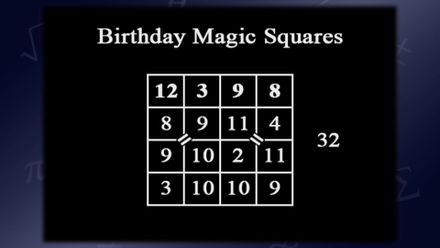
Professor Benjamin shows a trick for producing anyone's phone number; how to create a magic square based on one's birthday; how to play mathematical survivor; a technique for computing cube roots; an interesting card trick.
S1:E24 • Apr 11, 2007 • 31mMore Like This
 TVPG • 1 season
 TVPG • 1 season
 TVPG • 1 season
 TVPG • 1 season
 TV14 • 1 season
 TVPG • 1 season
 TVPG • 1 season
 TVPG • 1 season
 TVPG • 1 season
 TVPG • 1 season
 TVPG • 1 season
 TVPG • 1 season
 TVPG • 1 season
 TVPG • 1 season
 TVPG • 1 season
 TVPG • 1 season
 TVPG • 1 season
 TVPG • 1 season
 TVPG • 1 season
 TVPG • 1 season