

Understanding the New Testament
S1:E22 New Leaders in the Pastoral Epistles
Paul's first and second letters to Timothy and the letter to Titus form a special group of epistles because they are written not to congregations but to church pastors; they help one explore the development of an independent, organized religion.
Already subscribed?
Sign in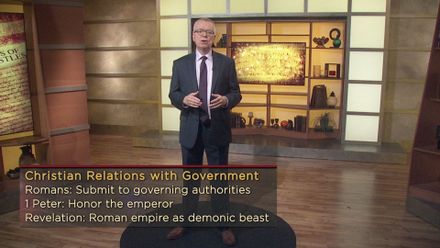
The New Testament comprises 27 books by more than a dozen authors; it is also presented as a single, unified text; the paradox of one book versus many; how historians view the New Testament; why they are excited by its diversity of voices.
S1:E1 • Nov 29, 2019 • 31m
Looking at ancient Judaism for context about the birth of Christianity before delving into the New Testament; exploring key stories and themes of the Old Testament to understand the world of Jesus of Nazareth.
S1:E2 • Nov 29, 2019 • 31m
The New Testament includes many types of narratives; the first episode on Paul's epistles; reflecting on the chronologically earliest book of the New Testament; the structure of a Pauline letter; what his mission of evangelism is all about.
S1:E3 • Nov 29, 2019 • 29m
A look at Paul's letter to the Galatians; in it, he offers a rebuke to a congregation he believes has backslid after his departure; why he believes it is important to establish faith in Jesus as the one and only quality that gets one into heaven.
S1:E4 • Nov 29, 2019 • 30m
Paul's letter to the Romans is his masterpiece; he writes this letter to introduce himself and his teachings to lay the groundwork for his arrival, unpacking the key message of his theology, namely that one is made righteous through faith in Christ.
S1:E5 • Nov 29, 2019 • 29m
Considering one tension inherent to Christian congregations; in Paul's theology, everyone is equal in the eyes of the Lord; yet, Corinth is prosperous; how Paul reconciles economic, intellectual and educational diversity with religious unity.
S1:E6 • Nov 29, 2019 • 29m
The two letters to the Corinthians give insight into Paul's theology and early Christian congregations; how believers worship; who the church leaders are; what the roles for men and women are; what the letters say about the community.
S1:E7 • Nov 29, 2019 • 30m
Paul's letters to Philemon and to the Philippians have two major things in common; Paul writes them both from prison; they each concern slavery; gaining insight into Paul's views around imprisonment; his ideas about Christ's humanity and divinity.
S1:E8 • Nov 29, 2019 • 31m
The three "Deutero-Pauline" letters likely date to the years after Paul's death; they seek to reassure readers that a series of events must occur before the end times arrive; faith in Christ is all that is necessary for salvation in the present.
S1:E9 • Nov 29, 2019 • 31m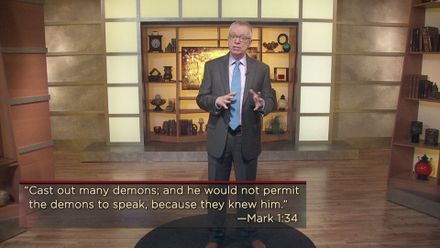
Starting with the Gospel According to Mark and reviewing what historians know about the author and the book's composition, Professor Brakke surveys the time of Jesus' ministry and death and explicates the key themes of Mark's gospel.
S1:E10 • Nov 29, 2019 • 30m
Matthew presents a different theological portrait of Jesus and his ministry than Mark; whereas Jesus in Mark is a mysterious figure, Matthew emphasizes Jesus' divinity; comparing the two gospels; what scholars believe about their composition.
S1:E11 • Nov 29, 2019 • 30m
Continuing the study of the Gospel of Matthew; Matthew's interest in forming and leading the church; the conflict, in Matthew, between the Jesus who teaches Jewish law and the Jesus who critiques Jewish leaders.
S1:E12 • Nov 29, 2019 • 29m
The Gospel of Luke is the first book in a two-volume work; Luke presents himself as a historian; considering the two-volume Luke-Acts as a historical work; who Luke's sources are; the story he wants to tell; how and why his story unfolds.
S1:E13 • Nov 29, 2019 • 30m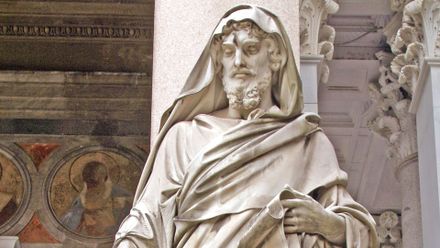
The grand narrative in the books Luke through Acts presents a unified narrative of early Christian history; looking at the people and parables presented in Luke's history; encountering an expansive, inclusive vision for Christianity.
S1:E14 • Nov 29, 2019 • 29m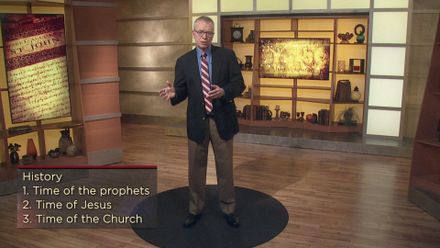
Luke does not recreate the past; Luke has a perspective on the history he tells; unpacking his vision of early Christian history; considering the message he sends to his readers; comparing that message to the earlier Gospel According to Mark.
S1:E15 • Nov 29, 2019 • 31m
The Gospel According to John is an anomaly, set apart from the other three "Synoptic Gospels"; although the basic story of Jesus remains the same, John's gospel contains more philosophy; it has been called a more "spiritual" gospel.
S1:E16 • Nov 29, 2019 • 31m
The Gospel of John contains troubling rhetoric around Jews and Judaism; the reasons behind John's depiction of the Jews; why it is so negative; why John's portrayal of Jesus makes this gospel an object of controversy and a source of spirituality.
S1:E17 • Nov 29, 2019 • 30m
What happens when an early Christian community begins to fall apart; the letters of John tackle problems such as disagreements over theology and challenges to church leadership; early efforts to unify a fractured church.
S1:E18 • Nov 29, 2019 • 29m
The "Historical Jesus" refers to the man named Jesus of Nazareth as opposed to the Christ found in the gospels; tracing the development of biblical scholarship and research after the Renaissance and Enlightenment.
S1:E19 • Nov 29, 2019 • 30m
Abraham plays a major role in the writings of the New Testament; in the book of Hebrews, Abraham appears as a model of faith; in James, he is an object of controversy over how people are saved, whether by faith alone or by faith and works.
S1:E20 • Nov 29, 2019 • 31m
Along with James and the three letters of John, 1-2 Peter and Jude are known as the "catholic" or general epistles; what these most recent books of the New Testament say about a mature and growing religious movement.
S1:E21 • Nov 29, 2019 • 31m
Paul's first and second letters to Timothy and the letter to Titus form a special group of epistles because they are written not to congregations but to church pastors; they help one explore the development of an independent, organized religion.
S1:E22 • Nov 29, 2019 • 31m
The book of Revelation presents a complex, symbolic and, at times, even bizarre vision of the present day and the future; why the Romans persecute the Christians; the content of Christ's revelation to John; diving into this challenging book.
S1:E23 • Nov 29, 2019 • 32m
Revisiting the paradox between the New Testament's diversity and unity; how theologians and scholars tackle this paradox; examples include the Christian leaders Irenaeus, Origen and Martin Luther, as well as modern historical researchers.
S1:E24 • Nov 29, 2019 • 33m