

Latin 101: Learning a Classical Language
S1:E25 The Perfect Tense Passive System
Complete all the tenses of the Latin verb by learning the perfect passive, which uses a form of the verb sum together with the past participle.
Already subscribed?
Sign in
Easing into the study of Latin by admiring its beauty and impressive history; exploring the letters and sounds of the restored classical pronunciation, which approximates the way Latin was spoken in the classical era; covering the rules of accents.
S1:E1 • Nov 15, 2013 • 32m
Examine the third conjugation, and learn the four principal parts of ago: the key words that allow you to conjugate any form.
S1:E2 • Nov 15, 2013 • 29m
Learning how the long vowel a is the key to the present subjunctive mood in verbs such as pono; the subjunctive expresses doubt or potential; exploring its use by the poet Catullus in a famous love poem to survive from the ancient world.
S1:E3 • Nov 15, 2013 • 32m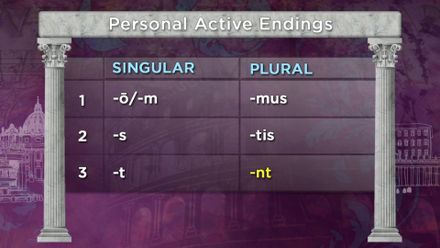
Learn two important irregular verbs - sum (I am) and possum (I am able) - and their present tense indicative, imperative, infinitive, and subjunctive forms.
S1:E4 • Nov 15, 2013 • 30m
Learning to decline nouns; investigating the largest class of nouns, called the third declension; discovering the function of the five cases and how to identify the noun stem; practicing with masculine and feminine nouns.
S1:E5 • Nov 15, 2013 • 29m
After a review of verb and noun endings, focus on third- declension neuter nouns, specifically the word corpus (body).
S1:E6 • Nov 15, 2013 • 31m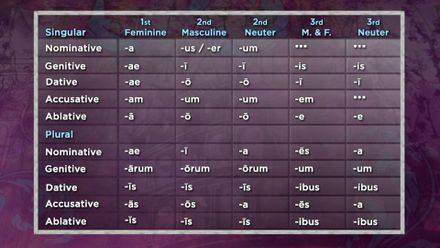
Adjectives must agree in number, case and gender with the nouns they modify; reviewing a chart of the endings for first and second declension adjectives; practicing matching adjectives with nouns in examples such as nox perpetua and basium fervidum.
S1:E7 • Nov 15, 2013 • 32m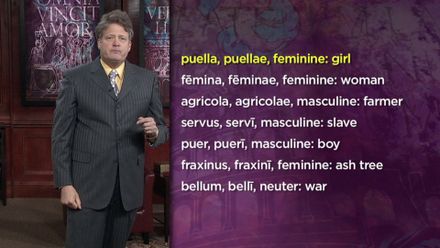
Study first- and second-declension nouns, discovering they have the same endings as first- and second-declension adjectives (with some peculiarities).
S1:E8 • Nov 15, 2013 • 32m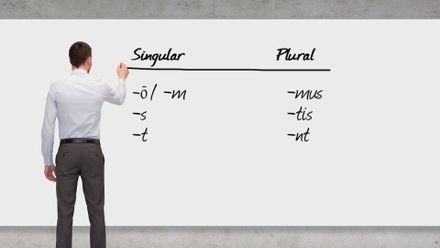
See how the magic of personal endings makes the passive voice in Latin elegantly simple - unlike awkward passive constructions in English.
S1:E9 • Nov 15, 2013 • 32m
Investigate two classes of verbs similar to pono: the third-io and fourth conjugations, then learn the forms in the present tense active indicative.
S1:E10 • Nov 15, 2013 • 29m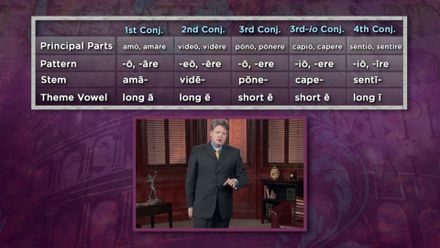
One's knowledge of the third, third-io and fourth conjugations paves the way for mastery of the remaining two patterns, the first and second conjugations; practicing all five conjugations; translating "O Come All Ye Faithful!".
S1:E11 • Nov 15, 2013 • 28m
Read and appreciate one of the most beautiful poems in Latin, which declares the poet Catullus's love for Clodia.
S1:E12 • Nov 15, 2013 • 28m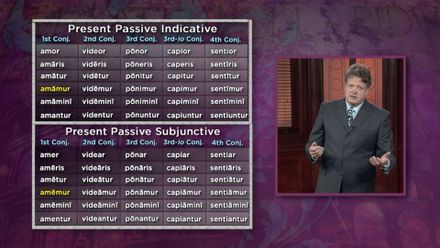
Cover the present passive endings in the first, second, third-io, and fourth conjugations, then decipher a passage from the book of Genesis.
S1:E13 • Nov 15, 2013 • 32m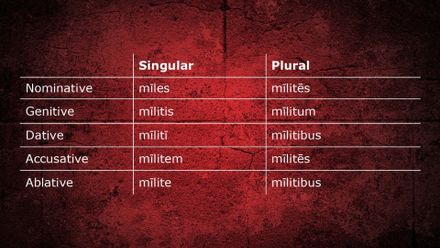
Learn why third-declension adjectives are actually easier to decline than first- and second-declension adjectives.
S1:E14 • Nov 15, 2013 • 31m
Here, explore a subset of third-declension nouns that has the letter "i" in certain forms called i-stems.
S1:E15 • Nov 15, 2013 • 30m
Here, experience relative pronouns in action by translating two extracts from Sallust's The Conspiracy of Catiline.
S1:E16 • Nov 15, 2013 • 30m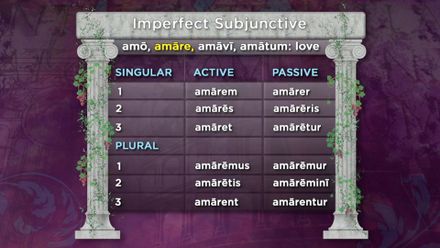
Learn the future and imperfect tenses, which are governed by simpler rules, then practice the active and passive forms in all four conjugations.
S1:E17 • Nov 15, 2013 • 29m
Apply your skills with the future and imperfect tenses to Latin texts, including a poem by Catullus and a disingenuous claim by Julius Caesar.
S1:E18 • Nov 15, 2013 • 30m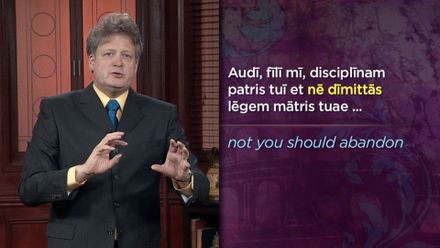
Here, grasp the wisdom of Solomon by analyzing four verses from chapter 1 of the book of Proverbs.
S1:E19 • Nov 15, 2013 • 29m
Studying the three basic demonstrative adjectives in Latin; seeing how they can be used as pronouns; looking at similar words that decline the same way; a passage from Cicero shows the dramatic use of a demonstrative adjective.
S1:E20 • Nov 15, 2013 • 29m
Here, tackle three new tenses: the perfect, pluperfect, and future perfect in the active voice.
S1:E21 • Nov 15, 2013 • 33m
Learn the rules for forming Latin participles, then investigate some of their many interesting applications.
S1:E22 • Nov 15, 2013 • 30m
Enhance your knowledge of infinitives by learning perfect active and passive infinitives, as well as future active and passive infinitives.
S1:E23 • Nov 15, 2013 • 28m
Work through three sentences from Caesar's Commentaries on the Gallic War, written in a direct style that has enthralled readers for 2,000 years.
S1:E24 • Nov 15, 2013 • 31m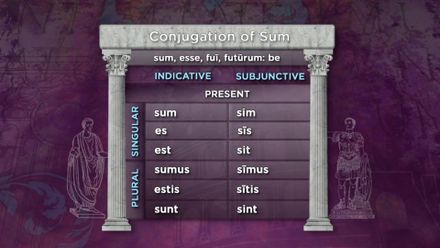
Complete all the tenses of the Latin verb by learning the perfect passive, which uses a form of the verb sum together with the past participle.
S1:E25 • Nov 15, 2013 • 31m
Learn to conjugate deponents, an intriguing class of verbs whose active forms are identical to the passive forms of regular verbs.
S1:E26 • Nov 15, 2013 • 31m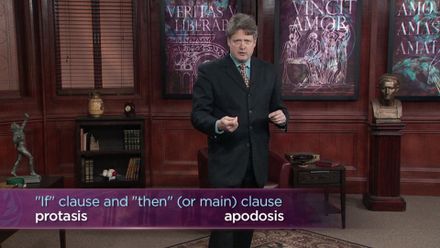
Expand appreciation for Latin syntax and the subjunctive by learning to express conditions using if-then clauses; knowing that Latin can convey deeper shades of meaning in conditional sentences; seeing how Cicero put this grammatical tool to use.
S1:E27 • Nov 15, 2013 • 30m
Study other uses of the subjunctive, particularly provisos and temporal clauses, exemplified by a famous reply of Emperor Caligula.
S1:E28 • Nov 15, 2013 • 32m
Probe examples of Roman legislation in the original Latin, starting with a provision from the Twelve Tables, the most ancient codification of Roman law.
S1:E29 • Nov 15, 2013 • 29m
Asking a question in Latin; covering the three particles used to introduce a question; learning interrogative adjectives and pronouns and their corresponding correlatives; exploring relevant examples from Latin authors, including Catullus and Cicero.
S1:E30 • Nov 15, 2013 • 32m
Complete your tour of the Latin noun by mastering the fourth and fifth declensions, which pose no major hurdles after the third declension. Practice by translating a passage from a Latin requiem mass, which opens, dies irae (day of wrath).
S1:E31 • Nov 15, 2013 • 31m
The fourth principal part is the gateway to a verbal noun called the supine, used to denote purpose, as in mirabile dictu; studying another verbal noun called the gerund; comparing it to the gerundive; the subtleties of translating them into English.
S1:E32 • Nov 15, 2013 • 30m
Exploring the irregular verb eo (I go); the passive infinitive, iri, combines with the supine to create the future passive infinitive; for example, amatum iri (to be going to be loved); learning to count in Latin with ordinal and cardinal numbers.
S1:E33 • Nov 15, 2013 • 31m
Here, look at other irregular verbs, then discover strategies for streamlining your study of Latin forms.
S1:E34 • Nov 15, 2013 • 32m
Investigate patterns that govern comparisons of adjectives and adverbs, then try an example of Latin text that speaks across two millennia.
S1:E35 • Nov 15, 2013 • 30m
Use you knowledge to understand a complex message (that even features a mystery), then get recommendations for further studies.
S1:E36 • Nov 15, 2013 • 33m