

Do-It-Yourself Engineering
S1:E1 Why DIY Engineering?
Following the seven steps in the engineering design process to create a golf ball launcher; applying the principle of conservation of energy to select the right steel spring for the job; the joys of do-it-yourself projects; the insights they provide.
Already subscribed?
Sign in
Following the seven steps in the engineering design process to create a golf ball launcher; applying the principle of conservation of energy to select the right steel spring for the job; the joys of do-it-yourself projects; the insights they provide.
S1:E1 • Oct 20, 2017 • 36m
Using cardboard to build a tower capable of supporting two loads, this exercise closely replicates problems faced by real-world skyscraper designers, using vector math to analyze the forces exerted on each structural element of the building.
S1:E2 • Oct 20, 2017 • 34m
Conducting compressive and tensile strength experiments to determine the size and shape of the structure's beams, columns and braces; building the tower using ordinary wood glue and simple tools after designing it; piling on concrete blocks.
S1:E3 • Oct 20, 2017 • 36m
Design and build an 8-foot beam bridge. First, consider three different concepts. Then, develop these designs, analyzing their stresses and failure modes before selecting the optimum and building it.
S1:E4 • Oct 20, 2017 • 34m
Building a suspension bridge; supporting the deck with suspension cables draped between two towers; analyzing the flow of forces through the structural system before designing each element; planning the project with a 3-D computer model.
S1:E5 • Oct 20, 2017 • 34m
A concrete boat can be made to float; creating a concrete sailboat that can operate safely in 10-mph winds; hydrostatics comes into play in designing a hull with sufficient buoyancy; aerodynamics enters the picture in designing an effective sail.
S1:E6 • Oct 20, 2017 • 33m
Build your concrete sailboat. Then apply basic aerodynamics and vector mechanics to determine how the wind propels a sailboat. Try out various points of sail.
S1:E7 • Oct 20, 2017 • 29m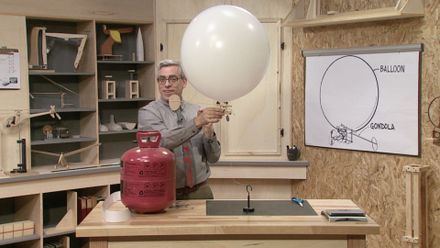
Discover 17 thrilling engineering projects that you can build at home - from a suspension bridge to a low-altitude sounding rocket. As you build, you'll learn how to think like an engineer.
S1:E8 • Oct 20, 2017 • 32m
Discover 17 thrilling engineering projects that you can build at home - from a suspension bridge to a low-altitude sounding rocket. As you build, you'll learn how to think like an engineer.
S1:E9 • Oct 20, 2017 • 33m
Dig deeper into aerodynamics. Choose an airfoil shape and wingspan, fuselage length, and stabilizer dimensions for your plane. Pay special attention to stability. Then, build the airframe.
S1:E10 • Oct 20, 2017 • 32m
Complete your plane by assembling a motor. Design and install an efficient propeller. Learn how to balance your aircraft, adjust its flight characteristics, and fine-tune the plane's performance.
S1:E11 • Oct 20, 2017 • 33m
Discover 17 thrilling engineering projects that you can build at home - from a suspension bridge to a low-altitude sounding rocket. As you build, you'll learn how to think like an engineer.
S1:E12 • Oct 20, 2017 • 32m
Tackle the problem of designing a model rocket that carries a video camera to 500 feet, then returns safely by parachute. In this lesson, focus on selecting an off-the-shelf model rocket engine.
S1:E13 • Oct 20, 2017 • 31m
Putting together the model rocket; paying attention to the engine mount and fins; giving the completed vehicle a drag-reducing finish; applying aerodynamics to calculate the parachute's required diameter; checking the rocket's stability.
S1:E14 • Oct 20, 2017 • 31m
Discover 17 thrilling engineering projects that you can build at home - from a suspension bridge to a low-altitude sounding rocket. As you build, you'll learn how to think like an engineer.
S1:E15 • Oct 20, 2017 • 35m
Discover 17 thrilling engineering projects that you can build at home - from a suspension bridge to a low-altitude sounding rocket. As you build, you'll learn how to think like an engineer.
S1:E16 • Oct 20, 2017 • 32m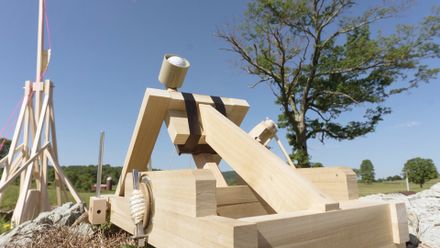
Delving into the history of catapults; examining the workings of the ballista, onager and trebuchet; getting started on a model ballista; analyzing the machine's nylon torsion springs to ensure that they can achieve the required 200-foot range.
S1:E17 • Oct 20, 2017 • 36m
Building a model ballista; constructing the onager and the trebuchet, designed such that they store the same amount of energy; field-testing all three models to determine which throws a golf ball farthest; seeing which weapon wins the contest.
S1:E18 • Oct 20, 2017 • 33m
Harnessing the power of moving water by building an impulse turbine; using Bernoulli's equation to determine the water reservoir's required height; plotting power versus load to determine the turbine's diameter; building the turbine.
S1:E20 • Oct 20, 2017 • 31m
Discover 17 thrilling engineering projects that you can build at home - from a suspension bridge to a low-altitude sounding rocket. As you build, you'll learn how to think like an engineer.
S1:E21 • Oct 20, 2017 • 31m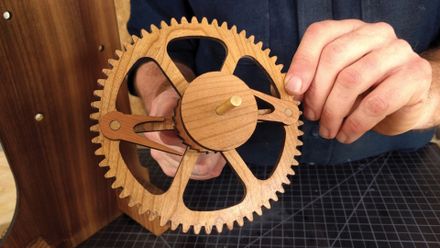
Discover 17 thrilling engineering projects that you can build at home - from a suspension bridge to a low-altitude sounding rocket. As you build, you'll learn how to think like an engineer.
S1:E22 • Oct 20, 2017 • 33m
Testing the limits of hobby motors by building a motor-driven crane; constructing the world's simplest electric motor to see how they work; calculating the torque requirements for a crane; adding gears and pulleys to achieve mechanical advantage.
S1:E23 • Oct 20, 2017 • 33m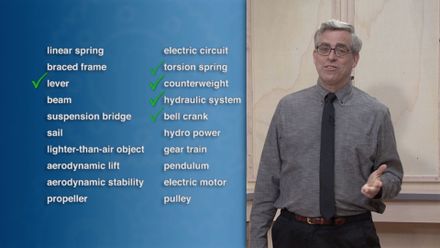
Building a tribute to cartoonist Rube Goldberg, known for his machine sketches; combining twenty design elements to create a machine that will click a computer mouse; Professor Ressler offers a solution that produces a surprising outcome.
S1:E24 • Oct 20, 2017 • 38m