

Chemistry and Our Universe: How It All Works
Chemistry is the study of matter and energy at the scale of atoms and molecules; covering a year's worth of introductory general chemistry at the college level; touching on topics that are rarely discussed in the classroom.
Already subscribed?
Sign in
Chemistry is the study of all matter, but matter at the very particular scale of atoms and molecules; Professor Davis begins by outlining his approach to this topic; introducing the periodic table of elements, which is a powerful conceptual tool.
S1:E1 • Sep 23, 2016 • 31m
Chemists have convenient units for dealing with matter at the atomic scale; learning the origin and relative size of the angstrom to measure length; the atomic mass unit; the mole for measuring quantity; the Kelvin scale for temperature.
S1:E2 • Sep 23, 2016 • 34m
Light interacts with matter in crucial ways; following the debate over whether light is a wave or a particle; how the wave theory appears to triumph in the 19th century; how it leads to the discovery of the electromagnetic spectrum.
S1:E3 • Sep 23, 2016 • 30m
Although light has wave-like properties, it also behaves like a particle that comes in discrete units of energy called quanta; how physicists build a revolutionary picture of light that recognizes both its wave- and particle-like nature.
S1:E4 • Sep 23, 2016 • 29m
Investigating what is inside the atom; how electrons, protons and neutrons are distributed; how they give an atom its identity; how they affect its electrical charge and atomic mass; the meaning of terms such as isotope, anion and cation.
S1:E5 • Sep 23, 2016 • 31m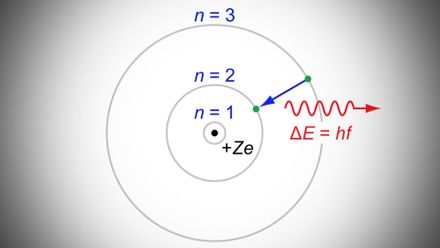
How electrons organize themselves within the atom depending on their energy state; graduating from Niels Bohr's model of the atom to Erwin Schrödinger's more precise theory; charting different electron configurations in heavier atoms.
S1:E6 • Sep 23, 2016 • 33m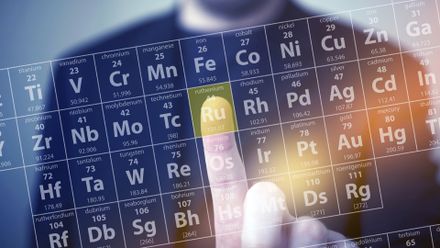
Returning to the periodic table to practice predicting properties of elements based on their electronic structure; witnessing what happens when three different alkali metals react with water; theory forecasts a pronounced difference in the result.
S1:E7 • Sep 23, 2016 • 30m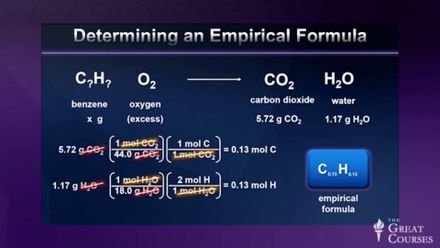
Turning to molecules, which are groups of atoms that make up compounds and some elements; learning to calculate the empirical formula for a simple molecule; determining its molecular formula, which gives the exact number of each type of atom.
S1:E8 • Sep 23, 2016 • 29m
Starting to unravel the mystery of what joins atoms into molecules; investigating how molecular bonds reflect the octet rule; how they fall into the four classes of ionic, covalent, polar covalent and metallic bonds.
S1:E9 • Sep 23, 2016 • 31m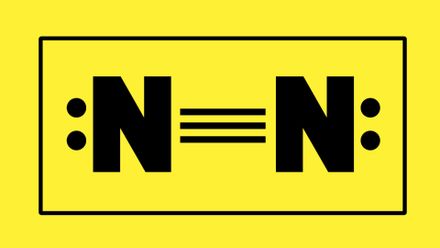
At the turn of the 20th century, chemist Gilbert N. Lewis devises a method for depicting the essential blueprint of a molecule's structure; how to draw Lewis structures; using this technique to explore such concepts as formal charge and resonance.
S1:E10 • Sep 23, 2016 • 30m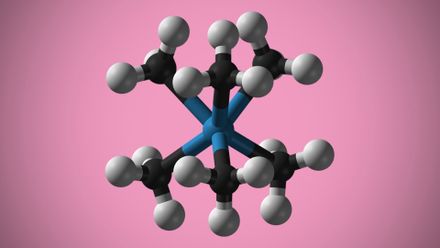
Taking the next step beyond Lewis structures to see how atoms in a molecule are arranged in three dimensions; VSEPR theory provides chemists with a quick way to predict the shapes of molecules based on a few basic assumptions.
S1:E11 • Sep 23, 2016 • 28m
Meeting one of the fathers of modern physical chemistry, Linus Pauling; his theory of orbital hybridization, which solves some of the shortcomings of VSEPR theory; Pauling's theory averages the charge of electrons in different orbitals.
S1:E12 • Sep 23, 2016 • 29m
Discovering an alternate model of chemical bonding; this idea explains such mysteries as why oxygen is paramagnetic; a demonstration of oxygen's attraction to a magnet; using molecular orbital theory to understand why this happens.
S1:E13 • Sep 23, 2016 • 26m
Beginning the study of chemical reactions; investigating how chemists write reactions using a highly systematized code; Professor Davis introduces the "big four" types of chemical reactions; how to translate between measurements in moles and grams.
S1:E14 • Sep 23, 2016 • 31m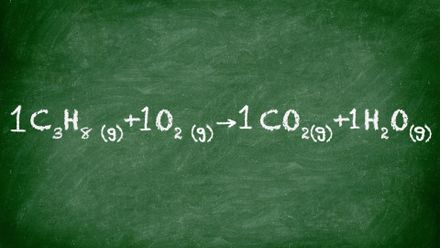
Defining stoichiometry; how to balance a reaction equation; learning how to solve various problems.
S1:E15 • Sep 23, 2016 • 31m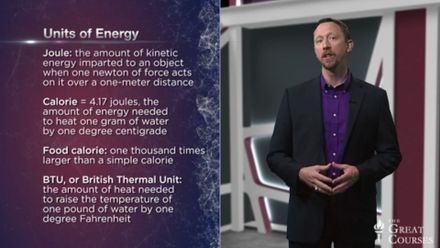
Considering how atoms and molecules can create, consume and transport energy; practicing calculating energy changes in reactions; exploring the concept of enthalpy; learning how chemists use a device called a calorimeter.
S1:E16 • Sep 23, 2016 • 34m
Chemist Germain Hess theorizes that the total heat change in a chemical reaction is equal to the sum of the heat changes of its individual steps; the implications of this principle, known as Hess's law; learning about heat of formation.
S1:E17 • Sep 23, 2016 • 29m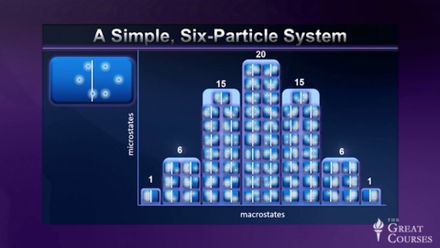
Turning to entropy, which is a measure of disorder; according to the second law of thermodynamics, the entropy of closed systems always increases; how this change can be calculated in chemical reactions through the absolute entropy table.
S1:E18 • Sep 23, 2016 • 31m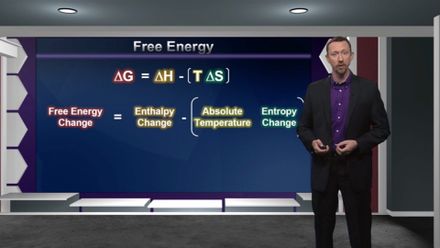
Enthalpy and entropy are combined in the free energy equation discovered by chemist J. Willard Gibbs; it predicts whether a reaction will take place spontaneously; probing the difference between reactions that are endothermic and exothermic.
S1:E19 • Sep 23, 2016 • 29m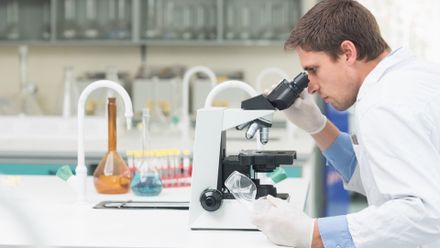
Investigating the physical properties that define common phases of matter; the intermolecular forces that control which of these phases a substance occupies; the roles of London dispersion forces, dipole-dipole interactions and hydrogen bonding.
S1:E20 • Sep 23, 2016 • 31m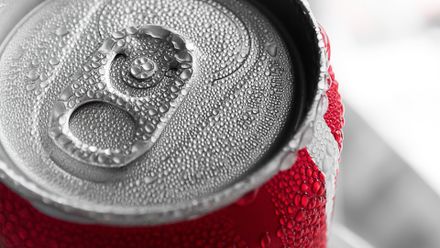
Surveying events at the molecular level when substances convert between solid, liquid and gaseous phases; the role of temperature and pressure on these transitions; becoming familiar with a tool of prediction called the phase diagram.
S1:E21 • Sep 23, 2016 • 28m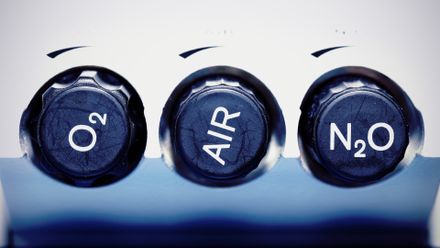
A look at the properties of gases; the basic equations that describe their behavior; the history of Boyle's law, Gay-Lussac's law, Charles's law and Avogadro's law; using these four expressions to derive the ideal gas law.
S1:E22 • Sep 23, 2016 • 27m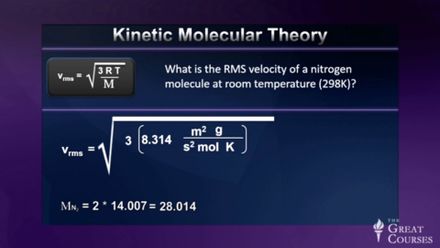
Applying the physics of moving bodies to the particles comprising a gas; how Graham's law links the mass of gas particles to the rate at which they escape through a small aperture; how this technique is used in the making of the first atomic weapons.
S1:E23 • Sep 23, 2016 • 30m
Turning to liquids, which have a more complicated behavior than gases; intermolecular forces apply at a much closer range for liquids; exploring the resulting properties, including viscosity and volatility; the applications of these qualities.
S1:E24 • Sep 23, 2016 • 29m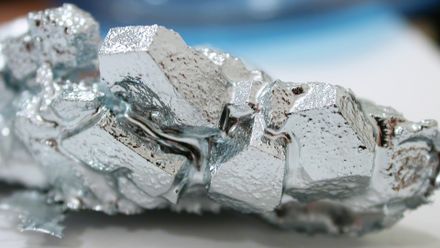
Solids are characterized by a defined volume and shape; this is created by the close packing of atoms, ions or molecules; how packing is very regular in crystalline solids; the structure and properties of metals and alloys.
S1:E25 • Sep 23, 2016 • 31m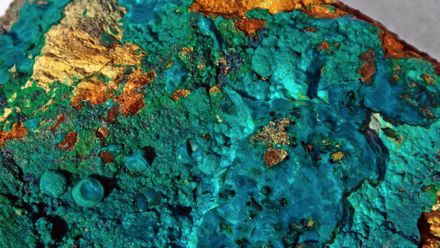
Examining solids that are held together by forces other than metallic bonds; sodium chloride exhibits a lattice structure joined by ionic bonds; sugar has covalent bonds; diamond and graphite are cases of covalent network solids, as are silicates.
S1:E26 • Sep 23, 2016 • 30m
The nature of solutions; distinguishing between solutes and the solvent; ways of reporting solution concentrations including molarity, molality, parts per million, and parts per billion; how chemists prepare solutions of known concentrations.
S1:E27 • Sep 23, 2016 • 34m
The maximum solubility of materials in water; the concept of saturated solutions; the effect of temperature on solutions; demonstrating Henry's law on the solubility of gases in liquids; the phenomenon of supersaturation.
S1:E28 • Sep 23, 2016 • 29m
Certain properties of solutions depend on the concentration of the solute particles dissolved; colligative properties involve such behaviors as lowering the freezing point, raising the boiling point, and osmotic pressure.
S1:E29 • Sep 23, 2016 • 32m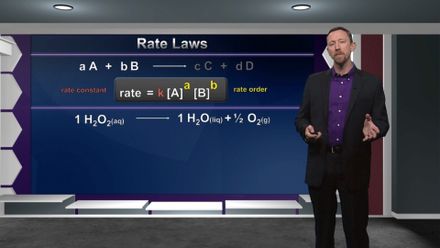
The elephant's toothpaste; investigating reaction rates; expressing rates mathematically; understanding the importance of rate order; it is is related to the powers of the concentrations; half-life equations are vital for dating geologic processes.
S1:E30 • Sep 23, 2016 • 32m
The effect of temperature on reactions; how to use the Arrhenius equation to calculate the activation energy for a reaction; cooling food in a refrigerator reduces its spoilage.
S1:E31 • Sep 23, 2016 • 32m
Chemical reactions take place in a series of steps; converting starting materials into intermediates; intermediates are converted into products; each stage in this process has its own associated rate law; analyzing these steps; catalysts.
S1:E32 • Sep 23, 2016 • 29m
How reactions are reversed; studying dynamic equilibrium; reactions that take place simultaneously in both directions; homogeneous equilibria involves reactants and products in the same phase; an introduction to the reaction quotient.
S1:E33 • Sep 23, 2016 • 29m
Gas-phase equilibria; investigating Le Chatelier's principle; it describes what happens when a chemical system is disturbed; three different scenarios that employ this rule; exploring an application of Le Chatelier's principle.
S1:E34 • Sep 23, 2016 • 30m
Acids and bases; their defining qualities; independent discoveries made by J. N. Bronsted and T. M. Lowry in the 1920s; Soren Sorensen devises the pH scale for measuring acidity and basicity.
S1:E35 • Sep 23, 2016 • 28m
Strong acids and bases ionize completely in solution; surveying weak acids and bases; they only partially ionize; practising techniques for calculating their properties and concentrations in various solutions.
S1:E36 • Sep 23, 2016 • 29m
How acids and bases combine; how a desired pH can be achieved through regulation of acid-base reactions; how to use the Henderson-Hasselbalch equation, which is indispensable in biology and medicine.
S1:E37 • Sep 23, 2016 • 30m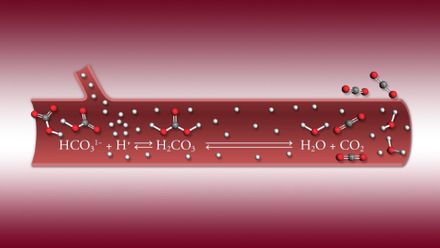
Acids that donate a single hydrogen ion in an acid-base reaction; polyprotic acids donate more than one proton per molecule; investigating the complex ionization processes that ensue; how they play a role in regulating blood pH.
S1:E38 • Sep 23, 2016 • 30m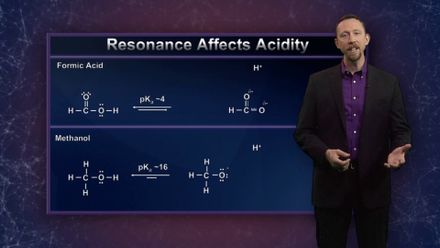
The behavior of acids and bases; the reasons for their disparities; how various acids ionize; electronegativity; molecular geometry; hybridization; covalent bonding.
S1:E39 • Sep 23, 2016 • 30m
Reduction-oxidation reactions; the exchange of electrons between substances; this process explains geological events on the early Earth; iron in its metallic state is so rare in nature; exploring associated phenomena.
S1:E40 • Sep 23, 2016 • 34m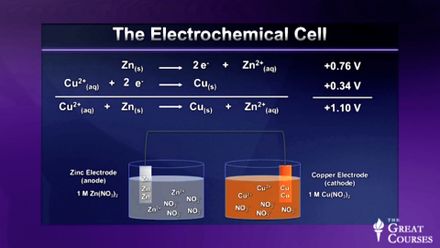
Three scientists lay the foundations for electrochemistry; Robert Millikan measures the charge on the electron; Michael Faraday discovers the relationship between free energy and electrical potential; Walther Nernst's contributions.
S1:E41 • Sep 23, 2016 • 33m
The electrical storage battery; the evolution of batteries from ancient times to Alessandro Volta's pioneering voltaic cell; alkaline, lithium, and other innovative battery technologies.
S1:E42 • Sep 23, 2016 • 31m
The energy in chemical bonds; the energy holding atomic nuclei together; the secrets of the nucleus; the discovery of radiation emanating from elements such as uranium; the harnessing of this phenomenon for weapons and electrical power.
S1:E43 • Sep 23, 2016 • 30m
Understanding the nucleus; how a nuclear explosion occurs; Albert Einstein's mass-energy equation; nuclear binding energy and mass defect; their connection to the release of nuclear energy.
S1:E44 • Sep 23, 2016 • 29m
Scientists work out techniques for speeding up the radioactivity of uranium isotopes by means of a fission chain reaction; demonstrating how the reaction can be controlled in a reactor or unleashed catastrophically in a bomb.
S1:E45 • Sep 23, 2016 • 30m
The nuclear energy binding curve; noting that most elements lighter than iron can release energy by fusing together; this releases more energy than fission; it is what powers the sun; the development of fusion weapons; fusion reactors.
S1:E46 • Sep 23, 2016 • 29m
An exploration of organic chemistry; why carbon makes such a versatile molecule; surveying the variety of hydrocarbons, from bitumen to gasoline and methane.
S1:E47 • Sep 23, 2016 • 30m
Hydrocarbons contain hydrogen and carbon; hydrogen atoms can be replaced with new elements and groups of elements to create compounds with new properties; heteroatoms form virtually unlimited combinations of organic molecules.
S1:E48 • Sep 23, 2016 • 31m
Challenges for organic chemists; turning one organic compound into another; three types of reactions from organic synthesis; substitution, elimination, and addition; considering the vital role of water in organic chemistry.
S1:E49 • Sep 23, 2016 • 30m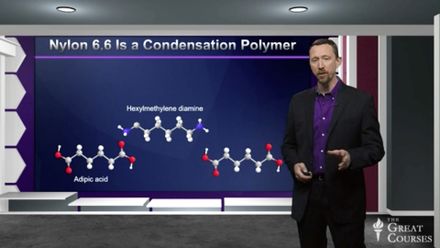
The mystery of the ancient Mayan rubber ball; the story of polymer chemistry; the advances of chemist Hermann Staudinger; in the early 20th century, he discovers that polymers are macromolecules; how synthetic polymers are created.
S1:E50 • Sep 23, 2016 • 28m
Synthetic polymers and biopolymers; biopolymers occur naturally; polysaccharides, nucleic acids, and proteins; living systems exercise a level of control over the synthesis of these polymers that no chemist could ever hope to achieve in the lab.
S1:E51 • Sep 23, 2016 • 32m
Creating molecules to correct medical issues such as inflammation, bacterial infections and cancer; studying the lock-and-key model of enzyme activity, which explains how many enzymes work; highlighting a weak link that can be exploited by drugs.
S1:E52 • Sep 23, 2016 • 30m
The chemicals that can harm human health; analyzing poisons; learning how arsenic disrupts ATP production; what makes nicotine deadlier than most people realize; why venoms are typically complex proteins.
S1:E53 • Sep 23, 2016 • 29m
Chemistry as a weapon of war; crude chemical weapons; their sophistication and strategic significance in World War I; the father of modern chemical warfare; Fritz Haber; the specific action of a number of deadly chemical agents.
S1:E54 • Sep 23, 2016 • 31m
The chemistry of fuels; materials react with an oxidant to produce energy; cellulose is the primary constituent of wood; surveying petroleum distillates, such as kerosene, diesel, and gasoline; learning how plant oils can be used to make biodiesel.
S1:E55 • Sep 23, 2016 • 30m
Methods of detecting explosives; what constitutes a detonation; its technical meaning; observing what happens at the molecular level that distinguishes fuel combustion from an explosion; surveying explosives from gunpowder to nitroglycerin.
S1:E56 • Sep 23, 2016 • 35m
A short tour of geochemistry; examining Earth's core; Earth's magnetic field; how radioactive atoms move continents and build mountain ranges; how digging a hole to extract resources can produce a chemical catastrophe.
S1:E57 • Sep 23, 2016 • 29m
Water covers Earth's surface; dissolved carbon dioxide; methane hydrates; the quest to extract dissolved gold; Earth's surface is bathed in an aqueous solution; it is a mixture of water and many different dissolved solutes.
S1:E58 • Sep 23, 2016 • 30m
The chemistry of the atmosphere; the structure of the atmosphere; charting its temperature profile; the part of the atmosphere composed of gases other than nitrogen and oxygen; the good and bad news about ozone; probe the cause of acid rain.
S1:E59 • Sep 23, 2016 • 30m
Atoms and molecules in the cosmos; searching for two substances that are the prerequisites for life; water and organic molecules; their availability; the study of chemistry has a bright future.
S1:E60 • Sep 23, 2016 • 33mMore Like This
 TVPG • 1 season
 TVPG • 1 season
 TVPG • 1 season
 TVPG • 1 season
 TVPG • 1 season
 TVPG • 1 season
 TVPG • 1 season
 TVPG • 1 season
 TVPG • 1 season
 TVPG • 1 season
 TVPG • 1 season
 TVPG • 1 season
 TVPG • 1 season
 TVPG • 1 season
 TVPG • 1 season
 TVPG • 1 season
 TVPG • 1 season
 TVPG • 1 season
 TVPG • 1 season
 TVPG • 1 season