

Geometry: An Interactive Journey to Mastery
S1:E1 Geometry - Ancient Ropes and Modern Phones
Exploring the origins of one of the oldest branches of mathematics; how geometry not only deals with practical concerns like mapping and navigation, but also offers an intellectual journey in its own right; the big and deep questions it invites.
Already subscribed?
Sign in
Exploring the origins of one of the oldest branches of mathematics; how geometry not only deals with practical concerns like mapping and navigation, but also offers an intellectual journey in its own right; the big and deep questions it invites.
S1:E1 • May 2, 2014 • 33m
Laying the basic building blocks of geometry by examining the terms point, line, angle, plane, straight and flat; learning the postulates or axioms for how those building blocks interact; working through the vertical angle theorem.
S1:E2 • May 2, 2014 • 28m
How three angles in a triangle can add up to 180 degrees; how the experience of turning a pencil on a flat triangle differs from walking in a triangular shape on the surface of a sphere; the difference between flat and spherical geometry.
S1:E3 • May 2, 2014 • 28m
The ubiquity of shapes with straight lines; how to define polygons mathematically despite understanding them intuitively; analyzing their properties; finding out the answers to these questions and more.
S1:E4 • May 2, 2014 • 31m
The common definition of the Pythagorean theorem; Pythagoras himself would be confused by that; how this famous theorem can be explained using common geometric shapes; how it is a critical foundation for the rest of geometry.
S1:E5 • May 2, 2014 • 29m
How watching a fly on his ceiling inspires mathematician Rene Descartes to link geometry and algebra; how this powerful connection allows people to use algebra to calculate distances, midpoints and more.
S1:E6 • May 2, 2014 • 29m
How the usual definition of parallelism is impossible to check; using fundamental assumptions to create an alternative way of checking if lines are parallel; how it is possible to compute the circumference of the Earth.
S1:E7 • May 2, 2014 • 35m
The beauty of geometry is that each result logically builds on the others; mathematicians demonstrate this chain of deduction using proofs, learning this step-by-step process of logic and how to construct one's own proofs.
S1:E8 • May 2, 2014 • 29m
What it means for polygons to be similar or congruent by thinking about photocopies; proving the third key assumption of geometry, which is the side-angle-side postulate; Thales of Ionia uses this principle in 600 B.C. to impress the Egyptians.
S1:E9 • May 2, 2014 • 34m
Building on the side-angle-side postulate; deriving other ways of testing whether triangles are similar or congruent; diving into several practical applications, which include estimating the heights of trees and measuring the width of a river.
S1:E10 • May 2, 2014 • 31m
Delving into the connections between algebra and geometry by looking at lines and their equations; using the three basic assumptions to prove that parallel lines have the same slope; calculating the shortest distance between a point and a line.
S1:E11 • May 2, 2014 • 29m
Knowing how to find the midpoint between two points; what if one has three or four points; exploring the concept of equidistance; how it reveals even more about the properties of triangles and other shapes.
S1:E12 • May 2, 2014 • 33m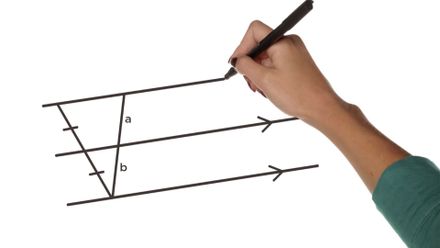
Continuing the study of parallelism by exploring the properties of transversals, which are lines that intersect two other lines; proving how corresponding angles are congruent; how this fact ties into the trapezoid, which is a type of polygon.
S1:E13 • May 2, 2014 • 31m
Classifying the different types of four-sided polygons called quadrilaterals; the surprising characteristics of the diagonals and interior angles of various shapes; how real-life objects like ironing boards exhibit these geometric characteristics.
S1:E14 • May 2, 2014 • 30m
Continuing the work of classification with triangles; what mathematicians mean when they use words like scalene, isosceles, equilateral, acute, right and obtuse; how to use the Pythagorean theorem to determine the type of triangle.
S1:E15 • May 2, 2014 • 30m
How one can figure out the "height" of the sun in the sky; answering this question using angle of elevation and a branch of geometry called trigonometry; the basic trigonometric identities; how physicists use them to describe circular motion.
S1:E16 • May 2, 2014 • 32m
Trigonometric identities go beyond circles; how to define all of them using just triangles, which is expressed in a famous acronym; uncovering how trigonometry is practically applied by architects and engineers to measure the heights of buildings.
S1:E17 • May 2, 2014 • 28m
How to calculate the sine, cosine and tangent of basic angles; calculating them for other angles without a calculator; using the Pythagorean theorem to come up with formulas for sums and differences of the trigonometric identities.
S1:E18 • May 2, 2014 • 32m
Exploring the world of circles; the definition of a circle; what mathematicians mean when they say things like radius, chord, diameter and secant; how these interact; using that knowledge to prove the inscribed angle theorem and Thales' theorem.
S1:E19 • May 2, 2014 • 29m
Using a combination of geometry and algebra to determine all kinds of interesting properties and characteristics; doing the same for circles, including deriving the algebraic equation for a circle.
S1:E20 • May 2, 2014 • 33m
The meaning of area; exploring how its definition is not quite so straightforward; working out the formula for the area of a triangle; how to use that formula to derive the area of any other polygon.
S1:E21 • May 2, 2014 • 28m
What pi really is; why it matters; what it has to do with the area of a circle; exploring the answers to these questions and more; how to define pi for shapes other than circles, such as squares.
S1:E22 • May 2, 2014 • 31m
Figuring out all kinds of fun properties with two-dimensional shapes and moving to three dimensions; classifying common 3-D shapes such as cones and cylinders; learning surprising definitions; studying the properties of these shapes.
S1:E23 • May 2, 2014 • 32m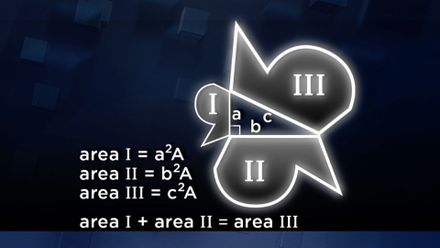
Learning what happens to a shape's area when its side-lengths are doubled; exploring the concepts of scale; applying this idea to derive the Pythagorean theorem; using the areas of any shape drawn on the edges of the right triangle.
S1:E24 • May 2, 2014 • 30m
Uniting geometry with the world of probability theory; seeing how connecting these seemingly unrelated fields offers new ways of solving questions of probability; figuring out the likelihood of having a short wait for the bus at the bus stop.
S1:E25 • May 2, 2014 • 30m
Drawing basic geometric shapes without having a marked ruler to measure lengths or a protractor to measure angles; exploring how the ancient Greeks construct angles and basic geometric shapes using no more than a straight edge for marking lines.
S1:E26 • May 2, 2014 • 29m
If one plays squash and hits the ball against the wall, knowing at what angle the ball will bounce back; if one is playing pool and wants to play a trick shot against the side edge, how one needs to hit the ball; exploring the reflection principle.
S1:E27 • May 2, 2014 • 31m
Seeing geometric tiling patterns on the bathroom floor and in the works of great artists; knowing what happens when one makes repeating patterns in 3-D space; discovering the five Platonic solids; creating beautiful patterns.
S1:E28 • May 2, 2014 • 32m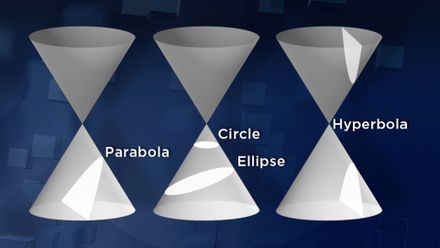
Using paper-folding to unveil sets of curves including parabolas, ellipses and hyperbolas; studying their special properties and seeing how these curves have applications across physics, astronomy and mechanical engineering.
S1:E29 • May 2, 2014 • 29m
Human aesthetics seem to be drawn to symmetry: exploring this idea mathematically through the study of mappings, translations, dilations and rotations, and seeing how symmetry is applied in modern-day examples such as cell phones.
S1:E30 • May 2, 2014 • 28m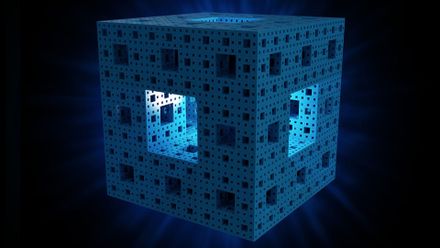
Exploring the mysterious world of fractals; learning how to create them; examining examples such as Sierpinski's Triangle and the Koch Snowflake; uncovering how fractals appear in nature; the structure of sea sponges and walls of small intestines.
S1:E31 • May 2, 2014 • 30m
If one has a fixed-length string, knowing what shape one can create with that string to give the biggest area; uncovering the answer to this question using the legendary story of Dido and the founding of the city of Carthage.
S1:E32 • May 2, 2014 • 31m
Wandering through the crazy counterintuitive world of rotations; using a teacup and string to explore how the mathematics of geometry can describe an interesting result in quantum mechanics.
S1:E33 • May 2, 2014 • 29m
Pondering another surprising appearance of geometry, the mathematics of numbers and number theory; looking into the properties of square and triangular numbers; using geometry to do some fancy arithmetic without a calculator.
S1:E34 • May 2, 2014 • 32m
Rene Descartes unites geometry and algebra with the invention of the coordinate plane; exploring the power and surprises that come from using the complex number plane; examining how using complex numbers can help solve tricky geometry problems.
S1:E35 • May 2, 2014 • 32m
Exploring the counterintuitive behaviors of shapes, angles and lines in spherical geometry, hyperbolic geometry, finite geometry and even taxi-cab geometry; seeing how the world of geometry is never a closed-book experience.
S1:E36 • May 2, 2014 • 32m