

The Science of Information: From Language to Black Holes
The science of information is an underappreciated field in science today; humans are able to acquire, record and use information in different forms; this revolution goes far beyond limitless content; information helps humans understand themselves.
Already subscribed?
Sign in
The meaning of information; American mathematician Claude Shannon concludes that information is the ability to distinguish reliably among possible alternatives; the idea is revolutionary; it leads to the concept of the basic unit of information.
S1:E1 • Dec 11, 2015 • 33m
Claude Shannon goes to the Massachusetts Institute of Technology; he submits a master's thesis proving that Boolean algebra can simplify analogue computing devices; how to design a simple electronic circuit that performs mathematical calculations.
S1:E2 • Dec 11, 2015 • 31m
How information is measured; how it is encoded efficiently; entropy is vital to the science of information; measuring information in terms of entropy sheds light on everything from password security to efficient binary codes; how to design a game.
S1:E3 • Dec 11, 2015 • 31m
According to intuition, information is measured by looking at the length of a message; Shannon's information theory starts with something more fundamenta; discovering that entropy provides a measure of the average surprise.
S1:E4 • Dec 11, 2015 • 31m
The link between entropy and coding; Shannon's first fundamental theorem; how far information can be squeezed in a binary code; the basis for data compression; Conan Doyle's "The Return of Sherlock Holmes".
S1:E5 • Dec 11, 2015 • 31m
How some data can be compressed beyond the minimum amount of information required by the entropy of the source; techniques that reduce the size of a file without significant loss of quality; how this works in different formats.
S1:E6 • Dec 11, 2015 • 30m
A key issue in information theory is noise; how the message received may not convey everything about the message sent; Shannon's second fundamental theorem; it proves that error correction is possible and can be built into a message.
S1:E7 • Dec 11, 2015 • 31m
Different techniques for error correction; the perils of mistaking one letter for another and how to guard against it; how to correct errors in computer operating systems; data transmissions from the Voyager spacecraft..
S1:E8 • Dec 11, 2015 • 32m
The Voyager spacecraft is 12 billion miles from Earth; it is sending back data with a 20-watt transmitter; delving into the details of the Nyquist-Shannon sampling theorem; signal-to-noise ratio and bandwidth.
S1:E9 • Dec 11, 2015 • 31m
The science of information is also the science of secrets; the history of cryptography; Julius Ceaser's cipher; entropy is a useful measure of the security of an encryption key; the deciphering strategies that cracked early codes.
S1:E10 • Dec 11, 2015 • 29m
The analysis that breaks the Enigma code system that the Germans are using during World War II; Alan Turing; code breakers repeat their feat everyday; Claude Shannon's views on the nature of secrecy.
S1:E11 • Dec 11, 2015 • 31m
The one-time pad is unbreakable in principle; considering the mistakes that make this code system vulnerable; the Venona project deciphers Soviet intelligence messages encrypted with one-time pads; the mathematics behind public-key cryptography.
S1:E12 • Dec 11, 2015 • 31m
DNA and RNA serve as the digital medium for genetic information; how shared features of different life forms allow us to trace our origins back to an organism known as LUCA.
S1:E13 • Dec 11, 2015 • 31m
Survey a selection of intriguing theories about life's origins, including the view that genetic information results from eons of natural computation.
S1:E14 • Dec 11, 2015 • 31m
Study the workings of the brain, the innermost information system; top-down and bottom-up approaches; focusing on the world of perception, experience and external behavior; the intricacies of neuron activity; the information capacity of the brain.
S1:E15 • Dec 11, 2015 • 31m
The concept of entropy; tracing its origin to thermodynamics; it is the branch of science dealing with heat; the laws of nature and information; the second law of thermodynamics; a famous thought experiment called Maxwell's demon.
S1:E16 • Dec 11, 2015 • 30m
Maxwell's demon has startling implications for the push toward faster computers; the connection between the second law of thermodynamics and the erasure of information; a practical barrier to computer processing speed.
S1:E17 • Dec 11, 2015 • 31m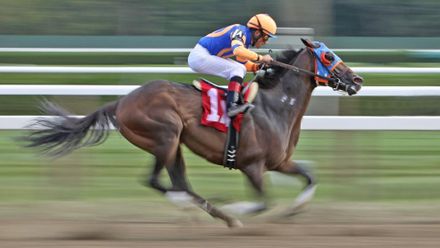
One of Claude Shannon's colleagues at Bell Labs is John Kelly; Kelly believes that information is an advantage in betting on possible alternatives; applying his log-optimal strategy to horse racing and stock trading.
S1:E18 • Dec 11, 2015 • 32m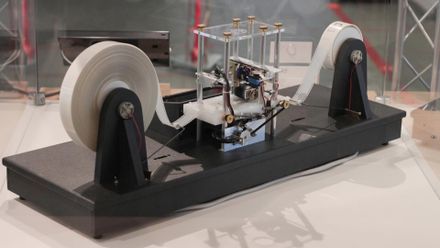
Contrasting Shannon's code-based and communication-based approach to information with an algorithmic way of thinking about the problem in terms of descriptions and computations; Alan Turing's theoretical universal computing machine.
S1:E19 • Dec 11, 2015 • 31m
Algorithmic information is plagued by an impossibility that shakes the foundations of logic; the Berry Paradox; Turing's surprising proof that no single computer program can determine whether other programs will ever halt.
S1:E20 • Dec 11, 2015 • 31m
Quantum physics is transforming the science of information; the double-slit experiment pinpoints the bizarre behavior that makes quantum information so different; the quantum computer.
S1:E21 • Dec 11, 2015 • 30m
Entanglement, a feature of the quantum world, is the key to an unbreakable code; the counterintuitive rules of entanglement; a game illustrates the monogamy of entanglement; the principle underlying quantum cryptography.
S1:E22 • Dec 11, 2015 • 32m
John Wheeler's phrase makes a profound point about the connection between reality and information; investigating the status of information in a place of unlimited density; the information content of the entire universe.
S1:E23 • Dec 10, 2015 • 31m
Surveying the phenomenon of information from pre-history to the projected far future; focusing on the special problem of anti-cryptography; designing a message for future humans or alien civilizations; Shannon's definition of information.
S1:E24 • Dec 11, 2015 • 33mMore Like This
 TVPG • 1 season
 2010 • PG • 1h 37mDetails
 TVPG • 1 season
 TVPG • 1 season
 TVPG • 1 season
 TVPG • 1 season
 TVPG • 1 season
 2024 • UR • 1h 22mDetails
 TVMA • 1 season
 TVPG • 1 season
 TVPG • 1 season
 TVPG • 1 season
 TVPG • 1 season
 TVPG • 1 season
 TVPG • 1 season
 TVPG • 1 season
 TVPG • 1 season
 TVPG • 1 season
 TV14 • 2 seasons
 TVPG • 1 season