

Understanding Calculus II: Problems, Solutions, and Tips
S1:E7 Areas and Volumes
Using integration to find areas and volumes; planar regions bounded by two curves; the disk method for calculating volumes; focusing on ellipses and solids obtained by rotating ellipses about an axis; how knowledge of ellipsoids applies to Saturn.
Already subscribed?
Sign in
Learning what distinguishes Calculus II from Calculus I; embarking on a three-episode review; the top 10 student pitfalls from precalculus; a refresher on basic functions and their graphs, which are essential tools for solving calculus problems.
S1:E1 • May 31, 2013 • 32m
Reviewing the concept of derivatives while recalling the derivatives of trigonometric, logarithmic and exponential functions; applying the knowledge of derivatives to the analysis of graphs; closing by reversing a problem.
S1:E2 • May 31, 2013 • 30m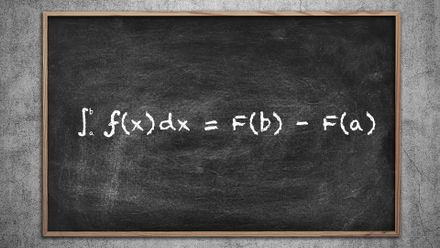
Covering the basic facts of integration; an example of integration by substitution; turning to definite integrals and the area problem; the fundamental theorem of calculus; the second fundamental theorem of calculus; solving a differential equation.
S1:E3 • May 31, 2013 • 31m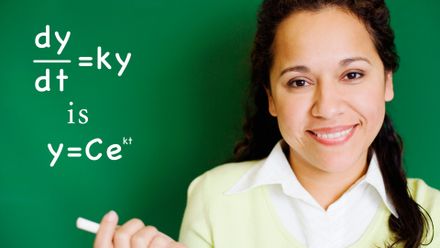
Learning various techniques for solving differential equations; separation of variables; Euler's method, which is the simplest numerical technique for finding approximate solutions; looking at growth and decay models, with two applications.
S1:E4 • May 31, 2013 • 31m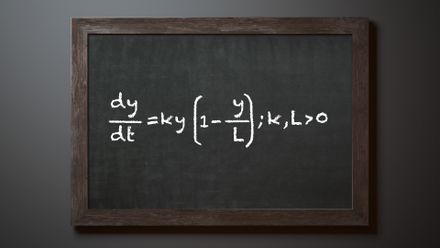
Examining orthogonal trajectories, which are curves that intersect a given family of curves at right angles; these occur in thermodynamics and other fields; developing the logistic differential equation, which is widely used in mathematical biology.
S1:E5 • May 31, 2013 • 31m
Investigating linear differential equations; the key to their solution is what Professor Edwards calls the "magic integrating factor"; trying several examples and applications; returning to an equation involving Euler's method.
S1:E6 • May 31, 2013 • 31m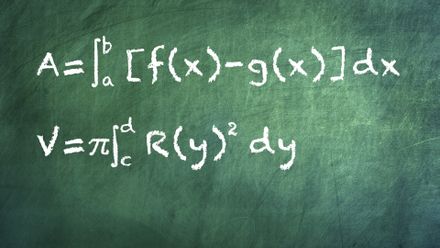
Using integration to find areas and volumes; planar regions bounded by two curves; the disk method for calculating volumes; focusing on ellipses and solids obtained by rotating ellipses about an axis; how knowledge of ellipsoids applies to Saturn.
S1:E7 • May 31, 2013 • 31m
Exploring the power of integral calculus; arc length computations; calculating the areas of surfaces of revolution; surveying the concept of work; answering questions such as how much work it takes to lift an object from Earth's surface.
S1:E8 • May 31, 2013 • 30m
Studying moments and centers of mass; developing formulas for finding the balancing point of a planar area, or lamina; progressing to arbitrary planar regions; closing with the theorem of Pappus; using it to calculate the volume of a torus.
S1:E9 • May 31, 2013 • 31m
Focusing on techniques of integration; reviewing basic formulas from Calculus I; learning to develop a method called integration by parts, which is based on the product rule for derivatives; exploring applications involving centers of mass and area.
S1:E10 • May 31, 2013 • 31m
Exploring integrals of trigonometric functions; finding that they are often easy to evaluate if either sine or cosine occurs to an odd power; learning when one must resort to half-angle trigonometric formulas; products of tangents and secants.
S1:E11 • May 31, 2013 • 31m
Trigonometric substitution is a technique for converting integrands to trigonometric integrals; evaluating several cases; one can represent these substitutions by right triangles; what to do if the solution does not match the calculator's answer.
S1:E12 • May 31, 2013 • 32m
Splitting up complicated algebraic expressions to make them easier to integrate; how to deal with linear factors, repeated linear factors and irreducible quadratic factors; applying these skills to the solution of the logistic differential equation.
S1:E13 • May 31, 2013 • 32m
Revisiting the concept of limits from elementary calculus; focusing on expressions that are indeterminate; learning how to use L'Hopital's rule for evaluating indeterminate forms; applying this theorem to a variety of examples.
S1:E14 • May 31, 2013 • 31m
Studying integrals that appear to be outside the fundamental theorem of calculus; such "improper integrals" usually involve infinity as an end point; they may appear to be unsolvable until one splits the integral into two parts.
S1:E15 • May 31, 2013 • 31m
Starting on the topic of infinite series: the concept of an infinite series is based on sequences, which can be thought of as an infinite list of real numbers, exploring the characteristics of different sequences, including the Fibonacci sequence.
S1:E16 • May 31, 2013 • 31m
Looking at an example of a telescoping series; studying geometric series, in which each term in the summation is a fixed multiple of the previous term; proving an important convergence theorem; applying knowledge to repeating decimals.
S1:E17 • May 31, 2013 • 32m
Exploring an important test for the divergence of an infinite series; if the terms of a series do not tend to zero, then the series diverges; solving a bouncing ball problem; investigating a paradoxical property of the Cantor set.
S1:E18 • May 31, 2013 • 32m
Discovering a proof using the integral test; generalizing to define an entire class of series called p-series; proving a theorem showing when they converge; closing with the sum of the harmonic series, which is the Euler-Mascheroni constant.
S1:E19 • May 31, 2013 • 31m
Developing more convergence tests; how the direct comparison test for positive-term series compares a given series with a known series; the limit comparison test allows analysis of a series without having a comparison with a known series.
S1:E20 • May 31, 2013 • 31m
Turning to series having terms that alternate between positive and negative; how to apply the alternating series test; using absolute value to look at the concepts of conditional and absolute convergence for series with positive and negative terms.
S1:E21 • May 31, 2013 • 31m
Finishing the exploration of convergence tests; the ratio test is particularly useful for series having factorials; the root test is useful for series involving roots to a given power; asking if these tests work on the p-series.
S1:E22 • May 31, 2013 • 32m
Trying out techniques for approximating a function with a polynomial; the first example shows how to construct the first-degree Maclaurin polynomial for the exponential function; investigating Taylor polynomials, along with Taylor's theorem.
S1:E23 • May 31, 2013 • 31m
A power series can be thought of as an infinite polynomial; finding a power series' interval of convergence; in general, this will be a point, an interval or perhaps the entire real line; differentiation and integration of power series.
S1:E24 • May 31, 2013 • 31m
Learning the steps for expressing a function as a power series; experimenting with differentiation and integration of known series; investigating some series formulas for pi, including one by the Indian mathematician Ramanujan.
S1:E25 • May 31, 2013 • 30m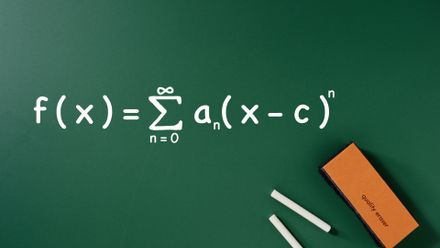
Exploring the Taylor and Maclaurin series in greater depth, one can calculate series representations in many ways, using an infinite series to derive one of the most famous formulas in mathematics, which connects the numbers e, pi and i.
S1:E26 • May 31, 2013 • 32m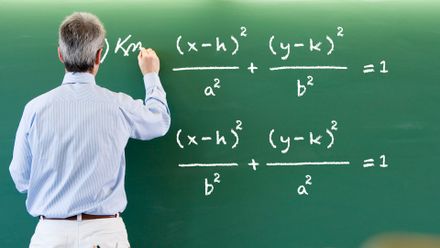
Reviewing parabolas, ellipses and hyperbolas; how calculus deepens one's understanding of these shapes; looking at parabolas and arc length computation; turning to ellipses; examining hyperbolas; looking ahead to parametric equations.
S1:E27 • May 31, 2013 • 30m
Parametric equations consider variables in terms of one or more additional variables; this adds more levels of information to the graph of a parametric curve; the calculus concept of slope in parametric equations; the equation of the cycloid.
S1:E28 • May 31, 2013 • 31m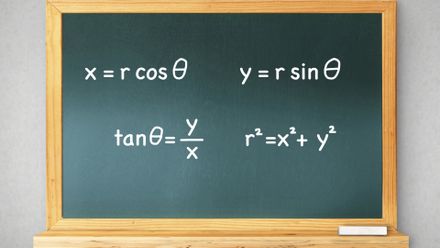
Reviewing the main properties and graphs of polar coordinates; considering the cardioids, which have a heart shape; looking at the derivative of a function in polar coordinates; studying where the graph has horizontal and vertical tangents.
S1:E29 • May 31, 2013 • 31m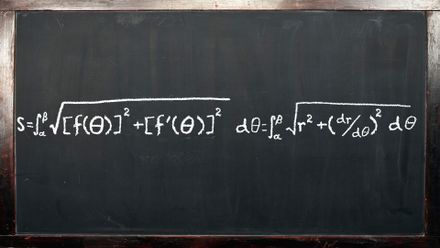
Focusing on applications involving integration; developing the polar equation for the area bounded by a polar curve; turning to arc lengths in polar coordinates; discovering that the formula is similar to that for parametric equations.
S1:E30 • May 31, 2013 • 32m
Defining vectors and their properties; reviewing vector notation; learning how to express an arbitrary vector in terms of the standard unit vectors; applying what one has learned to an application involving force.
S1:E31 • May 31, 2013 • 30m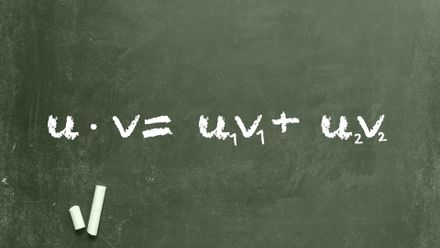
Exploring the dot product method for determining the angle between two nonzero vectors; turning to projections of one vector onto another; closing with some typical applications of dot product and projection that involve force and work.
S1:E32 • May 31, 2013 • 31m
Exploring vector-valued functions, which are functions whose values are vectors; the derivative of such a function is a vector tangent to the graph that points in the direction of motion; a major application is describing the motion of a particle.
S1:E33 • May 31, 2013 • 31m
Combining parametric equations, curves, vectors and vector-valued functions to form a model for motion in the plane; deriving equations for the motion of a projectile subject to gravity; solving several projectile problems.
S1:E34 • May 31, 2013 • 31m
Using the unit tangent vector and normal vector to analyze acceleration; the unit tangent vector points in the direction of motion; the unit normal vector points in the direction an object is turning; decomposing acceleration into these components.
S1:E35 • May 31, 2013 • 31m
How the concept of curvature helps with the analysis of the acceleration vector; coming full circle by using ideas from elementary calculus to determine the point of maximum curvature; looking at the riches offered by the continued study of calculus.
S1:E36 • May 31, 2013 • 31m