

Language and the Mind
In 24 fascinating episodes, exploring questions about the origin of the human mind; whether language influences thought; knowing how babies learn their native language and more.
Already subscribed?
Sign in
How the human mind could have developed language; why dualism, materialism, structuralism and reductionism have each come up short; the concept of emergentism; why this model offers the best framework for understanding the development of language.
S1:E1 • Mar 27, 2020 • 30m
The five components of language are pragmatics, syntax, semantics, morphology and phonetics; they contribute to the meaning of language; how language is, and is not, similar to other systems in the body; learning a second language can be challenging.
S1:E2 • Mar 27, 2020 • 27m
The aspects of language one takes for granted every day — one's ability to use symbols, understand rules, generate novel utterances, speak about the past and future and even purposefully lie — make language our greatest tool.
S1:E3 • Mar 27, 2020 • 31m
Whether language can be considered as an organism whose only natural habitat is the human mind; the results of the efforts to analyze and influence animal communication; one studies honeybees, songbirds, vervet monkeys, chimpanzees and dolphins.
S1:E4 • Mar 27, 2020 • 31m
There is no single gene for language or any other complex human system; the biological environment for the development of language; the relationship between the brain's Broca's and Wernicke's areas; language as a new machine built out of old parts.
S1:E5 • Mar 27, 2020 • 32m
Whether the human brain evolves a specialized mental organ for language; one's relationship to the human microbiome; not born with the bacteria in their microbiome, but one's biology is receptive to them; the relationship transforms one's abilities.
S1:E6 • Mar 27, 2020 • 32m
Knowing what the earliest forms of human language sound like; many researchers believe hand gesture is one's first attempt at language; embodied brains to the prevalence of gesture; its human uniqueness; evidence that language is born in the body.
S1:E7 • Mar 27, 2020 • 30m
Scientists think of human development in terms of nature v. nurture; the human mind is guided by neuroplasticity, the process underlying all human learning; the biological processes underlying how babies learn facial recognition and language.
S1:E8 • Mar 27, 2020 • 30m
The brain structures of babies that give them auditory abilities; it is difficult for adults to learn new languages; exposure to one's native language changes one's brain; one's ability to access objective auditory information in the environment.
S1:E9 • Mar 27, 2020 • 29m
The mechanisms babies use in identifying discrete words from the streams of sound in language; their ability to employ the cognitive constraints of whole object assumption, mutual exclusivity bias and taxonomic assumption; what babies need to hear.
S1:E10 • Mar 27, 2020 • 27m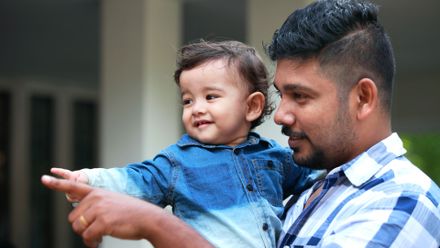
The features that help babies prepare for successful interaction; the social cues that help them identify specific word meanings; the power of pupillary contagion as it activates the brain networks involved in perspective taking; the theory of mind.
S1:E11 • Mar 27, 2020 • 29m
Knowing how the mind is wired from birth to see structure in language; how children utilize Bayesian learning to understand language; they update their future predictions in a never-ending loop; the perfect innate mechanism for language acquisition.
S1:E12 • Mar 27, 2020 • 29m
The three basic principles of the brain; neural specialization, the connectome and the brain's plasticity; the developments in neuroimaging (including ERP, MEG and fMRI scans); understanding the relationships between brain mechanisms and behavior.
S1:E13 • Mar 27, 2020 • 29m
Scientists have the tools to examine the neural processing of language; a brain that processes language as a survival mechanism; the brain's dual-stream pathways; the research that words activate practically every square inch of the brain's surface.
S1:E14 • Mar 27, 2020 • 31m
The scientific research related to the brain's ability to produce speech; a complex activity requiring the coordination of nearly 100 muscles in the lungs, throat, jaw, tongue and face; why one needs to hear their speech to successfully produce it.
S1:E15 • Mar 27, 2020 • 30m
Language is an example of emergentism; why language production cannot be fully understood without considering how human brains connect; the mirror neuron system, neural synchrony and the N400 response; face-to-face interactions are crucial.
S1:E16 • Mar 27, 2020 • 32m
The plasticity of the brain; a neural network for reading and writing; using dyslexia and synesthesia to illustrate this property; this network develops at different times for different people; the reading brain is a technological transformation.
S1:E17 • Mar 27, 2020 • 30m
A version of language that operates in a different modality than speech; an appreciation of what language is; sign language and its linguistic elements; an understanding of neural mechanisms reveals that language is language, regardless of modality.
S1:E18 • Mar 27, 2020 • 30m
How the arbitrary and abstract elements of language interact with the body's iconic and concrete expressions; language originally evolves within a face-to-face context; the body influences all parts of language; taking meaning from what one hears.
S1:E19 • Mar 27, 2020 • 31m
Knowing what happens in the brain when one learns a language in addition to their native tongue; it depends on when that additional language is learned and its modality relative to the native language; the brain's bilingual language control function.
S1:E20 • Mar 27, 2020 • 30m
Whether one cannot experience snow in all its forms; if an African tribe has fewer color names than English, is their vision different from others; whether language influences one's perception or vice versa; the arguments on all sides of this debate.
S1:E21 • Mar 27, 2020 • 28m
A series of experiments developed to determine whether language can influence thought independent of culture; working with individuals from preverbal infants to adults; language and culture both influence thought, often working in tandem.
S1:E22 • Mar 27, 2020 • 29m
The by-products of speaking multiple languages; how having multiple languages opens up different emotional, cognitive and social worlds; how the mind travels back and forth between them; whether becoming bilingual improves one's cognitive reserve.
S1:E23 • Mar 27, 2020 • 31m
Language allows humans to develop math, build a capacity for logic, categorize the world, develop the concept of metaphor and construct narratives; these functions feel so natural, but none would have been possible without language.
S1:E24 • Mar 27, 2020 • 33mMore Like This
 TVPG • 1 season
 TVPG • 1 season
 TVPG • 1 season
 TVPG • 1 season
 TVPG • 1 season
 TVPG • 1 season
 TVPG • 1 season
 TVPG • 1 season
 TVPG • 1 season
 TVPG • 1 season
 TVPG • 1 season
 TVPG • 1 season
 TVPG • 1 season
 TVPG • 1 season
 TVPG • 1 season
 TVPG • 1 season
 TVPG • 1 season
 TVPG • 1 season
 TVPG • 1 season
 TVPG • 1 season