

The Meaning of Life: Perspectives From the World's Great Intellectual Traditions
Investigating the meaning of life; how to find that meaning; to whom one should listen as they shape the path they walk in the world; beginning or continuing the pursuit of these and other questions; embarking on an intellectually gripping course.
Already subscribed?
Sign in
Establishing the solid ground from which one's journey will begin; learning the meanings that the word "meaning" itself may embody; previewing the approaches one will take to the question that gives the course its name.
S1:E1 • Jan 16, 2011 • 33m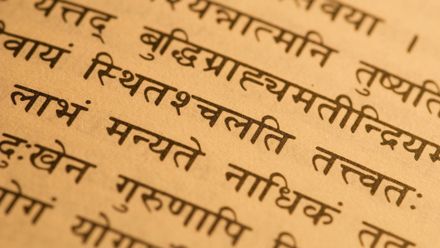
One of the core texts of the Mahabharata, a major moral and religious text, introduces the critically important skill of reading a text deeply and with comprehension, beginning one's consideration of the concept of human choice.
S1:E2 • Jan 16, 2011 • 30m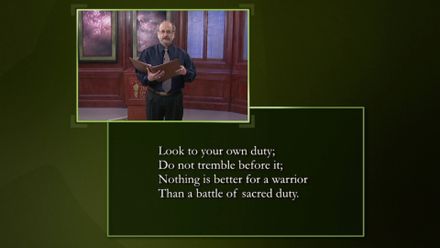
Plunging into the Bhagavad Gita's wisdom; grasping the three kinds of yogas, or disciplines, embedded in its metaphors; why these disciplines of action, knowledge and devotion are all required if life is to be coherent, integrated and rational.
S1:E3 • Jan 16, 2011 • 30m
An appreciation of the theophany; Krishna's revelation of the nature of divinity; according to the Gita's final message, true freedom comes from disinterested action, reflective knowledge and a finding of value at the cosmic level of the universe.
S1:E4 • Jan 16, 2011 • 32m
The roots of Western thought about life's meaning; beginning the study of Aristotle's Nichomachean Ethics; examining the framework of Aristotle's view, as set forth in the lecture notes kept by his son and pupil, Nichomacheus.
S1:E5 • Jan 16, 2011 • 31m
Aristotle's search for the highest good; it is a search that takes one through his function argument; an explanation of the comprehensive state of being known as eudaimonia, the fully flourishing life that may elude evaluation until long after death.
S1:E6 • Jan 16, 2011 • 30m
Examining Aristotle's ethical teachings; concluding with his explanation of virtue, its key dimensions and its necessary coupling with action; special attention is also paid to the importance of friendship.
S1:E7 • Jan 16, 2011 • 32m
The Hebraic tradition; grasping how the core question has shifted; instead of seeking an answer in the relationship to the cosmos, as in the Indian tradition, or to society, as in that of the Greeks; the focus is on relationship to a personal God.
S1:E8 • Jan 16, 2011 • 30m
The book of Job brings an encounter with a troubling conclusion; although life may indeed have meaning, it is a meaning shrouded by a mysterious divine; one may need to live in ignorance of what that meaning may be.
S1:E9 • Jan 16, 2011 • 32m
The beginnings of Stoic moral theory in the writings of Seneca and Epictetus; their accounts of a good life describe one that is moderate, reasonable and controlled; living in harmony with the universe and society; the inevitability of death.
S1:E10 • Jan 16, 2011 • 29m
A brief introduction to Lucretius serves as a gateway to the thought of Marcus Aurelius; Aurelius's "Meditations" synthesizes Stoic ideas about rational order and the importance of emotional control; Epicurean ideas about finitude and impermanence.
S1:E11 • Jan 16, 2011 • 31m
Moving to China and the ideas attributed to the man known to the West as Confucius; his teachings talk about concepts like warm-heartedness, propriety, the nature of the universe and the achievement of effortless excellence of character.
S1:E12 • Jan 16, 2011 • 29m
Exploring a different Chinese approach to understanding than that set forth in Confucianism; beginning with a cautionary demonstration of the startling differences in interpretation; always present among various translations of a text.
S1:E13 • Jan 16, 2011 • 30m
Some beautiful readings from the Daodejing bring out the profound differences in outlook that set it apart from Confucianism: its turning away from social structures and cultivation of individual excellence in favor of a simple life.
S1:E14 • Jan 16, 2011 • 31m
Immersing in the Daodejing with an examination of some of its most important aspects; taking in its perspectives on the nature of the universe, the subtlety and suppleness of virtue, the value of negativity and the delicacy of life.
S1:E15 • Jan 16, 2011 • 31m
Exploring Daoism ends with its longest classical text, the Zhuangzi; finding the themes of spontaneity and the suspicion of logic, and the ridicule of the Confucian emphasis on ritual, propriety and rigid relationships.
S1:E16 • Jan 16, 2011 • 32m
Commencing with the search for enlightenment by a young Indian prince; concluding with an introduction to what he finds; the so-called four noble truths; including the eightfold path to sharing that enlightenment.
S1:E17 • Jan 16, 2011 • 32m
Beginning the study of one of the major evolutions in Buddhist thought, the Mahayana; exploring one of its major texts, Santideva's Bodhicaryavatara, which offers a manual for leading an enlightened life.
S1:E18 • Jan 16, 2011 • 32m
Enhancing one's grasp of Mahayana Buddhism and Santideva's description of a meaningful life, achieved only through the six perfections, these include the pursuit of generosity, propriety, patience, effort, meditation and wisdom.
S1:E19 • Jan 16, 2011 • 31m
Understanding Buddhism and introducing Zen; this path to Buddhahood is aimed at direct transformation; knowledge is handed directly from mind to mind; emphasis is placed on a teacher-disciple lineage; tracing directly to Zen's originating moment.
S1:E20 • Jan 16, 2011 • 32m
Exploring Zen concepts like duality and non-duality, perception and conception, Dogen's presentation of time as the very nature of our world; what is required to reawaken one's primordial Buddha-nature.
S1:E21 • Jan 16, 2011 • 32m
Looking back at the classical traditions studied thus far, although there is no unanimity, there are common dimensions: a consensus about the value of a virtuoso life attained through contemplation and practice.
S1:E22 • Jan 16, 2011 • 31m
European modernity brings the first challenges of science and reason to the primacy of theology; David Hume argues that, although theism may well be reasonable, it cannot be rational; the foundation for separate public and private spheres.
S1:E23 • Jan 16, 2011 • 32m
Exploring Hume's distinctions between nature and second nature; the importance of social lives to one's cognitive lives; the key roles one's passions and imagination play in their beliefs and actions.
S1:E24 • Jan 16, 2011 • 31m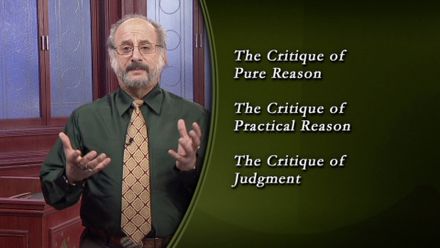
The work of Immanuel Kant is considered the demarcation line for modern academic philosophy. Kant viewed the Enlightenment as a call for people to emerge from their self-imposed immaturity, realizing their nature as fully-formed human beings.
S1:E25 • Jan 16, 2011 • 30m
Readings from John Stuart Mill's "On Liberty" reveal the first purely individualistic doctrine of the meaning of life; Mill presents the strongest possible defense of the connection between a meaningful life and a liberal social order.
S1:E26 • Jan 16, 2011 • 32m
A novella by Tolstoy presents a very different and critical view of modernity, suggesting that its values of secularization and mass society invariably lead one, in fact, to a life that is meaningless.
S1:E27 • Jan 16, 2011 • 31m
Nietzsche initiates postmodernism in philosophy; through readings from his "Twilight of the Idols", one grasps Nietzsche's dismissal of modernity's core values, including philosophical progress, reason, systematicity, god and transcendent value.
S1:E28 • Jan 16, 2011 • 30m
Nietzsche's repudiation of modernity's concept of a meaningful life does not mean he lacks his own; this lecture presents his vision of life as a successful creative act on a grand scale, with oneself as the hero of a great autobiography.
S1:E29 • Jan 16, 2011 • 30m
Gandhi's thoughts reveal him as even more radical than Nietzsche; a realization of Gandhi's views admittedly sacrifices many of modernity's benefits, including much of technology, medicine and law, a price one must be willing to pay.
S1:E30 • Jan 16, 2011 • 31m
Gandhi's own life serves as an example of the supernormal life he advocates, seeing his argument for what he believes to be the only meaningful life, and includes echoes from almost every text examined.
S1:E31 • Jan 16, 2011 • 31m
Readings from "Lame Deer, Seeker of Visions" offer a different vantage point for seeking meaning; a symbolic view of life; it is not that modernity lacks its own symbolism or meaning; says this Lakota Sioux holy man; but it means the wrong things.
S1:E32 • Jan 16, 2011 • 28m
Going deeper into Lame Deer's critique of modernity; examining his ideas about the impact of money and fetishism about it; the alienation from nature it brings about; modernity's simultaneous denial and spreading of death.
S1:E33 • Jan 16, 2011 • 33m
Exploring the Dalai Lama's Buddhist-inflected but very modern, secular vision about the universal human goal of happiness; learning its components; the relationship between their pursuit and the interconnectedness of human life.
S1:E34 • Jan 16, 2011 • 32m
Discussing how to achieve happiness reveals how the Dalai Lama's views of a meaningful life, modern as they are, also contain a deep traditionalist thread; the bodhisattva path; the altruistic aspiration to attain awakening for the benefit of all.
S1:E35 • Jan 16, 2011 • 32m
Tempting as it may be to form a single answer agreed on by all, there is none to be found; learning that there are recurrent themes, the answer that works for one is likely to be found among those themes.
S1:E36 • Jan 16, 2011 • 34mMore Like This
 TVPG • 1 season
 TVPG • 1 season
 TVPG • 1 season
 TVPG • 1 season
 TVPG • 1 season
 TVPG • 1 season
 PG13 • 1 season
 TVPG • 1 season
 TVPG • 1 season
 TVPG • 1 season
 TVPG • 1 season
 TVPG • 1 season
 TVPG • 1 season
 TVPG • 1 season
 TVPG • 1 season
 TVPG • 1 season
 TVPG • 1 season
 TVPG • 1 season
 TVPG • 1 season
 TVPG • 1 season